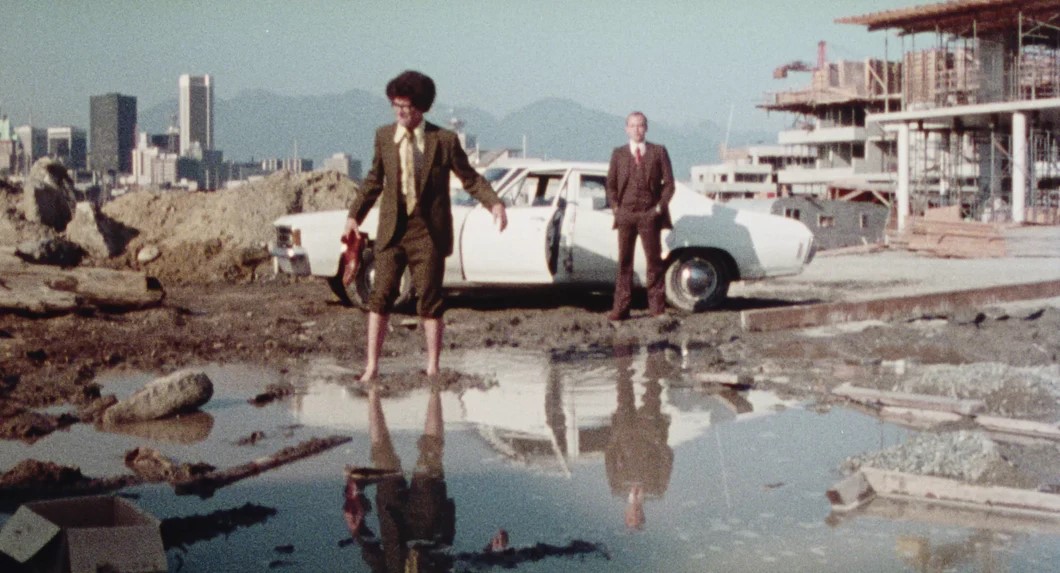


Before Repo Man, before Glengarry Glen Ross, there was Skip Tracer.
Made by a husband-and-wife director and producing team for less than $250,000, Skip Tracer follows a debt collector suffering pangs of conscience, as well as his share of beatings and stabbings. Shot (and set) in Vancouver in 1976, the film was critically acclaimed and the first Canadian feature to play at the New York Film Festival, earning comparisons to Francis Ford Coppola’s The Conversation. Skip Tracer prefigures not only the 1980s punk classic Repo Man but also the capitalist dogfighting of Glengarry Glen Ross. “The achievement is staggering,” The Globe and Mail said in its review. “Skip Tracer is reportage raised almost to the level of art.”
Yet for almost 50 years, Skip Tracer has either been out of distribution or difficult to track down, an elusive cult classic of independent cinema. In it, John Collins (David Petersen) has been Man of the Year three times running at the Vancouver collection company he works for. His secret? Ruthless determination. Collins has nothing in his life beyond his job. He likes it that way.
Together with a struggling young partner named Brent Solverman (John Lazarus), Collins collects from a wide range of humanity. But he encounters a series of setbacks. A filing error forces Collins and Solverman to un-repossess a vehicle, returning it to the irate owner they boosted it from. When Collins falls to second place in the contest, his boss takes away his office. And one night, Collins is viciously attacked by a stranger in a hockey mask (before Jason Voorhees donned one to terrorize Camp Crystal Lake).
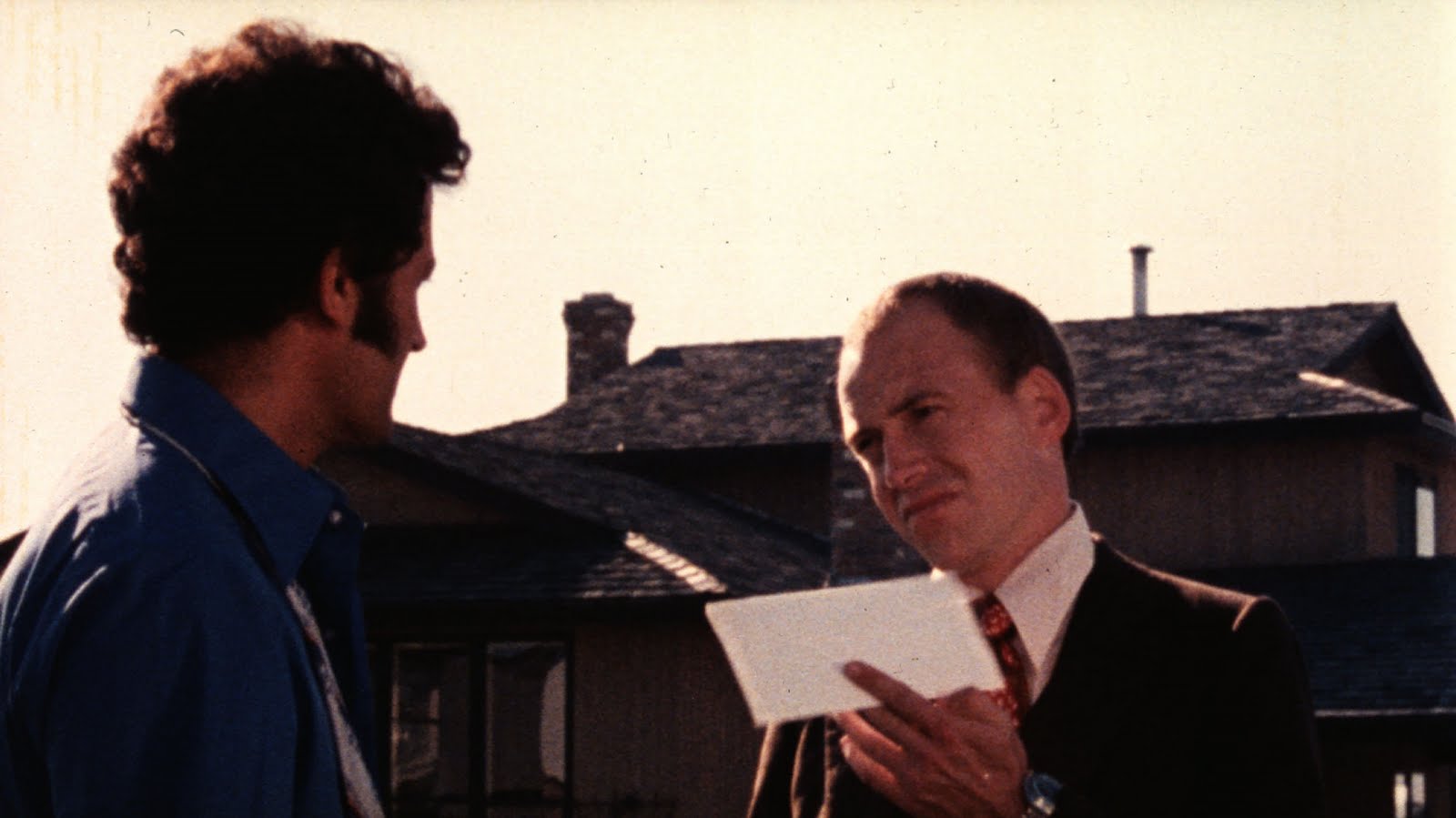
A still from Skip Tracer.
Collins bounces back, more determined than ever to earn the top spot. When the spouse of a car dealer with a large outstanding debt begs him for leniency, Collins ignores her, setting out on his collection duties relentlessly, and with dire consequences.
Zale Dalen (born David Scott) was a veteran of the Simon Fraser University Film Workshop who’d worked briefly for the CBC and apprenticed with independent filmmaker Allan King. While working as a sound man (including on The Keeper horror film starring Christopher Lee), Dalen began writing scripts and fundraising pitches. His wife, Laara Dalen (formerly Rena Bishop), an SFU law student, became his producer and creative partner. “We put together all our savings, started Highlight Productions Ltd., and began making shorts,” Laara told The Globe and Mail in 1978. Their big break came when Zale’s script for Skip Tracer was accepted by Telefilm, which put up 60 per cent of the funding, the rest coming from local private financiers. Laara would produce the film, with Zale directing.
Casting Skip Tracer was made easier by drawing from the local Tamahnous Theatre company, which shared rehearsal space with the Dalens. “Several of the actors in Skip Tracer were members,” Lazarus says, “including David Petersen, Sue Astley, Stephen E. Miller, Anna Hagan, and Larry Lillo…. I was not a Tamahnous member but a big fan, and David Petersen was one of my best friends…. I never asked him or Zale about this, but I always suspected that he had suggested me.” “We shared that space at Eighth and Maple for two or three years and were all good friends,” agrees Stephen Miller, who played multiple roles and worked as the boom operator. “It was the first real film I had worked on, and I loved every minute of it.” Another Tamahnous member, Tom Braidwood, served as the film’s assistant director, while the score was contributed by Douglas Dodd and jazz pianist Linton Garner. In a little over a month in the fall of 1976, the Dalens’ skeleton crew and local cast would film guerilla-style on the streets of Vancouver.
The city shown in Skip Tracer is far less dense and gentrified than Vancouver is now. Nighttime scenes of downtown, Chinatown, East Vancouver, and the West End fly past, along with used-car lots, strip clubs, smoky bars, and diners. Collins’s apartment on Yew Street looks much the same, though many of the street views of Broadway and Seymour have vanished. In a construction site on Granville Island, Collins confronts a debtor (Da Vinci’s Inquest’s Stephen Miller) who tries hiding in a cluster of pipes. “That whole sequence was shot there before Granville Island had been developed into a tourist attraction,” says Miller, who also played Collins’s masked assailant. The last shot of the film has Collins cross Granville Square, strolling over the raised concrete walkway approaching Hastings Street.
Locally, the response to Skip Tracer was enthusiastic, with an undercurrent of tall-poppy antipathy. “Our first screening was a world premiere at the Varsity Theatre in Vancouver,” Zalen said. “That got a great reaction from the audience. Months later, though, The Province would proclaim it “One of the best Canadian films in many years,” and Les Wedman would write in the Vancouver Sun, “Unequivocally, Skip Tracer is the best Canadian movie yet made in British Columbia.”
Invitations to film festivals in Montreal, New York, and London followed, and the film was well-received. In an enthusiastic review for The Globe and Mail, Jay Scott wrote, “You have to make concessions for the visuals—there’s enough grain to restore the beach at Lake Ontario … but you don’t have to make concessions of any kind to Dalen’s script or to the performances of most of the actors. Skip Tracer is a damned good movie.” “Honest rough and excellent,” the Montreal Gazette enthused, while The Boston Globe called it “a stunning piece of work, a film absolutely of this moment in time.” Variety and The Times also praised the Dalens’ film.
In an interview on the Blu-ray release, Zale Dalen recalled that Skip Tracer was “artistically incredibly well received,” and “the film paid back its private backers and gave us a little pocket change but never actually made any money.” Without a worldwide distributor, the Dalens were left to sell the rights themselves, which proved difficult. Skip Tracer aired on CBC and HBO before falling out of distribution, though in the 1980s it was released on VHS under the title Deadly Business.
While Skip Tracer languished in distribution limbo for decades, the fortunes of its cast and crew varied. David Petersen played small roles in First Blood and David Cronenberg’s debut Fast Company, as well as a memorable adversary in season one of The X-Files. He died in 2018. John Lazarus became an award-winning playwright (Babel Rap, Village of Idiots) as well as a drama teacher at Queen’s University. The film’s assistant director, Tom Braidwood, had a long career as a second unit director, producer, and actor, playing Frohike, one of The Lone Gunmen on The X-Files. The Dalens divorced, with Laara moving out of the film business. “We were a great team,” Zale Dalen recalled in an interview with Canuxploitation. “She was my best friend, constant companion, and an incredible producer. She was great at finding money and production details.… I couldn’t have done anything of any significance without her.”
Zale Dalen’s followup directing project, The Hounds of Notre Dame, was well reviewed but faced similar distribution problems to Skip Tracer. He pivoted to television, directing episodes of The Beachcombers, Kung Fu: The Legend Continues, 21 Jump Street, and The New Alfred Hitchcock Presents. In film, he directed Terminal City Ricochet, a satire starring punk legends Jello Biafra and Joe “Joey Shithead” Keithley (two soundtrack albums featuring Biafra with DOA and NoMeansNo would become sought-after collectibles). Dalen also directed the Billy Blanks sci-fi action film Expect No Mercy. After a stint as an ESL teacher in China, Dalen moved to Nanaimo and continued making low-budget independent films, taking advantage of digital technology.
Skip Tracer was ahead of its time. Yet distribution issues have made the film as hard to track down as one of Collins’s accounts. Skip Tracer is currently not available to stream—legally, that is—but the boutique distributor Golden Ninja Video offers a limited-edition Blu-ray, with commentary and a career retrospective interview with Dalen. “The film refuses to be forgotten,” Dalen wrote in a comment on his blog in 2012. “It seems it is becoming a historical artifact, much to my surprise. I still consider it the high point of my film career.” Indeed, Skip Tracer is a high point of Vancouver’s independent film scene, a cult classic that anticipated both the cutthroat capitalism of the 1980s and the punk rock rebellion against it.
Read more arts stories.