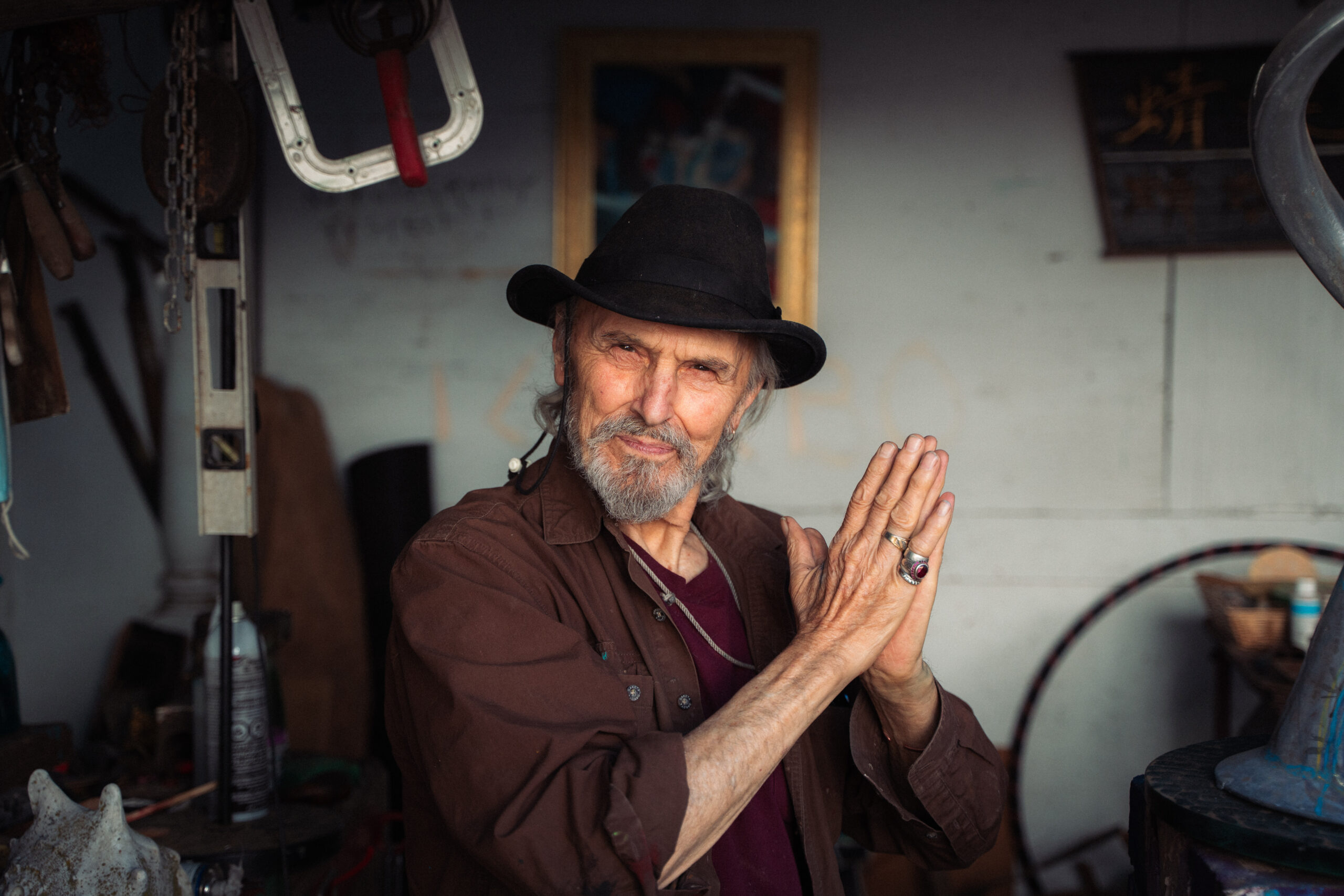


They don’t make them like Godfrey Stephens anymore. Maybe they never did. The Vancouver Island-born, self-taught artist dropped out of high school at 16 and hit the road, spending decades criss-crossing the world, large parts by hitchhiking, while engaging in a string of wild adventures. During the 1960s, he filled four passports, one with 138 stamps. He supported himself by making and selling his art or trading it for favours. He never held a nine-to-five job. He travelled without credit cards and no bank account. “It was really hard sometimes,” Stephens admits, but it suited his restless nature and innate curiosity. “I’m really just a vagabond at heart.”
After returning to B.C. in the late 1960s, he built sailing vessels that he lived on and used as mobile studios while he cruised the Pacific, producing impressive sculptural pieces and abstract paintings that are on display around the globe (He listened to the coverage of the moon walk on a shortwave radio while living on the beach at Florencia Bay in 1969.). In June, at 86, Stephens displayed several pieces at a group show at Victoria’s Inn at Laurel Point. He arrived, rail thin, sporting a cane, a fedora, a brown sports jacket, a wide grin, and his trademark moustache and short beard, escorted by a gaggle of family, followers, and female friends.
“Godfrey was the star of the show,” says event organizer Russ Reynolds, who has known Stephens for 25 years. “He’s as pure an artist as you could ever imagine. It’s in his bones.” Reynolds is not alone in his admiration. First Nations Nuu-chah-nulth carver Joe David has called Stephens “a cultural and national treasure.” Watching him at the exhibition, Reynolds was also amazed by Stephens’ energy, which he equated to that of a 16-year-old.
You can sense that energy over the phone lines when you converse with Stephens. Today, he is discussing artificial intelligence. A friend asked him to sing a few lines from a song that his father wrote about a place called Goldstream into his iPhone. Then this fellow did a few manipulations and hit play. “It sounded almost angelic in its perfection, and it frightened me and disappointed me and made me really sad, because that wasn’t my dad coming back,” Stephens says.
His father, Rupert, who owned an organic berry farm on Vancouver Island, and who was a creative gent in his own right, recognized his son’s natural artistic talent at a young age and encouraged him to pursue his muse. He originally thought his son might become a cartoonist. Stephens signed his early creations with the pen name Goof. It was a nickname he would carry his entire life. His younger brother Arran is also a gifted artist, but he pursued a different career, entering business and founding the organic food company Nature’s Path.
At 14, Stephens and his friend Tony Hunt learned to carve from Mungo Martin, the celebrated Kwakwaka’wakw artist, who was restoring totem poles at the Royal BC Museum. It was the start of both boys’ careers as carvers. Hunt became a hereditary chief of the Kwakwaka’wakw people, world-renowned artist, and champion of traditional Indigenous knowledge. The lessons Stephens picked up permeated his art. He became close to many Indigenous artists, and Hunt later held a potlach for Stephens at which he was given the name Wakaladzi, which means “Avalanche of Gifts.” He believes the title reflects his life’s journey.
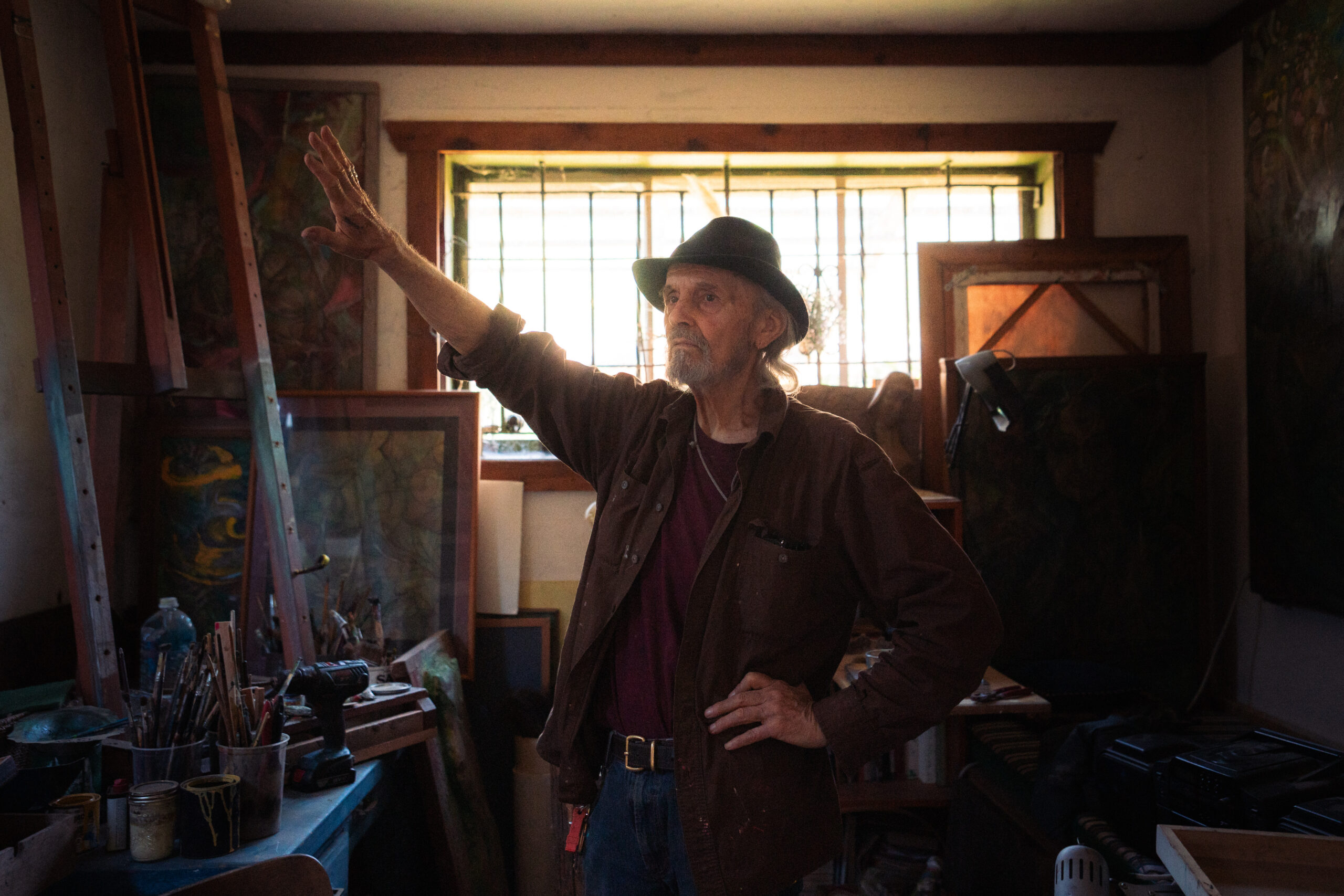
Stephens’s art, which is composed largely of sculptures and oil and acrylic paintings, is difficult to classify. “The Greeks described it as daydream art,” he says, remembering his time travelling through the Mediterranean. His abstract sculptures are sensuous and muscular with whirling shapes and twisted forms. His paintings are dense, filled with floating faces and bodies, labyrinthine in their complexity. Some evoke the sense of peering into a jungle. Stephens claims he never knows exactly what a piece will look like when he starts a project, that it gradually evolves and is influenced by everything in his environment and the thoughts in his head.
Stephens’s global odyssey began when his father sold a song for a Disney movie and moved the family to Hollywood so he could pursue a career as a songwriter. Stephens entered Hollywood High, an engagement that lasted only a few weeks before he quit.
Inspired by the free-wheeling lifestyle of the Beat Movement, he hitchhiked to New Orleans, where he was taken in by a lesbian poet named Kay “Kaja” Johnson. From there he headed to Birmingham, Alabama, where he carved a statue for a church, his “first big money,” then to New York’s Greenwich Village, where he drew pictures and painted murals on the walls of nightclubs and bars in exchange for a place to stay. This became a pattern—bartering art for food, money, or gifts. It financed his travels. After travelling the Eastern seaboard up to Montreal, he thumbed his way to San Francisco where he decorated the walls of North Beach’s famous beatnik hangout, the Co-Existence Bagel Shop. Then it was back to Victoria via Vancouver, where he did the same at several coffee shops, including the Black Spot on Dunbar Street and a place on Davie that became known as Goof’s Pad.
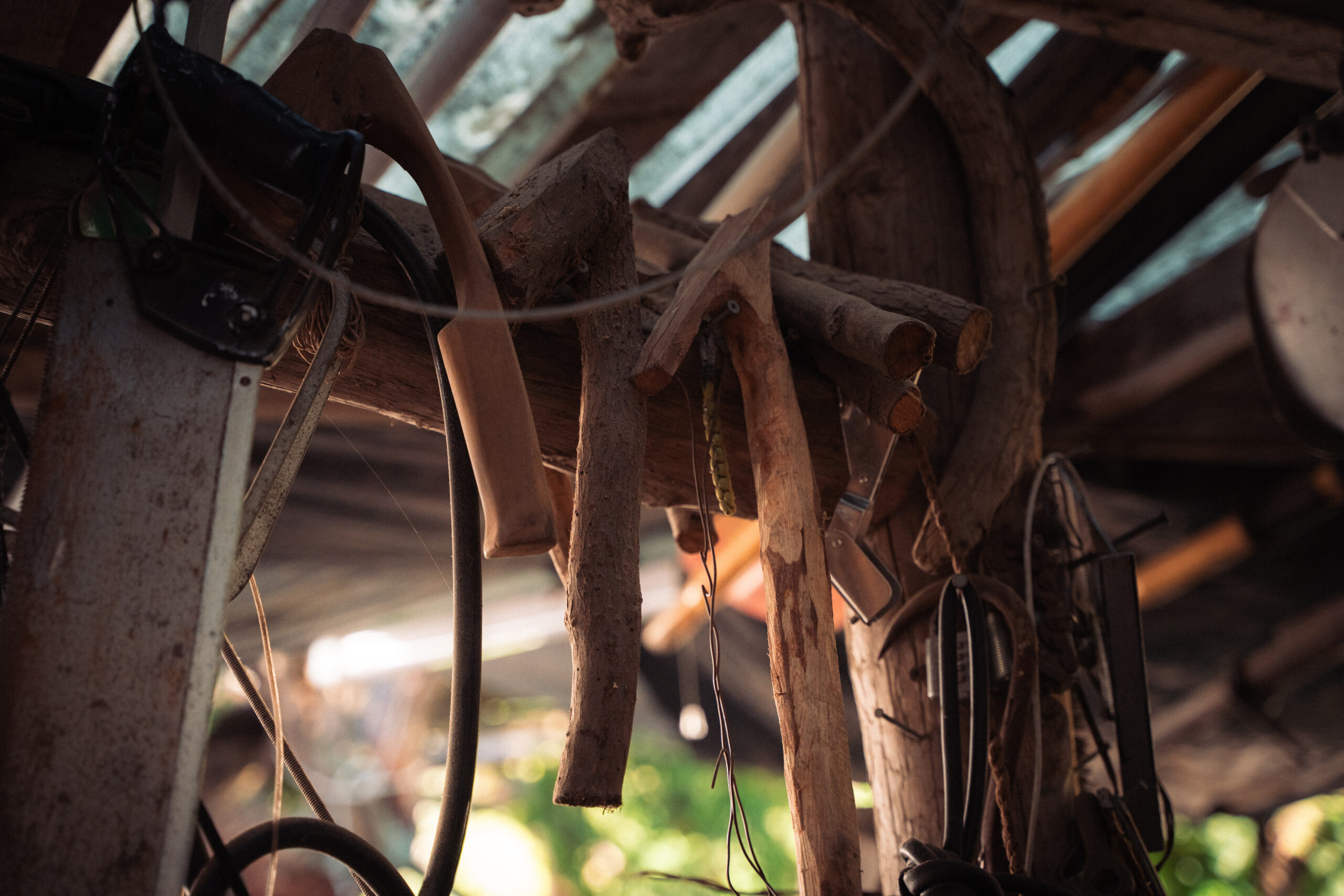
When travelling, Stephens always carried his tools, most notably an adze, a cutting device similar to an axe, but with the cutting blade perpendicular to the handle rather than parallel. Among the First Nations of the Pacific Northwest it was the carving instrument of choice. “It’s not like a white man’s hatchet or axe—it scoops like a hoe. You can get perfect aim. You can sharpen a pencil with it,” he says.
He carried a tape recorder for jotting down impressions and would hitchhike with a guitar and sometimes one of his sculptures because they sparked curiosity and helped him get rides. He often slept outside.
After canvassing North America, Stephens took a freighter to Europe where he lived for a while in an abandoned 14th-century castle and at Paris’s famous Beat Hotel, where he met poets Allen Ginsberg and Gregory Corso. There was a stint on a houseboat owned by Picasso’s dentist. “Dentists own a lot of my work,” notes Stephens, who often engaged their services in exchange for his art. At the time, he had a spider monkey named Achilles that he would carry around on his shoulder.
At a pub in Galway, Ireland, he got drunk with Brendan Behan shortly before Behan’s death in 1964 and drew his portrait. In return, the famous writer handed Stephens all the cash in his pockets, about seven pounds.
Conversing with Stephens can be exhausting. He careens through time zones and people, like a game of metaphysical pinball. Tales tumble out like leaves in a storm. He quotes lines from Rimbaud and slips into rambling bouts of freeform prose, populated by characters such as Eight Finger Eddie and Big Daddy Nord.
He mentions a moonlit beach in Casablanca when he and a girlfriend were robbed by brigands. They took the sweater he used as a pillow and a prized pair of hand-made sandals that he kept inside. He had to hitchhike barefoot all the way to Tangiers.
He stayed for free at a Kabul hotel because he created signs in English for the owner to attract Western travellers following the “hippie trail.”
In 1965, Stephens resided in a cave in Rishikesh, India. Two naked sadhus lived in the cave next door. The holy men would bring him tea sweetened with the juice of a hard-shelled fruit that monkeys cracked on rocks. During the day, Stephens would line up with the sadhus and other beggars and receive free dal and roti from local citizens. The cave was located beneath the ashram of Maharishi Mahesh Yogi, the founder of transcendental meditation. Stephens met the maharishi one morning coming down to the Ganges to have his photo taken by his disciples. “‘Oh, here you are in your gufa,’ (gufa means “cave” in Hindi), the Maharishi said. “And I said, ‘Yeah, my name is Goof, and I am Goof in the gufa.’”
While the maharishi was posing, the holy man slipped and nearly fell into the river. “And I thought, you know, he’s just a human being like everybody else. Everybody puts these people up too high,” Stephens says.
After circling the globe, he spent a year in Hawaiʻi. For a while, he lived in a bar on the Big Island that was owned by actor Richard Boone and his friend Teddy Ginn, a former bodyguard of Malcolm X. Eventually, he returned to B.C. and embarked on the maritime phase of his life. He resided at Florencia Bay, near Ucluelet, on a windswept stretch of beach in a teepee-like shack built with driftwood and plastic tarp and created his art next to the rolling surf.
Stephens was there with dozens of other squatters in 1971 when Princess Anne arrived to open Pacific Rim National Park. One of the wooden sculptures that he carved while ensconced on the beach, a piece inspired by the Jimi Hendrix tune “Voodoo Child,” was purchased by parks officials to be presented to Princess Anne. To protect it in the days before the ceremony, the sculpture was locked up in a jail cell in Ucluelet.
At the event, Stephens chatted with the Princess and then-minister of Indian Affairs Northern Development Jean Chrétien and posed for photos. A few days later, the officials who had selected his piece for the ceremony kicked him and his fellow beachcombers off the beach in order to build the park. “They burned down all our houses. Gave everybody $50. I never got my $50.” He did get $450 for the sculpture, which he used to buy a two-person sailing kayak.
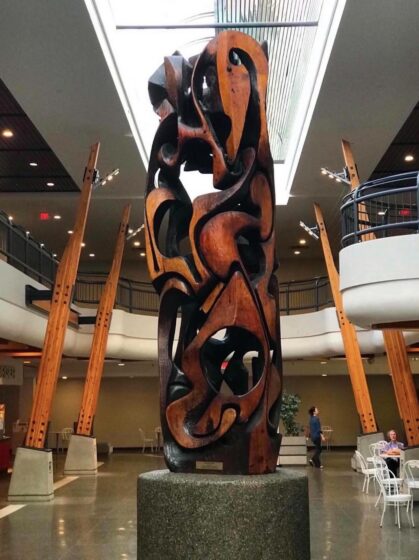
“Woodstorm.” Image courtesy of Godfrey Stephens.
Stephens crafted several other iconic West Coast sculptures in those years. In 1973, he carved two magnificent 24-foot abstract columns, one from red cedar and one from yellow cedar, that were mounted at the entrance of the Times-Colonist Victoria Press Building. Unfortunately, these sculptures were placed in storage after the building was sold in 2017 and underwent a redesign.
In 1984, Stephens created a sculpture from a 300-year-old, windfallen red cedar called Weeping Cedar Woman to protest the logging of the ancient trees of Clayoquot Sound. Carved with a chainsaw in two weeks, the 18-foot-tall piece featured tears flowing down over her chest to the bark and rope around her waist. Her right hand is raised in a “stop” gesture, and her left hand points to the earth. The sculpture stood on Strawberry Island for 16 years before being refurbished by Stephens in 2014 and moved to Tofino’s Village Green, where it is today.
Woodstorm, another massive wooden piece that he carved in 1977, stood anonymously for years in the atrium of New Westminster’s Royal Square Mall until a friend of Stephens recently contacted the mall owners and arranged to have a plaque attached.
There is something sad about his sculptures being literally forgotten in a shopping mall and hidden in storage. Although Stephens’s art has been profiled in several books, and he has been the subject of many newspaper articles, the coverage has not brought him the fame he deserves. Things might have been different had he been more of a self-promoter or had an agent. But of course, that is simply not part of his DNA.
Stephens has two daughters, Tilikum and Aija, from previous relationships. For the last couple of decades, he has lived with his wife, Megan, in a house in Esquimalt. “We own it, but I don’t have lots of money to just throw around. The only money I can spend is what I earn.” He says Megan is a stabilizing influence in his life. “She’s a very straight lady, but she still allows me to have a wild side.”
Stephens retains a burning desire to create. “I can’t stop. I’m manic. I imagine I will go to the end with a paint brush and a carving tool in my hand,” he says. “I’m still a kid. Like one of my friends says, ‘Godfrey, you’re too old. It’s too late to grow up now.’”
Read more stories about art in B.C.