

“There were quite a few incidents,” musician Tony Lee remembers. It was 2021, amid an upsurge of racism, primarily aimed at Chinese Canadians during the COVID pandemic. “Like an old Chinese man at the 7-Eleven getting pushed over, or old men or young women who got beat up or kicked at bus stops and stuff like that. There was a lot of pretty ugly sentiment around that time. So I was sitting at home and watching the news, thinking, ‘We better do something.’ So I called up Tim and Eric.”
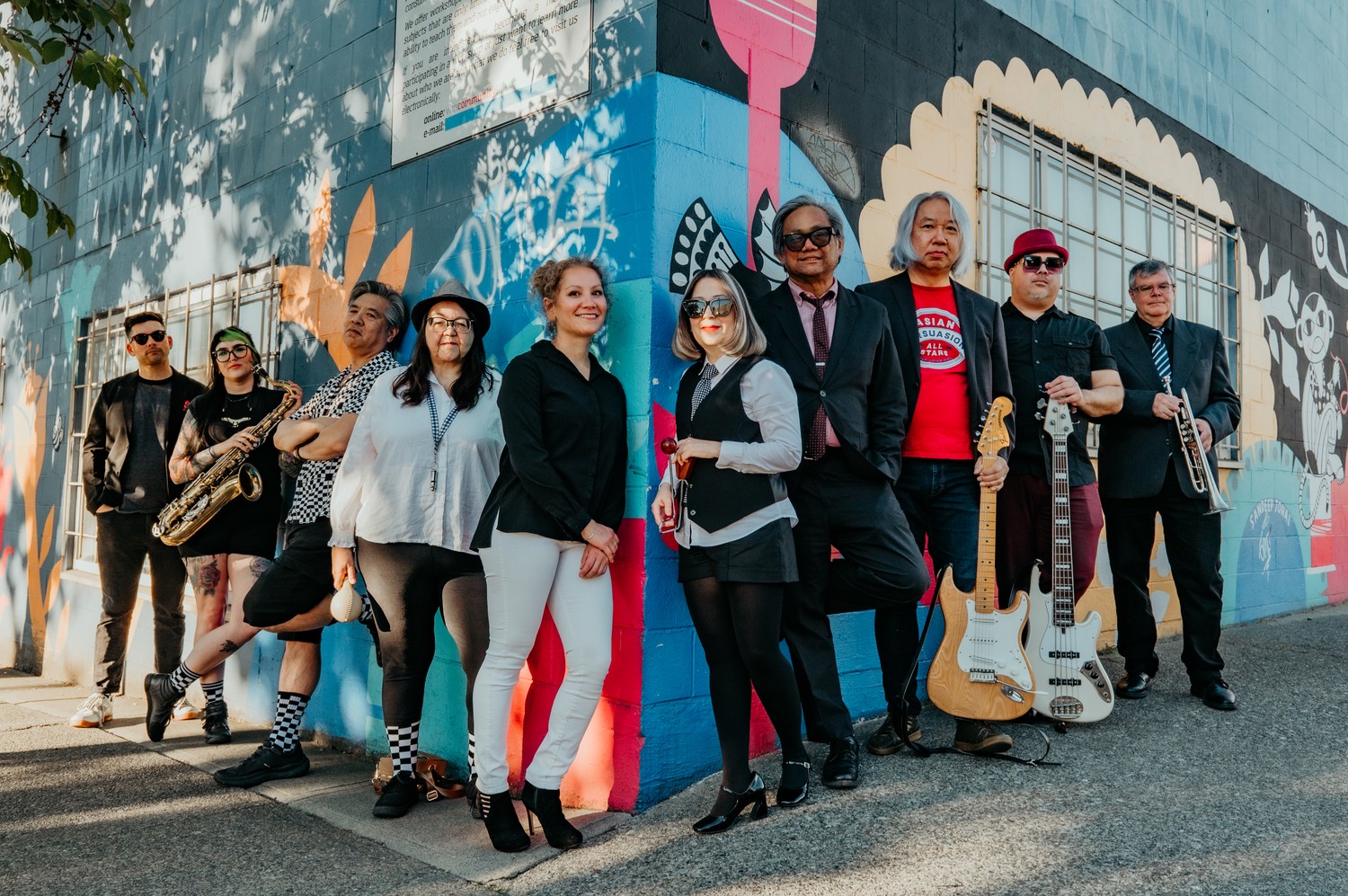
Tim, Eric—with Tony, they would become the brain trust of the Asian Persuasion All Stars, an anti-racism-themed ensemble whose members are (almost) all of Asian heritage.
Tim and Eric are Tim Chan and Eric Lowe, one of the longest-running collaborations in the 11-piece lineup of the Asian Persuasion All Stars. Chan remembers the call from Lee well. “There were a number of racist incidents that happened that year in Vancouver, and Tony said, ‘Let’s do something about this. We’re musicians—let’s do a song together and raise money to benefit an anti-racism cause.’”
Chan fronts two of the bands that contributed members to Asian Persuasion: 64 Funnycars, who first formed in the mid-1980s in Victoria, also with drummer and occasional lead vocalist Lowe, and China Syndrome, whose entire current lineup (bassist Mike Chang, keyboard player and percussionist Tamla Mah, and drummer Daniel Fortin) has been subsumed into Asian Persuasion All Stars for their June 19 gig at the Fox Cabaret, opening for Skaboom! (Fortin will be filling in for Lowe that night).
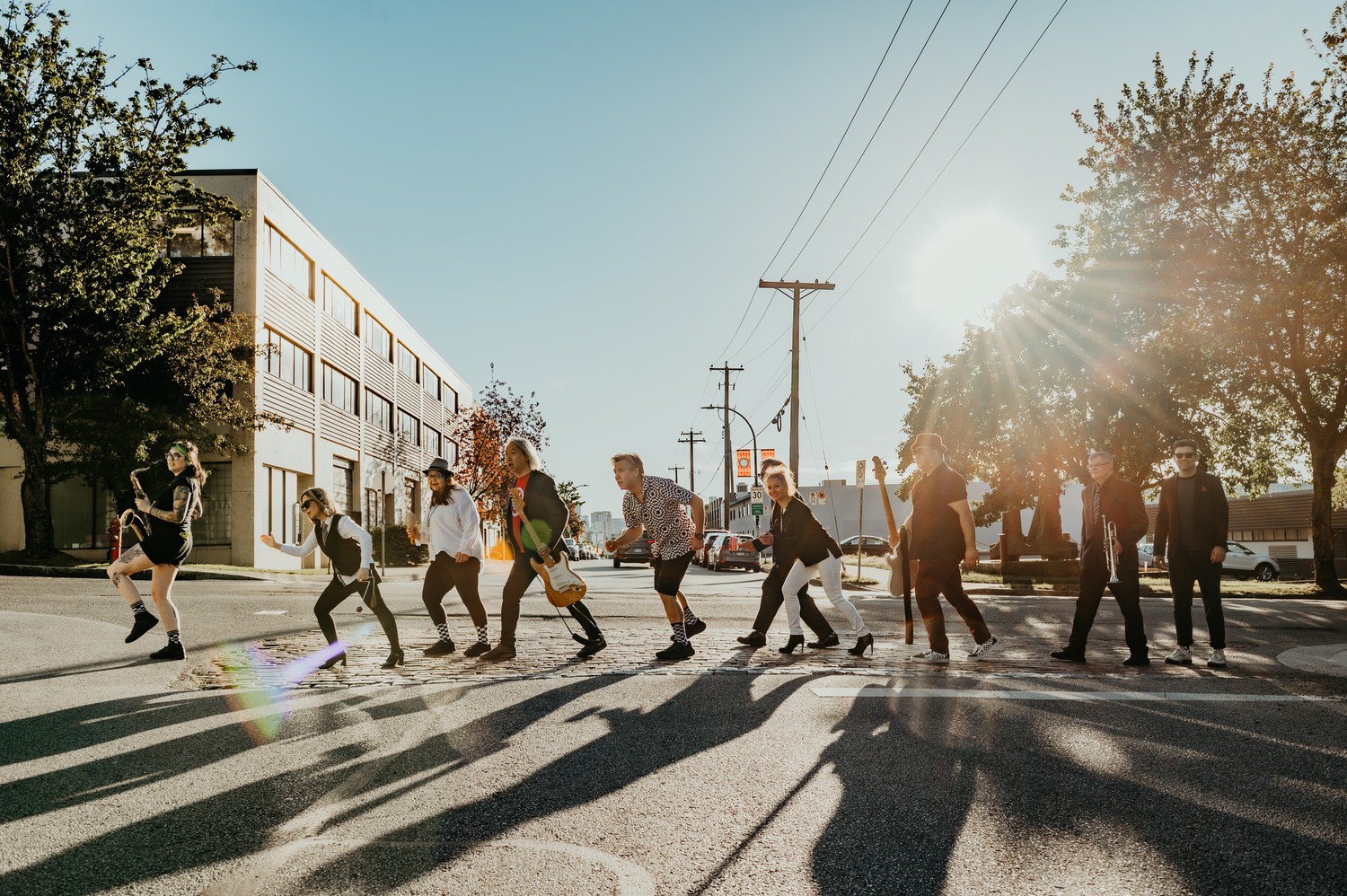
Lowe also drums for The Vanrays, who have contributed their tenor sax and trumpet players to the Asian Persuasion horn section: Melissa Lee, one of the non-Asian members of Asian Persuasion, sees herself as a “standard-issue white person” who is helping her friends spread an important message, while Jose Blanco looks white, but does speak with an accent and has an “obvious Latino name,” which he says has caused him some extra scrutiny at work or from security officials at airports, if not as much overt racism as other members of this group.
Blanco is very much enjoying being part of Asian Persuasion, “because we’re like family and believe in acceptance, and I want to project that same kind of energy out into the community.”
The band, in a slightly different lineup, initially recorded a one-off single with a socially distant video, a cover of The Special AKA’s “Racist Friend.” There was no thought at the time of the project’s having legs. “And then,” Lee says with a grin, “someone asked us to play live, so what are we going to do?”
With the input of Greg “Greggae” Hathaway of the local reggae band Roots Round Up, they compiled a list of other songs they could cover, with reggae being only one option. These ranged from second-gen British ska, such as “Big in the Body, Small in the Mind” by the Selecter, to odd Asian pop choices, like “Dynamite” by Korean boy band BTS, and American soul with a danceable protest vibe and room for a horn section, Lee explains. There was R&B music like “Everyday People” by Sly and the Family Stone, “a multiracial sort of dance band that had some sort of peace motives” Lee says, and “Why Can’t We Be Friends” by War, the basis of Asian Persuasion’s second video.
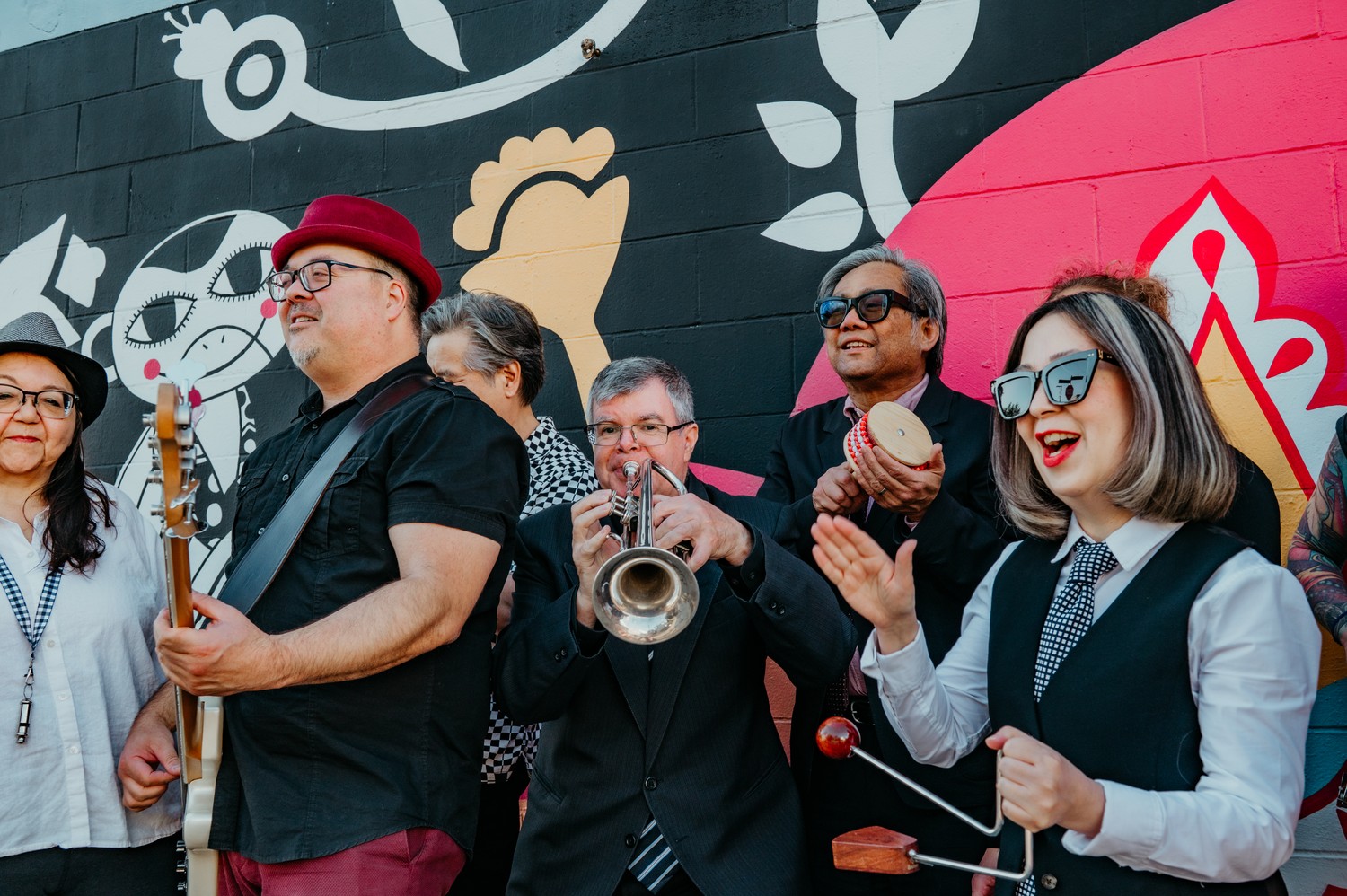
“A peace song by War is great,” Lee says with a chuckle, noting that the original video is really funny: “They have all these people who shouldn’t be getting along. There’s actually a black guy and a KKK guy high fiving or something.”
The band also perfected a reggae-fied version of Depeche Mode’s “People Are People,” which sent me scrambling for the lyrics online to see if they had tweaked them to be more antiracist (they hadn’t). “You don’t really think of them as peaceniks, but there you go,” Lee says. “It’s a great song, but it’s all, like, drum machines, so we couldn’t really do it the same way.”
While Chan and Lee weren’t themselves targets of racism during COVID, Chan observes that all the nonwhite members of Asian Persuasion, also including Indigenous two-spirit songwriter Norine Braun, keyboardist Ron Yamauchi, vocalist and percussionist Brooke Fujiyama, and half-Filipino trombonist Kevin Tang, have experienced racism in some form. “Our parents or our grandparents were all marginalized way worse than we were,” Chan says. “My grandfather, for instance, paid the head tax to come into Canada, and he worked on the railway, worked for CPR. He was separated from his family for years. He lived in Canada, he sent money back, and he could only go back to China every seven years. He left his wife there, and every time he went back there, there was a new kid who was born in China, but he couldn’t be there with them because he wasn’t allowed to bring his family over to Canada, as a direct result of the Chinese Exclusion Act that was in place between 1923 and 1947. So there’s that kind of shared experience, whether it’s ourselves or our families.”
Lee, for his own part, counts himself lucky as far as racism goes, having “grown up super-suburban,” going to Burnaby North high school, where, he says, there were tons of Asian people and everyone was more or less assimilated into a Canadian identity. He even cracks wise about being a “banana”: yellow on the outside, white on the inside.
Lee and Yamauchi, the other longest-running collaboration in the band, were budding music geeks at their school, despite being a bit too young to participate in the first-gen Vancouver punk scene. Lee jokes that they would genuflect around the 1974 grad photo of Joey Keithley, who was already an established star of the local scene when they were first going to shows. The two would later join the Soreheads, whose main release was a 1986 seven-inch.
In high school, racism occasionally raised its head in moments of bullying, stereotyping, and name-calling, which the band has talked about on video. But Lee mostly feels that he was lucky—his father had far more trouble than he did. “My dad Al graduated from business at UBC but had far fewer opportunities than his classmates,” he recalls. He ended up managing the lighting department at Eaton’s at Brentwood Mall.
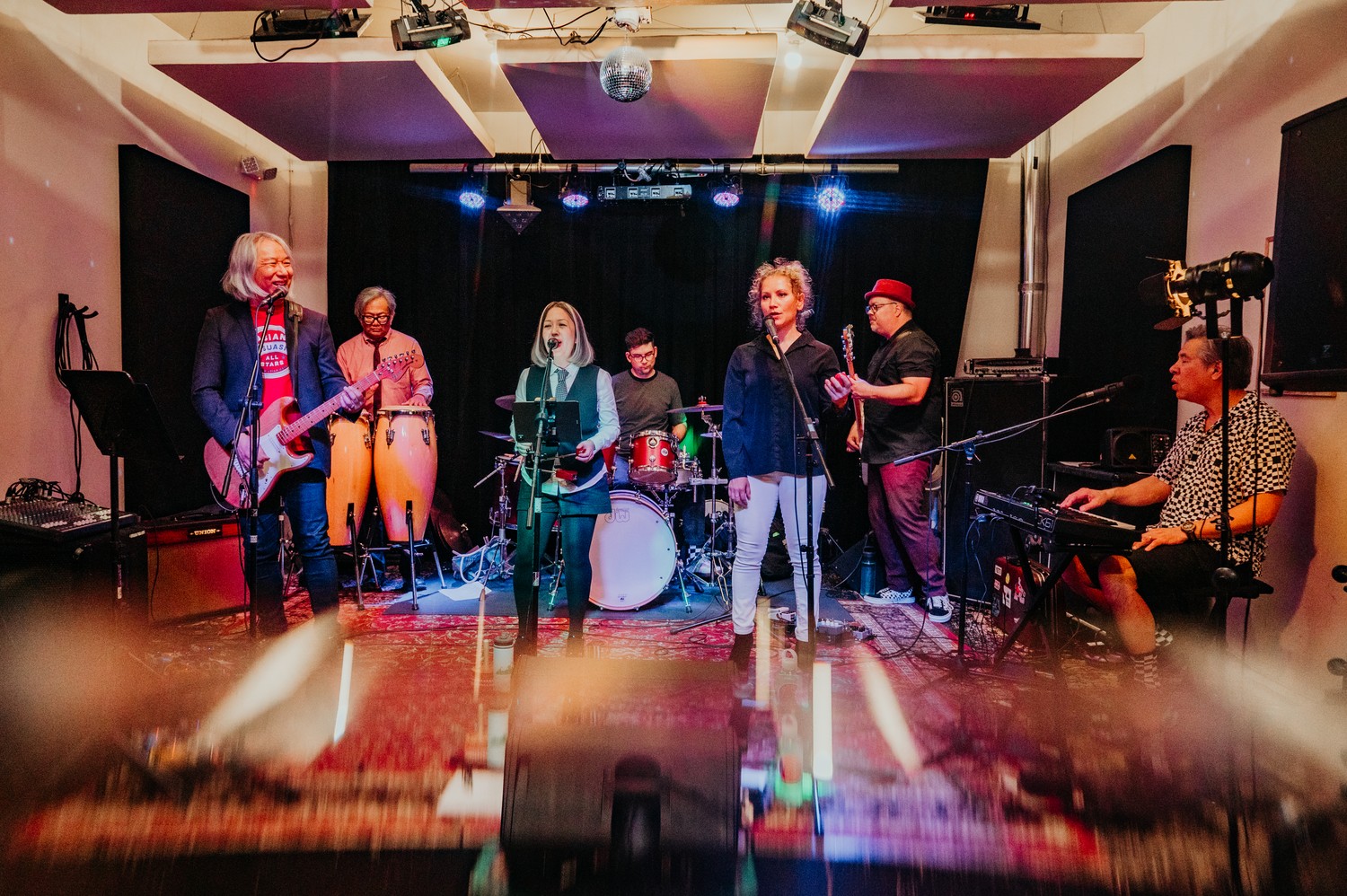
But one common experience the Asian Canadian members of the group feel is racist is being mistaken for one another.
Different members of the group have reacted to that differently—it’s only “mildly annoying” to Lee “but fine if they don’t hate you.” In fact, at a recent “120th birthday celebration” at LanaLou’s, where Lowe and Lee celebrated each turning 60 and performed together as Secret Asian Man, they made light of being mistaken for one another, as drummers of Asian decent and roughly the same height and body type, selling near-identical T-shirts, and offering helpful tips to the audience to tell them apart, mostly centring on Lee’s propensity to smile compared to Lowe’s to scowl.
Chan finds being mistaken for his bandmates more irritating. “Honestly, I do have a hard time when I am mistaken for Tony or Eric, as the three of us don’t look alike at all, so all they are seeing is our ethnicity or race. It all goes back to the ‘they all look alike’ stigma of Asian people,” he says. “The roots of this are from being marginalized in North American society previously. We weren’t seen as individuals but as a faceless mass of ‘yellow peril’ that were to be oppressed and subject to government-imposed race-based restrictions. It’s something I heard people say about Chinese people when I was younger, and I was actually taunted by racist comments relating to us ‘looking the same.’ I guess I’ve never gotten over it.”
Lee’s collaborations with Chan and Lowe began in 2010, shortly after the death of revered American musician Alex Chilton. A tribute show for Chilton was organized at the WISE Hall, where both China Syndrome and 64 Funnycars played. Lee, normally known as a drummer, did what at the time was a rare turn as a frontman for a one-off Alex Chilton tribute act called LXLXLX (“Alex Alex Alex”). Befitting Chilton’s association with The Cramps, they covered The Cramps’ “Goo Goo Muck” with Lee on vocals.
Lee later joined Chan and Lowe onstage to play cowbell with China Syndrome on their cover of The Replacements’ song “Alex Chilton” (you see him rise up in the background about 42 seconds into this clip). “That was totally spontaneous,” Chan remembers. “Like, I’m pretty sure I had met him before that, but I didn’t really know him at that time. He was kinda hiding behind an amp or something and suddenly leapt up and started playing the cowbell.”
Much later, Chan would discover he had heard the Soreheads, back when he was a DJ for UVic campus radio, on the 1986 Van-Cover cassette, covering a Beatles tune, but the Chilton night was the first of their many collaborations. After that, they shared many bills together: Lee was in The New Black, with whom China Syndrome would play shows frequently, for one. “And I played with him for fun at his 50th birthday party, with Secret Asian Man, that goofy project he has with Eric Lowe. The three also collaborated on a birthday project, doing a video for a friend, while Tony and Tim served in a backup band for late Vancouver scene fixture Brent Kane at a 2016 LanaLou’s gig. “We backed him up on some Bowie songs. He always wanted to sing in front of a band, so we all obliged for this birthday—I think it was his 50th.”
What other bands was Lee in, after the Soreheads?
“The next thing would be with the Saddlesores in the 1990s,” Lee says. “The Saddlesores were sort of a cowpunk band, and it turned into a cow-metal band. The singer Jason [Corbett] is the guy from Actors now, and the guitarist Pinto [Stiletto], he was in Crystal Pistol, and he had a band called Sucker Trap. We were going quite a few years, took our broken van to Toronto and sorta did SXSW one year, and we found out I’m a really bad snorer so you shouldn’t go on tour with me.”
After that, Lee was in The New Black, then had turns drumming with EddyD & the Sex Bombs and, for the last year and a half, the MeBats (a renamed version of Stab’Em in the Abdomen, fronted by Ed Hurrell and Eddy Dutchman, whose old band name kept running afoul of internet censors: “MeBats” is “Stab’Em” backwards).
“It’s like jury duty,” Lee says of his tenure with Stab’Em. “Eddy says you can never leave the band. You can be kicked out of the band, but you can never leave.”
Lee is also in The Nightflower Orchestra, fronted by Dennis Mills, “the confrontational lounge band,” again with Ron Yamauchi on keys.
As Asian Persuasion negotiates the challenges of turning from a cover band to a band with original material, another undersung member has been coming more to the forefront: China Syndrome and Asian Persuasion bassist Mike Chang, who is writing most of Asian Persuasion’s new music, in collaboration with the other members, with the intention of having an album ready for release early next year.
“Mike has written pretty much all the music for the original songs we play,” Chan notes. “Generally he comes with a pretty much finished demo, and we put lyrics and melody on the music. Sometimes we do tweak the music depending on how the lyrics and melodies go.”
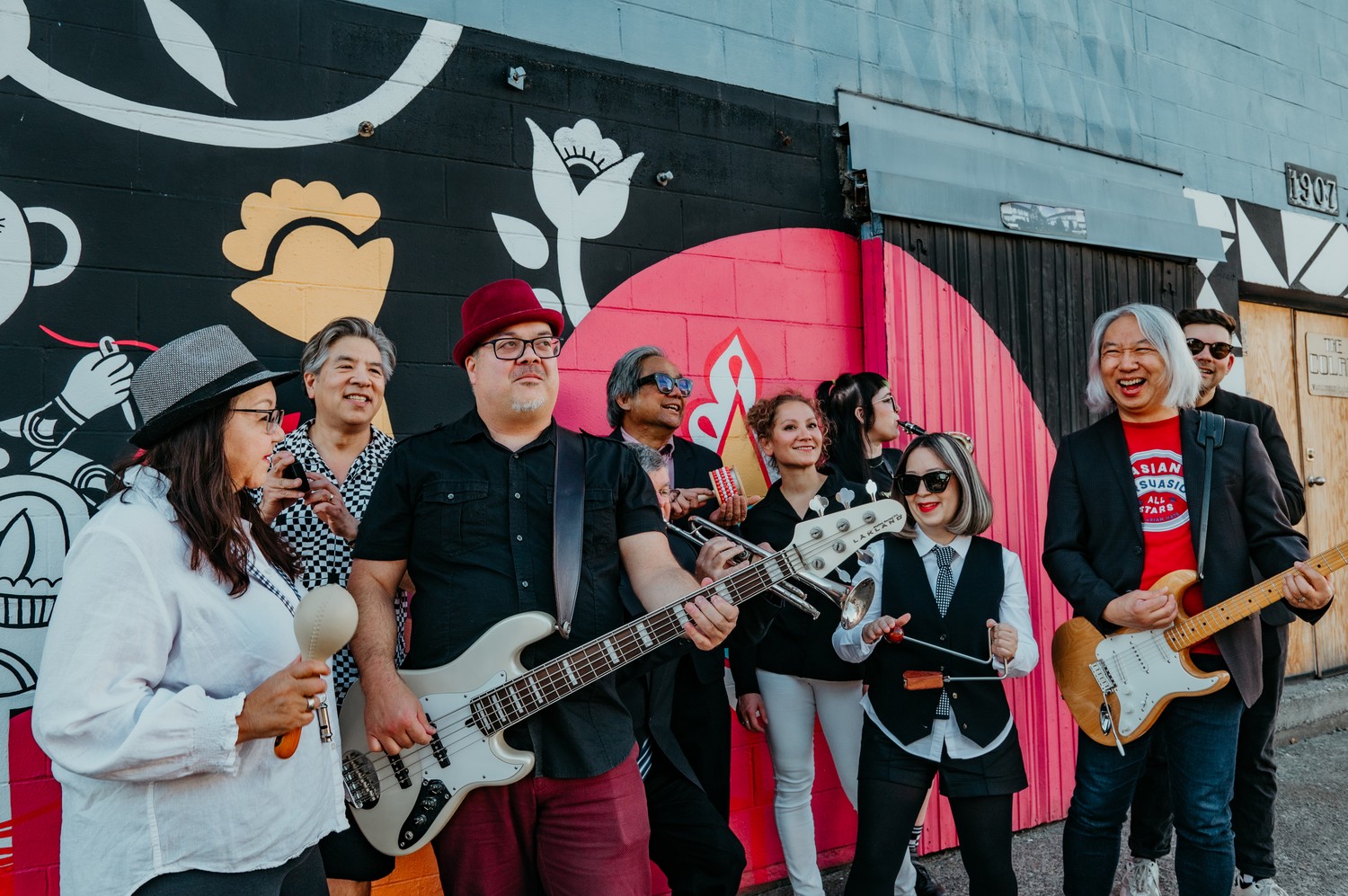
The new song “Stronger Together” is one of four songs Chan and Chang co-wrote for Asian Persuasion, but it’s the only one Chan sings. The other ones are sung by Tamla: ‘We Are Who We Are,’ ‘Love Is Free,’ and ‘Til Everything’s Alright,’ which, Chan explains, is “about how we’re going to fight racism till everything’s all right. My lyrical mandate for Asian Persuasion, and also melodically speaking, is to write some really accessible anthems with a message. ‘Stronger Together’ is a bit of a tidy slogan, but that song is kind of semi-autobiographical.”
The song’s lyrics of “growing up in white town/not seeing many like me” is a reference to Chan’s experience in the predominantly Caucasian city of Victoria, which left him “on the outside looking in.” The other verses tell the story of coming together “to try to make a difference,” with Chan wondering if the work of the band will ever end. “It sort of tells our story, the Asian Persuasion All Stars’ story. Tony likes to say, if there were a theme song for a sitcom about Asian Persuasion All Stars, that song would be it.”
So does the band feel stronger together? “Yeah, absolutely,” Chan says. “I think it’s maybe because of the history of marginalization of our ethnic groups. We’re all different: we’re not all Chinese, for instance. We have Chinese, Filipino, Japanese, Indigenous. So we’re all together as a group—it’s a special bond.”
Lee agrees. “The whole visible minority thing is kinda weird. Some people go, ‘Why would you do that?’ But it’s fun, and you don’t see it very often—being in a rock band is sort of a white person thing. I know quite a few Asian people from the scene, but there aren’t very many. So I do think we have a bit of a superpower together.”
Asian Persuasion All Stars shares a bill June 19 at the Fox Cabaret with Skaboom! Read more Arts stories.