

This story is the 20th in our series on the hidden history of Vancouver’s neighbourhoods. Read more.
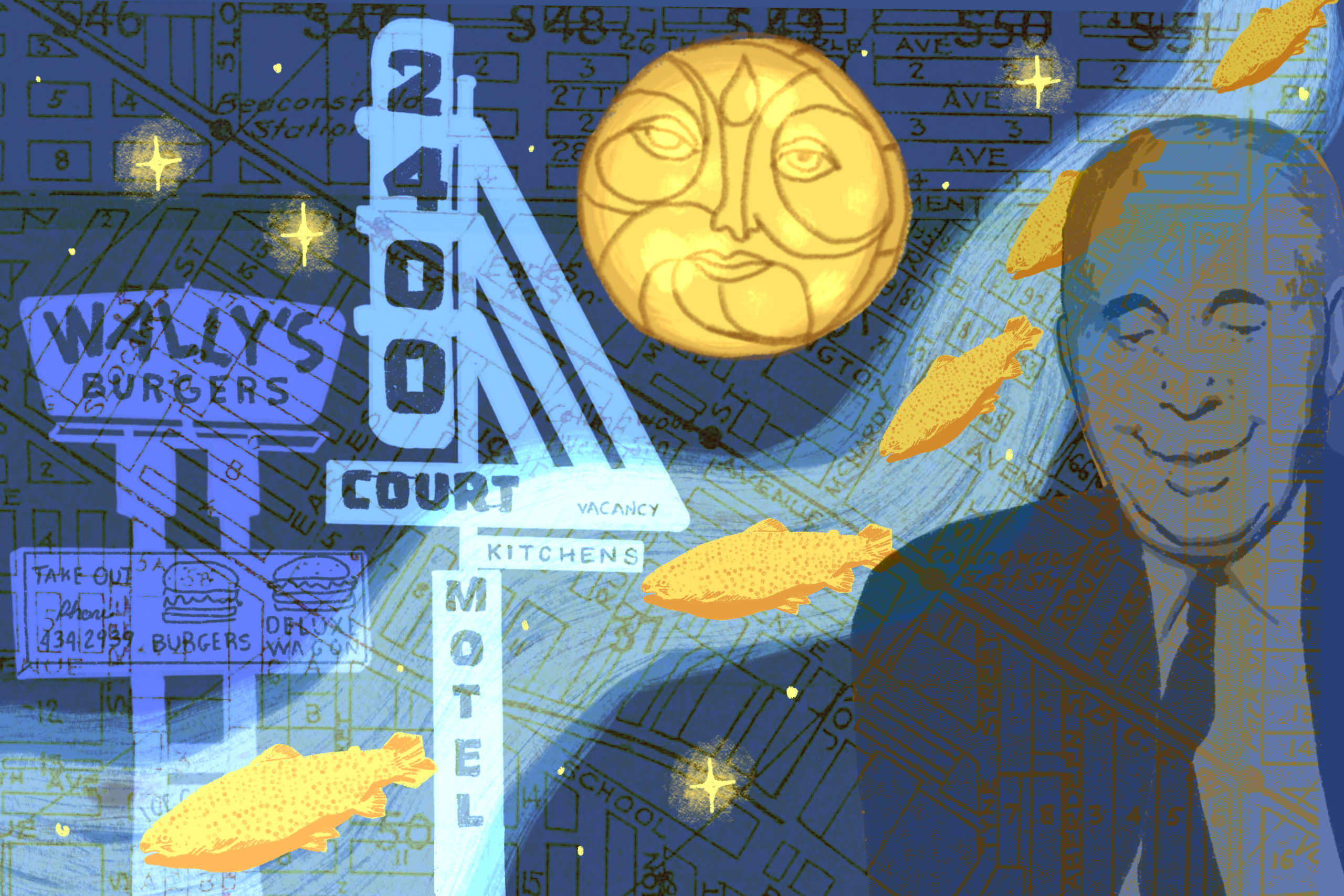
Like a lot of Vancouver’s hidden waterways, Still Creek is largely encased in piping and hidden by roadway—except for Renfrew Ravine Park, where the creek’s water sees daylight for about six city blocks. For decades, the park was a source of adventure for neighbourhood children in the Renfrew-Collingwood neighbourhood, who would enter the culvert on East 29th Avenue and emerge through a manhole at the parking lot of local institution Wally’s Burgers (which closed its Kingsway location in 2008).
Those kids might have also befriended a squatter named Ted Twetie, who lived in a cabin at the culvert on 22nd Avenue, where he raised bantam chickens. “I’ve smoked cigarettes for 90 years, but I’ve had to cut down my whiskey drinking,” Twetie, then 105, told The Province in 1967. “Blanked out when I was 100. Never had that happen before.”
By the 1990s, the park that surrounded the ravine had fallen into neglect when the Renfrew Ravine cleanup crew organized to gather garbage dumped in the creek. Within a decade, local engagement, informed by consultation from community members, brought on other park improvements such as a new greenway, public art projects, and the Renfrew Ravine Moon Festival, an environmentally minded harvest celebration.
Much like the ravine in the ’90s, Renfrew-Collingwood—bordered by Nanaimo Street and Boundary Road to the west and east, and Broadway and East 41st Avenue to the north and south—is currently in the midst of a transformation. Despite a reputation as a sleepy bedroom community, this ethnically diverse, working-class neighbourhood, chock full of toothsome eateries, sits squarely in the city’s plans to densify. Meanwhile, locals continue fighting to preserve the buildings and bonds they value most.
The history of the area begins with Still Creek, which begins near present-day Central Park in Burnaby. The trout-filled waters supported bogs, wetlands, and forests with cedar, hemlock, alder, and maple trees, and the area was used by the Squamish, Musqueam, Tsleil-Waututh, and Stó:lō peoples for fishing and hunting. There were several lakes: Moody Lake, where the Joyce-Collingwood SkyTrain station stands, and three smaller lakes, created by beavers, where Grandview Highway now runs.
European settlement came to Renfrew-Collingwood in the second half of the 19th century as Robert Burnaby and Colonel Moody surveyed the area. Development started in the southerly side of the neighbourhood. This part was named Collingwood after a town in Ontario by officials from the British Columbia Electric Railway Company , which built the interurban in 1891, spurring development throughout the city. One of the earliest businesses was the Collingwood Inn, which opened in 1892 at the corner of Kingsway (then known as Westminster Road) and Stamford Street, and offered respite to wagon drivers travelling from New Westminster to False Creek.
According to local historian Loretta Houben’s Collingwood Chronicles, building lots in that area went for $800 in 1912. At that time, the heart of Collingwood was around Kingsway and Joyce, where businesses, including the Collingwood Theatre, were clustered. A one-room schoolhouse was also built on its southeast corner in 1896. Another room was added to it in 1901, and the buildings were eventually known as Carleton Hall. In 1919, its schoolyard was filled with more than 5,500 students, who serenaded the Prince of Wales (later King Edward VIII, who abdicated in 1936 to marry American divorcee Wallis Simpson) with a rendition of “O Canada.” Farther north, on East 22nd Avenue, the city’s second-oldest fire station, Firehall No. 15, was built in 1913. Both buildings were restored in early 2010s—with the schoolhouse the current home of Green Thumb Theatre and the firehall still used by the fire department—and form the final vestiges of the original neighbourhood.
The area’s next wave of development came shortly after the Second World War. With soldiers returning home from combat billeted in downtown hotels, the government cleared forested hillside northeast of Collingwood and built hundreds of bungalows for families with at least two children, on streets named after European battle sites such as Normandy and Vimy. The area, named Renfrew Heights, was also colloquially known as “Diaper Hill” (because of all the babies booming out of these homes) and sometimes “the Projects.”
Fiction writer and journalist Don McLellan wrote about growing up as a “project kid” in his 2008 story collection In the Quiet After Slaughter. In one story, he describes a wayward, gambling father in sympathetic terms: “I viewed my father’s carousing like this: he was born during the First World War and orphaned in the Depression. He spent the best part of his 20s fighting the Second World War. I reckoned the occasional disappearance was his way of making up for lost time.”
The 2400 Motel, built in 1946, represents another pivotal aspect of postwar history: the advent of car culture. With ample parking, lawns for kids to frolic on, and bungalow-style accommodations with kitchen, the motel on Kingsway near Slocan has welcomed visitors, Syrian refugees, and even the Grateful Dead. It’s also possibly the most recognizable building in Renfrew-Collingwood, as it’s been famously used as a shooting location for music videos and TV shows such as The X-Files, Smallville, and Yellowjackets.
Despite its celebrity, the 2400 Motel’s days are numbered, as the city-owned property is slated to be demolished to make way for four highrises that will see more than 800 units of rental housing, along with retail and community space, raised as part of the Norquay Village Neighbourhood Centre Plan to enhance density and walkability in the area. Approved in 2010, that plan has already resulted in duplex-zoning transforming areas formerly replete with single-family homes and caused an uproar among the area’s large Filipino community about a proposed tower on Joyce Street.
In December, the Vancouver School Board voted to permanently close Sir Guy Carleton Elementary, the brick-clad school that has been sitting vacant since a 2016 fire—with which Carleton Hall shares property—thus paving the way for development on the six-acre site.
Renfrew-Collingwood presently sits in a precarious moment in its quiet history. If the community raises its voice, however, as it did with the Renfrew Ravine, then it will coast through this next phase in the city’s development with its community-minded, working-class character preserved.