

This story is the 21st in our series on the hidden history of Vancouver’s neighbourhoods. Read more.
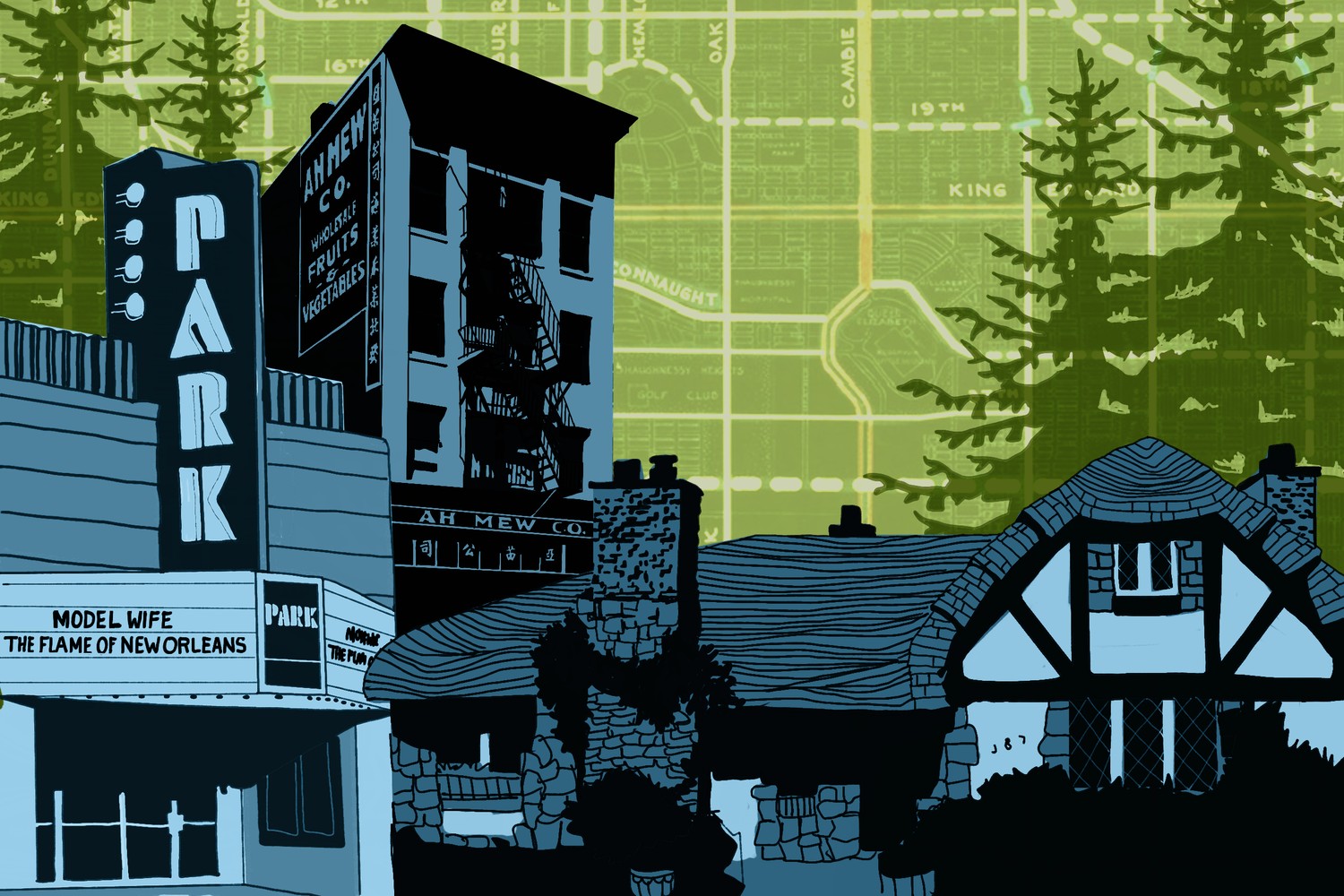
It’s fitting that South Cambie, one of the smallest neighbourhoods in Vancouver by geographic size and population, is famous for the Hobbit House. The Tudor-style cottage on King Edward Avenue near Cambie Street is so iconic and beloved that when the property was purchased for redevelopment in 2017, the developers of a 20-unit townhouse complex preserved this unintentional homage to Middle Earth on its site.
A less fortunate fate befell the “haunted house” on the other side of Cambie. Reputed, by turn, to be an ancient burial ground or a murder site, stories surfaced over the years of baby cribs moved close to the house’s window ledge and ghosts leaving suitcases on the lawn. This spooky house, located across from the King Edward SkyTrain station, was demolished to make way for more higher-density housing. There’s no word whether the ghosts like their new digs. (Perhaps they now live within the faces carved into the hedges of a home roughly a block away.)
In recent years, South Cambie, bordered by Oak and Cambie Streets to its west and east and West 16th and West 41st Avenues to its north and south, has seen a disproportionate share of displacement and upheaval. Whether it’s preserved, revived like the Park Theatre, or bulldozed, the history of this affluent neighbourhood still feels tangible.
Like much of the city, South Cambie was heavily forested until the 19th century. In 1874, logger and miner William Mackie claimed 160 acres of land around what’s presently known as Douglas Park. At the time, the site included a pasture for elk, a beaver dam, and a lake. A creek ran nearby. Soon afterward, another early settler, Jeremiah Rogers, set up a logging camp in the area. Within a decade, the land around the meadow was cleared and subdivided for homes. Craftsman-style houses from that era can still be found in the blocks around the park. Meanwhile, the pasture itself was kept for vegetable gardening.
In the first decades of the 20th century, the land was used as a market garden by a Chinese greengrocer named Ah Mew. In 2005, the Vancouver Courier interviewed Enid Taylor and Frances Pollack, who both grew up in that area and remembered Chinese gardeners in “coolie hats.” “They used to wrap all their vegetables in newspapers,” Pollack told Lisa Smedman. “Enid and I used to gather newspapers and put them in a wagon and we would go over there … and we would get two or three pennies for taking these piles of papers to wrap their vegetables.” The market garden closed when the park opened in 1926. A contest was held to name the park. Five children, who chose to honour either B.C. governor James Douglas or the Douglas fir tree, shared the $10 prize.
The present-day home of BC Children’s Hospital and BC Women’s Hospital & Health Centre, South Cambie (named after CPR engineer Henry Cambie) first gained its association with health and recovery in 1917 when the federal government took over Langara School, a boarding school for boys at 33rd Avenue and Heather Street, and Braemar School, a boarding school for girls at 28th and Willow, and founded Shaughnessy Hospital to accommodate recovering First World War veterans. Two years later, this convalescent home became a military hospital. In 1940, the hospital was rebuilt at Oak Street in a new building with 250 beds. Meanwhile, in 1927, the Salvation Army Grace Hospital was established at West 29th and Heather, welcoming mothers and newborns at that location until 1982, when it moved to the Shaughnessy Hospital site. Shaughnessy Hospital closed in 1992, its buildings absorbed into the hospitals for women and children.
By the first decades of the 20th century, a bustling commercial district, now known as Cambie Village, was established on Cambie Street between 16th and King Edward. For entertainment, one could watch a movie at the Park Theatre, which opened in 1941 featuring a double bill of Model Wife and a Marlene Dietrich project called The Flame of New Orleans. The city’s Jewish population, whose community centre was located in nearby Oakridge, established its still-sizable presence. This includes private elementary and secondary schools and several synagogues, including Congregation Schara Tzedeck, the city’s oldest Orthodox temple, which moved from Strathcona, the original home of the city’s Jewish people, in the 1940s.
Drivers approaching South Cambie from the south proceeded down the majestic Cambie Heritage Boulevard, a 1930s-era beautification project meant to showcase the city for visitors that features a central median lined with 450 trees, including, at its northern end, a selection of sequoias and elms.
The neighbourhood’s importance as a transportation artery would later be reinforced by what was initially called the RAV (Richmond Airport-Vancouver) line before it became the Canada Line. After the “crème de la crème” of Kerrisdale passed on the opportunity to welcome mass transit to their neighbourhood, South Cambie in the years preceding the 2010 Winter Olympics experienced the disruption and inconvenience of cut-and-cover subway construction.
“Slowly but surely, commerce is dying along Cambie Street, done in by the dust, noise and massive disruption from construction of the largest infrastructure project in B.C. history,” Rod Mickleburgh wrote in The Globe and Mail in 2007. “The deep ditch for the $1.9-billion transit line is being dug right up the middle of the road, complete with concrete barriers, large steel fences, a maze of closed off roads and sidewalks and enormous earth-moving machines, all of which have virtually marooned affected businesses for months.”
Longtime Cambie Village favourites like the Tomato Fresh Food Cafe and Don Don Noodles, Mickleburgh reported, would be shuttering. Then-MLA Gregor Robertson, a South Cambie resident, introduced a private member’s bill calling for tax relief and emergency loans to businesses.
The Canada Line precipitated the Cambie Corridor Plan, which saw single-family homes give way to midrise developments that would generate 14,000 new homes. As neighbourhood dwellings waited for the wrecking ball, squatters began to move into them. In 2018, the CBC interviewed a squatter named Trevor Montgomery, who’d been living in a boarded-up home near the King Edward Canada Line station. “I just started squatting a couple of weeks ago. I’ve been living in a tent actually. I’ve been a tenter for a while,” he told Cathy Kearney. “My background is field geologist, so I’ve been outside in tents—so squatting in a house in Vancouver is a five-star resort, right?”
Nearly two decades after the Canada Line’s first ride, few Vancouverites look askance at this quick and convenient connector between downtown Vancouver to YVR. But its effects still can be felt in South Cambie’s evolving skyline and in the bank balances of area merchants who won a lawsuit for damages in 2018 but, because of Translink appeals, still await compensation.