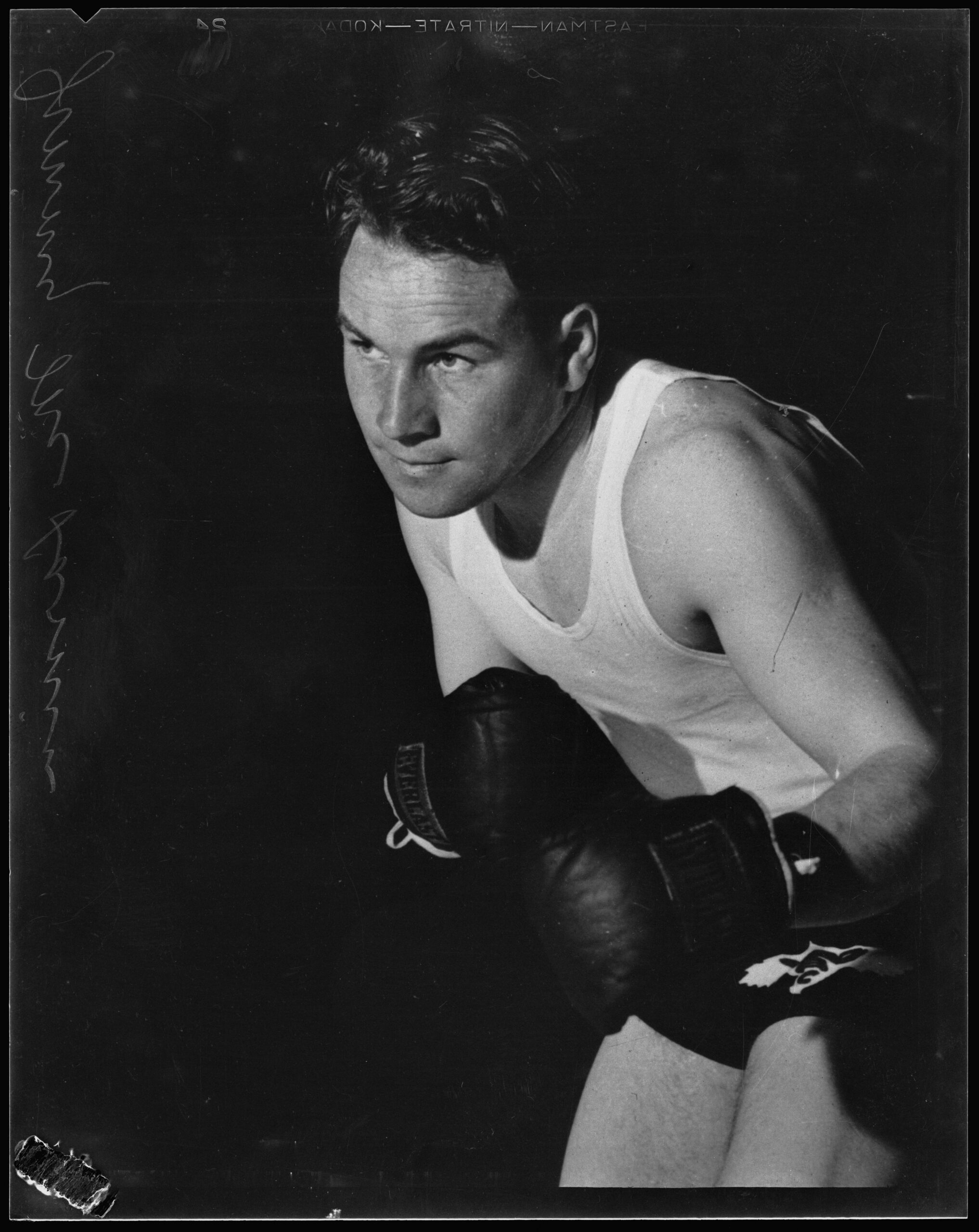


On the evening of May 29, 1933, Vancouver movie-house managers halted their feature presentations to announce that hometown hero Jimmy McLarnin had won the world welterweight boxing title. McLarnin’s victory was huge news. Boxing was among the top sports in North America, and the win helped boost his reputation as one of the world’s greatest fighters.
Unfortunately, few Canadians today are familiar with McLarnin’s remarkable ring exploits. In boxing’s golden age of the 1920s and 1930s, he took on the world’s top prizefighters and more than held his own. McLarnin is not only widely regarded as Canada’s greatest boxer, he is also ranked fifth all-time among welterweights by Ring magazine and second behind only Sugar Ray Robinson by the influential online boxing site BoxRec. He won 63 of 77 fights in his career and was never knocked out. Incredibly, his dance card included 13 former, future, or current world champions.
McLarnin was born near Belfast but was raised in Vancouver’s Strathcona district in a family of 12. He hawked newspapers as a boy to help the family make ends meet, fighting off other youths who tried to steal his prime corner at Main and Hastings. His unlikely rise to fistic fame began at age 13 when he hooked up with Charles “Pop” Foster, a part-time stevedore and former British prizefighter, who tutored McLarnin in a makeshift ring set up—by one account—in the basement of McLarnin’s father’s second-hand furniture store. After three years of training, and beating all the local talent, the pair sailed to San Francisco seeking bigger paydays. The 16-year-old McLarnin stood four feet 11 inches tall and weighed 105 pounds. Despite his diminutive size, the Vancouverite possessed a crushing right hand, fast footwork, a fiery spirit, and an iron jaw.
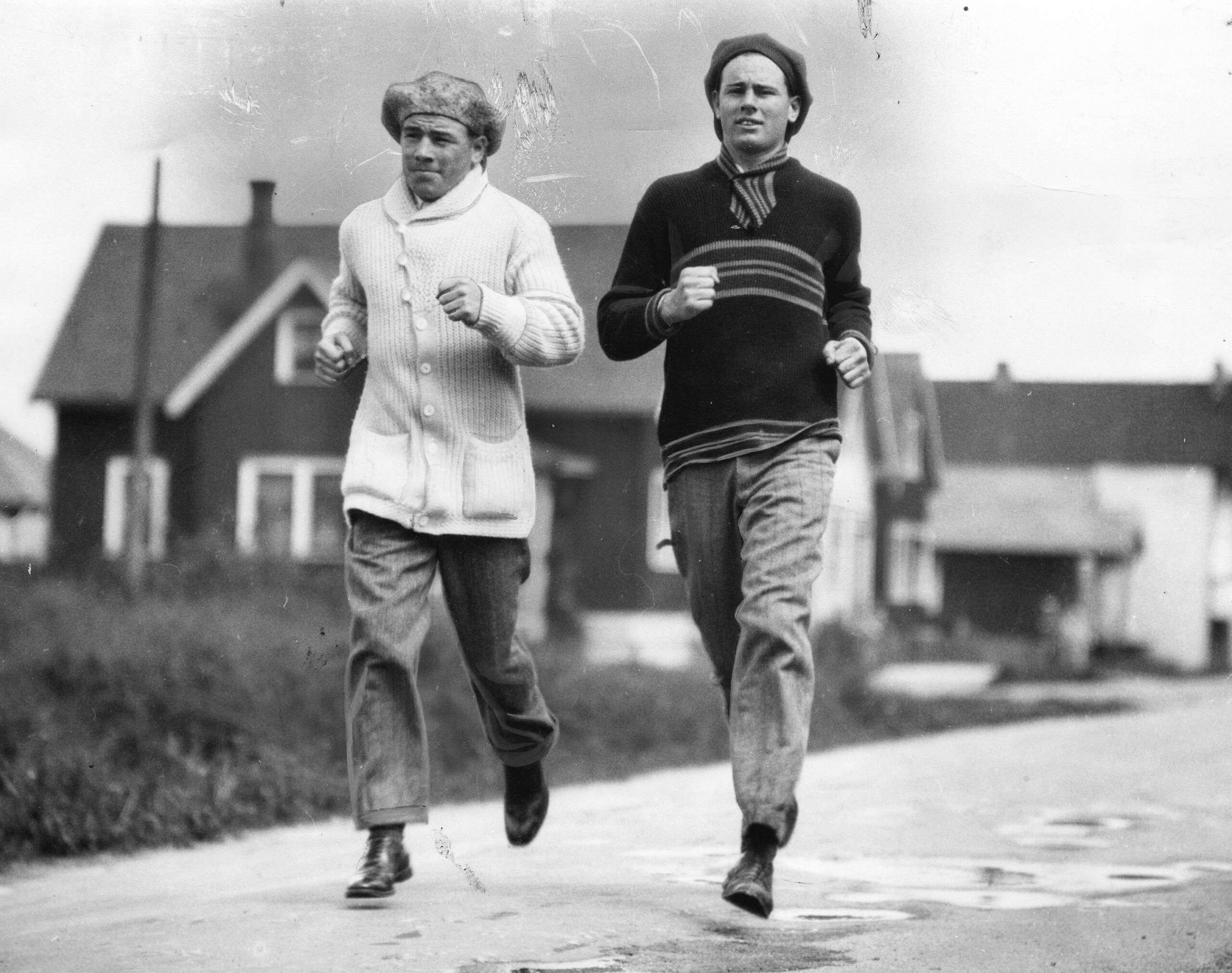
Welterweight Jimmy McLarnin in training with his brother Bob. Photograph attributed to Stuart Thomson, City of Vancouver archives.
Foster tried to pass McLarnin off as 18, but no one took him seriously. With his tiny charge standing beside him cap in hand, Foster told Frisco promoter Tommy Simpson he had a promising kid. Simpson replied, “Look, he doesn’t need a fight. He needs a nursemaid.”
Unable to land a fight, the two barely scraped by, living in a fleabag hotel in the Black section of Oakland while dining on boiled brussels sprouts and crabs that Foster trapped in San Francisco Bay. It was only after promoters saw McLarnin sparring with local fighters that they realized he was for real. The bouts started to come, and McLarnin reeled off 17 straight wins, attracting an avid following with his ferocious style, which earned him the moniker “the Baby-Faced Assassin.”
Setting their sights higher, the duo moved to Los Angeles, where McLarnin tangled with the top flyweights of the era. His vanquished foes included Fidel LaBarba, the 1924 flyweight Olympic champion, who McLarnin fought three times, winning the first and third encounter with a draw in between. He also defeated Jackie Fields, a rising star who had copped the 1924 Olympic gold medal in the lightweight division, and who would go on to win 70 fights in his career. They met at L.A.’s Olympic Auditorium, where McLarnin brutalized Fields with five knockdowns in two rounds, finally stiffening him with a vicious right cross. It marked the only time Fields was stopped in his 86-fight career. McLarnin scored an even more impressive victory by beating the great Filipino flyweight champion Pancho Villa in a nontitle bout, despite being pegged as a 10-1 underdog.
McLarnin was now a headliner and earning decent money. Fans and newspaper writers alike were charmed by his boyish looks and modest manners. He was also quick with a quip. “The only time he touched me,” he once said of an opponent, “was when we shook hands in the ring at the start of the fight.”
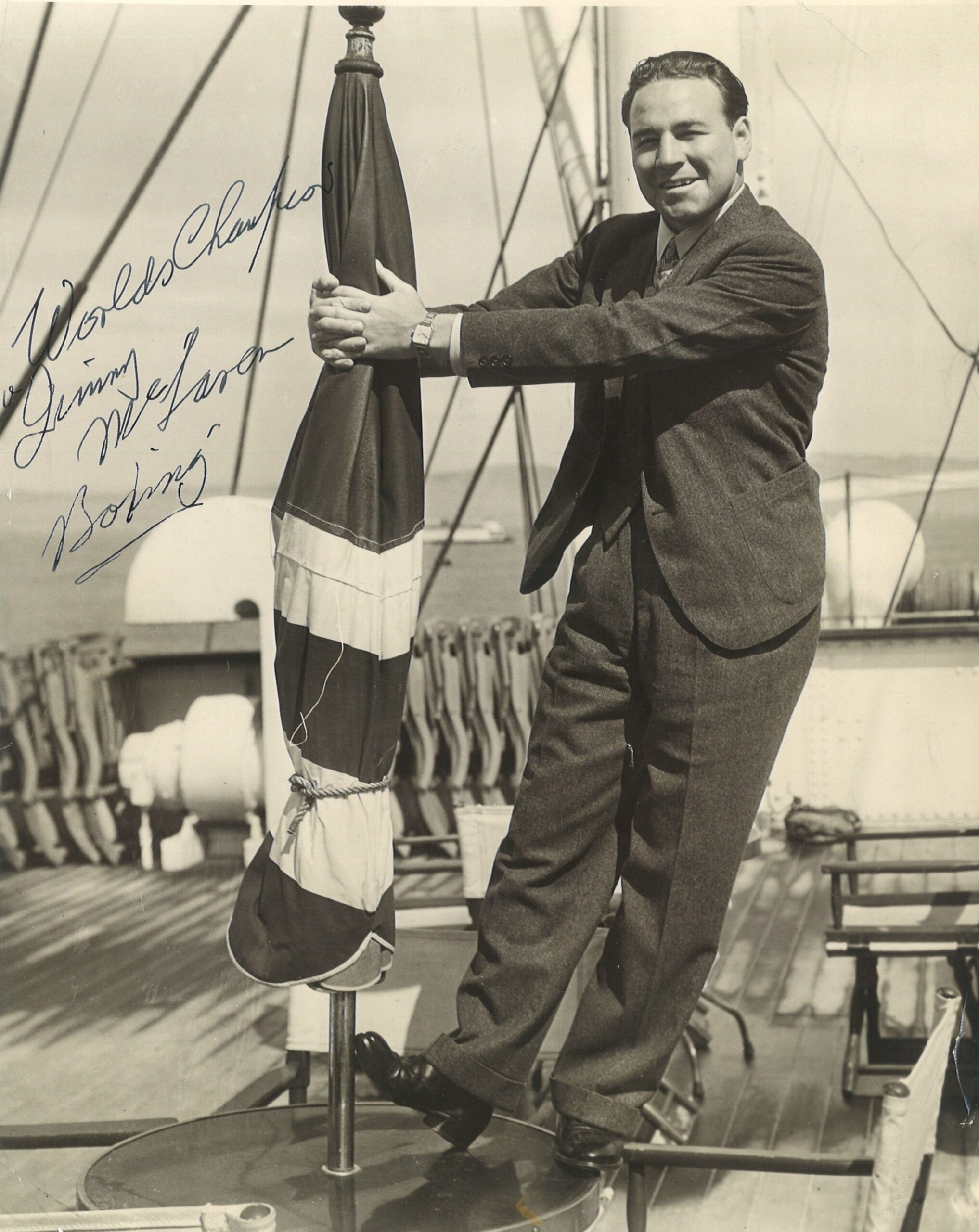
Courtesy of the BC Sports Hall of Fame.
In his 2014 biography of McLarnin, Fighters Should Be Gentlemen, author Des Corry notes that it was at this point that Foster and McLarnin began encountering a challenge that kept a world title out of their reach for several years. Promoters and managers liked matching their champions against McLarnin because he drew large crowds, but they didn’t want to lose their belt to a Canadian with an independent manager. And so McLarnin was awarded fights with champions, but only if he agreed to arrive at the official weigh-in a few pounds overweight, making the bout a nontitle affair.
By 1927, McLarnin had grown to five feet seven inches and 125 pounds and had moved up to the lightweight division, where he displayed knockout power that earned him another nickname—the “Irish Lullaby” because he put opponents to sleep. That year, McLarnin took a break and headed to Vancouver, where he reconnected with his family and began courting Lillian Cupit, a local lass.
In 1928, he travelled to Chicago to meet Louis “Kid” Kaplan, who had retired undefeated from the featherweight ranks and was now seeking a shot at the lightweight crown. Both men came in overweight, so it was not a title bout. Things did not start well for McLarnin. Kaplan’s first punch knocked him down and broke his jaw. The youngster struggled to his feet but could not keep Kaplan at bay and was floored repeatedly. After round three, Foster noted that Kaplan looked arm weary and suggested that McLarnin start throwing punches. His fighter mounted a stirring comeback, eventually flattening Kaplan in round eight.
McLarnin had now defeated the world flyweight, the world bantamweight, and the world featherweight champion but had not received an offer of a legitimate title fight. The pair headed east to New York, the mecca of boxing, to try to score the big one. Soon after arriving, Foster was informed that any fighter coming from the West had to pay a 10 per cent fee to an “Eastern representative” with solid mob and boxing connections. Back then, the “representative” was Owney “Killer” Madden, a cutthroat gangster who ran the liquor trade in New York and Chicago and owned the famous Cotton Club. Madden was Irish but had been born in Liverpool like Foster. In a remarkable bit of verbal creativity, Foster used this connection and McLarnin’s Irish heritage to induce Madden to drop his fee.
McLarnin’s first fight in the Big Apple was at Madison Square Garden against Sid Terris, the number three-ranked lightweight, a Jewish pugilist whose style and speed had electrified Eastern fans and earned him the nickname the “Ghost of the Ghetto.” The Irish versus Jewish theme was common in boxing during this era, especially prevalent in New York. McLarnin sent the Irish fans into a frenzy when he caught Terris with a hard overhand right and put him away at one minute and 36 seconds of the first round. He celebrated the win with his trademark handspring.
The victory fetched McLarnin a title shot with Sammy Mandell (Salvatore Mandala), a smooth technician with a solid punch, who had held the lightweight crown for five years and would log an incredible 191 fights during his career. In a bout at New York’s Polo Grounds, Mandell retained his title, beating McLarnin on points. McLarnin’s downfall was his struggle to make the 135-pound weight limit. The effort drained him and sapped him of his punching power. McLarnin would later soundly thump Mandell twice, but not for the title.
McLarnin, still growing, moved up to welterweight, where he clashed with the best boxers in the division, winning most of the tilts. In 1932, he thrashed the legendary Benny Leonard, which led to a fight for the welterweight crown at L.A.’s Wrigley Field with Young Corbett III, a name adopted by a muscular Italian named Ralph Giordano.
Corbett’s handlers felt he would make quick work of McLarnin, but the Irish Lullaby caught Corbett with a sneaky left hook in the first round and dropped him to the canvas. When he got up, McLarnin floored him again, and when he rose again McLarnin renewed his attack until the ref ended the slaughter after two minutes and 37 seconds.
After the victory, McLarnin visited Vancouver, where he received a police escort in from the border and was presented with the key to the city by the mayor. He then took a year off boxing, travelling and enjoying the high life.
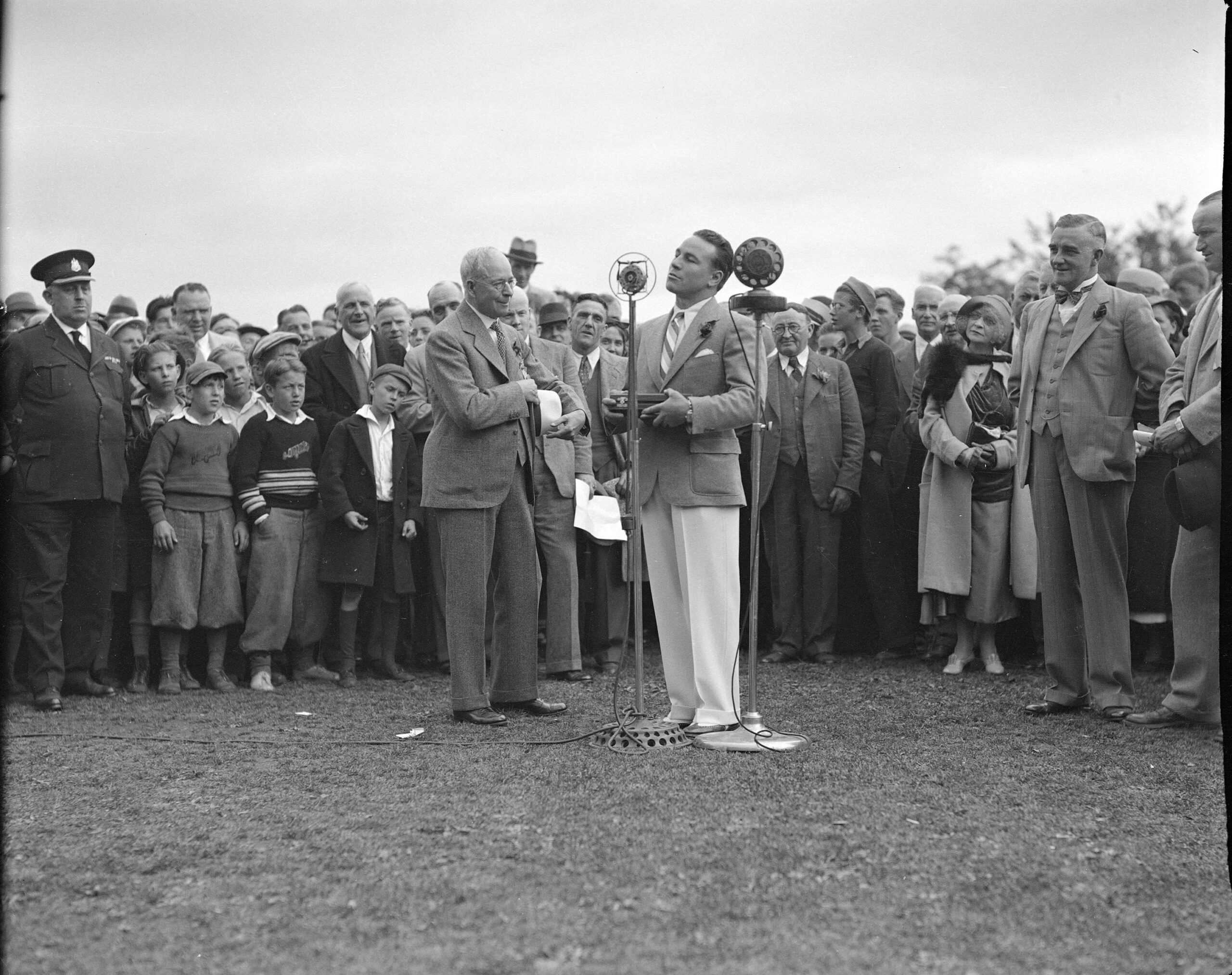
Jimmy McLarnin receiving key to the city from mayor L.D. Taylor during police sports. Photograph attributed to Stuart Thomson, City of Vancouver archives.
His first title defence came against Barney Ross, a renowned Jewish warrior who held the lightweight and junior welterweight belts. Ross, whose real name was Dov-Ber Rosofsky, had an early ambition to become a Talmudic scholar, but his life and attitude changed after his father was murdered in a Chicago robbery that left the family penniless. Ross joined teenage gangs and worked as a money-runner for mobster Al Capone before turning to boxing, where he excelled.
The two champions met on May 28, 1934 at the Madison Square Garden Bowl, an outdoor venue in Queens, before 60,000 excited fans. McLarnin’s decision to take a year off cost him: he was rusty, and he dropped a 15-round decision to Ross. Four months later, McLarnin regained the title in a hard-fought battle. They collided a third time the next year when Ross won a contentious decision in a savage slugfest. The 45 rounds they fought in the three title bouts drew 125,000 fans at the height of the Depression and earned McLarnin $150,000 (more than $3 million in today’s dollars).
McLarnin only fought three more times after losing the title. He split two bouts with the great Tony Canzoneri, another three-division champion, and then handily won a 10-round decision over lightweight champ Lou Ambers in a nontitle bout.
Then, at the urging of his manager, McLarnin retired. He left the game at 29, with his grey matter intact and a healthy bank account. Despite several tempting offers, McLarnin resisted the urge for a comeback. Instead, he married his childhood sweetheart, Lillian Cupit, opened a successful machine shop, pursued golf and acting, hobnobbed with Bing Crosby, Bob Hope, Humphrey Bogart, and other Hollywood stars, and raised a family. When Pop Foster died in 1956, he left McLarnin two-thirds of an estate estimated at $200,000. Most of the remainder went to the four McLarnin children. Unlike so many other boxers, there would be no sad unravelling.
After his wife died in 1985, McLarnin moved to western Washington to be close to his children. He lived out the rest of his days untroubled by regret, finally passing away at age 96. He was buried at Forest Lawn Memorial Park cemetary in Glendale, California, between the graves of his wife and his manager. The inscription on his gravestone reads “Champ To All.”
Read more community stories.