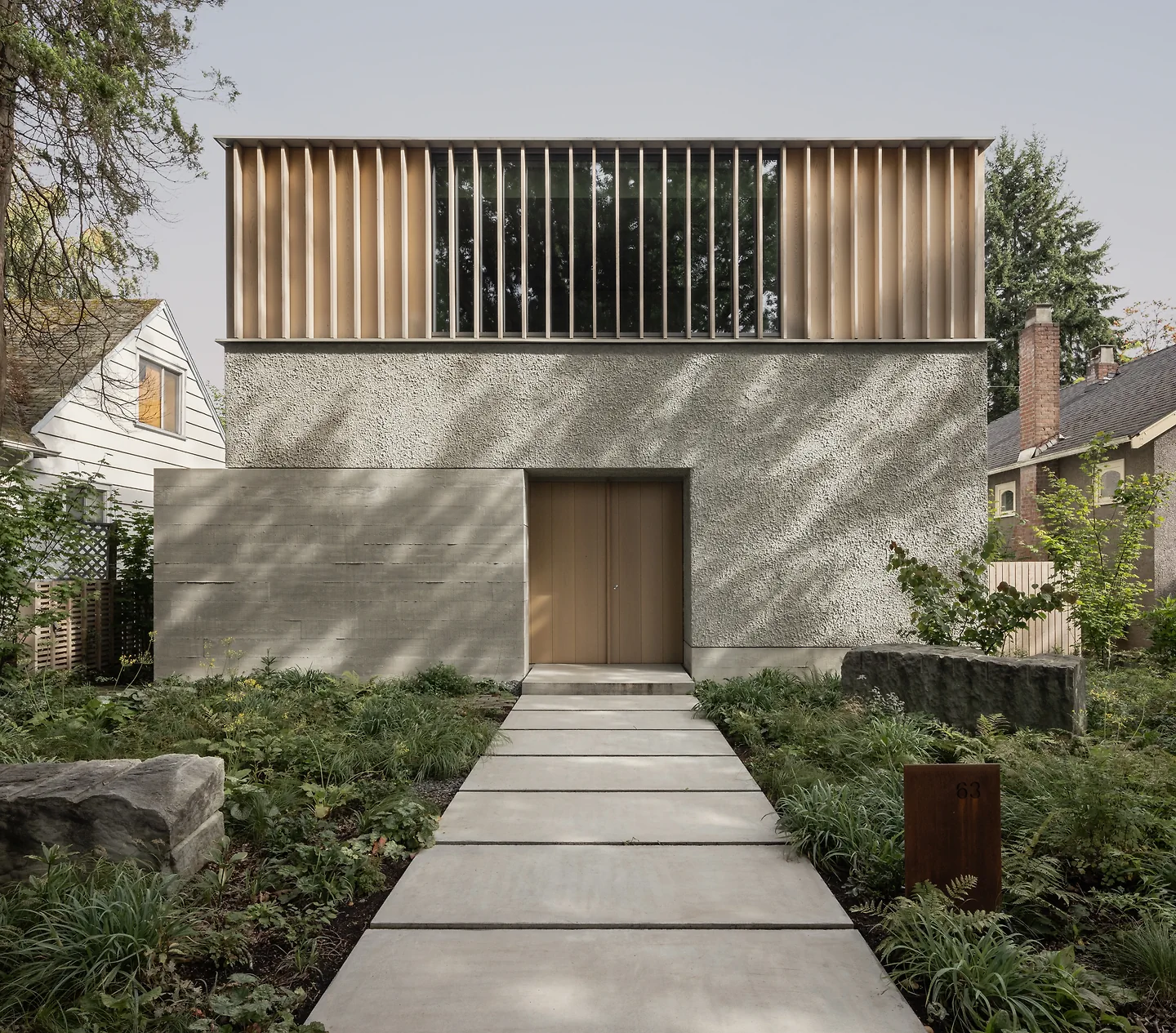


“The clients have heard all kinds of crazy comments. You know, people walk by, and they’re like, ‘Oh my gosh, this is a house for blind people’—preposterous things,” admits Michael Leckie, principal architect at Leckie Studio.
Despite its humble façade, Lantern House’s exterior is a controversial subject, with random passersby assuming it’s a windowless concrete box. The fact is, there has been plenty of opportunity for anyone and everyone to pass judgement on this striking home and its wooden-screen crown: Lantern House is firmly in the design spotlight. Accolades have rolled in from Architectural Record, Architecture MasterPrize, the World Architecture Festival, and Canadian Interiors, to name a few. For a home that was designed with privacy in mind, it’s a lot of buzz. It’s an irony that’s not lost on architect Leckie or on his client (who, appropriately, elected to remain anonymous).
“Living in a beautiful, tight-knit neighbourhood is great, and we did love the idea of feeling a connection with the nature around us,” the homeowner says, “but not necessarily staring directly into our neighbour’s windows.” The houses on this typical Vancouver oak-tree-lined street sit quite close together, so it can be difficult to design a home that lets in natural light without also letting in the gaze of any curious onlookers. But obviously, the team at Leckie Studio didn’t simply reject the concept of windows altogether.
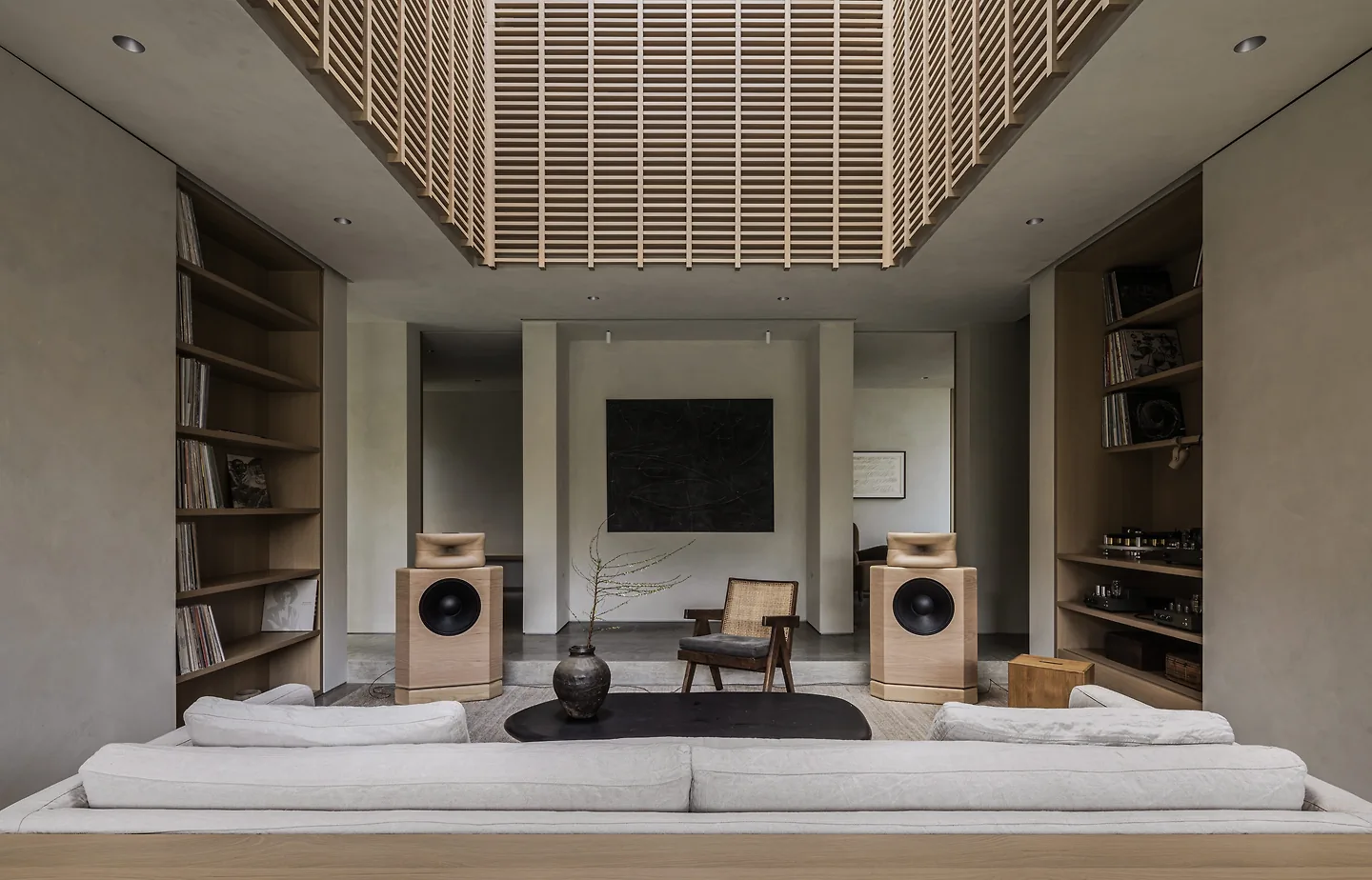
To get precise sound—the highest fidelity—the speakers are free-standing and conspicuous.
The bright idea? A towering central wooden lattice that opens to a mesmerizing 10-foot-square skylight. On clear days, sunshine pours in, making its way down to the first-floor living room undisturbed. On grey days, one can lounge on the sofa and watch the clouds drift by directly overhead. “It’s a light tunnel, essentially, almost reminiscent of an art installation,” the homeowner says. The wooden screen continues on the building’s exterior, hiding the large window facing the street and looking out to the stunning canopy of 30-metre oak trees. Leckie says it’s tragic to use expansive glass and then cover it with curtains for privacy. Lantern House’s wooden grid shields the occupants without obscuring the view to the outside.
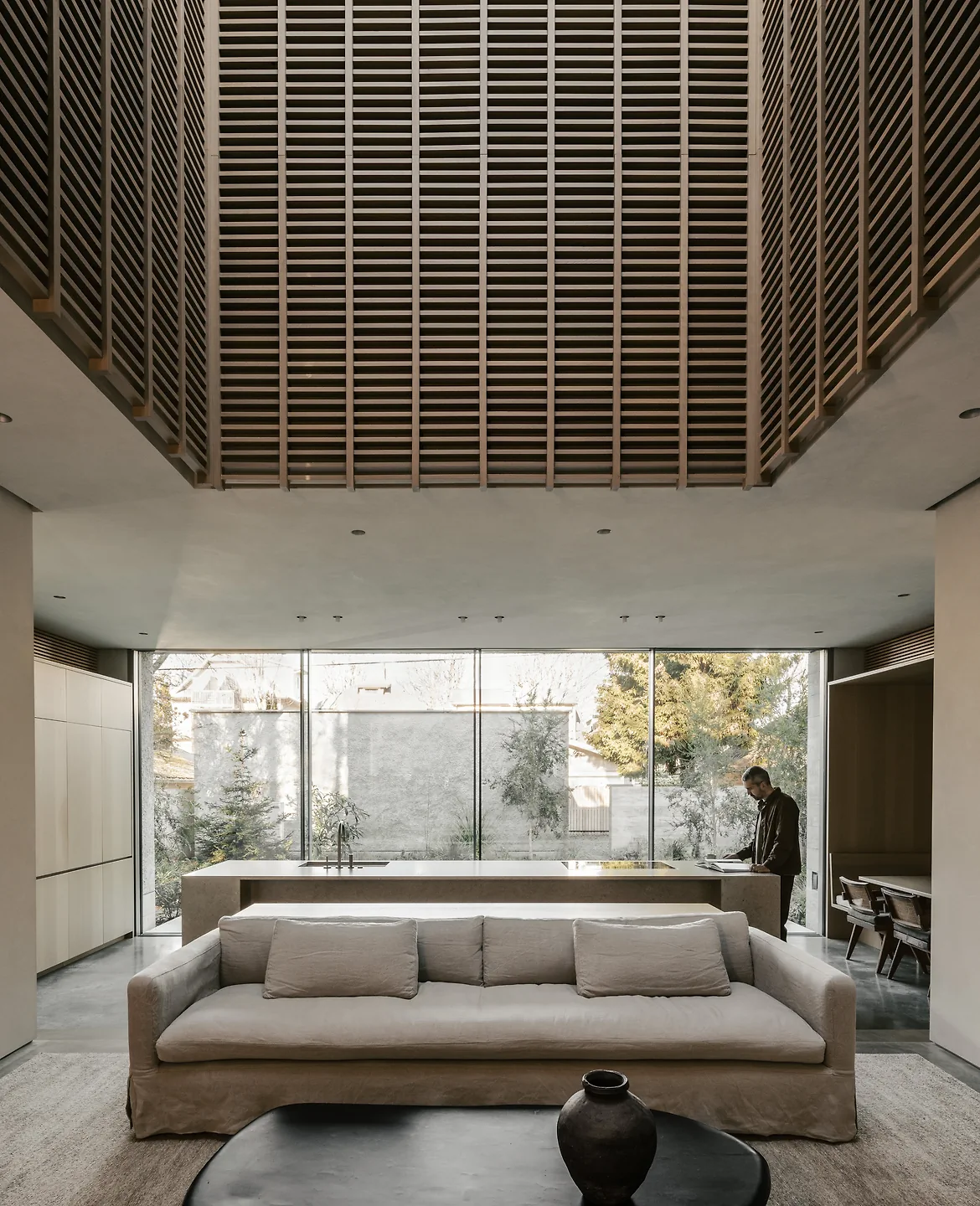
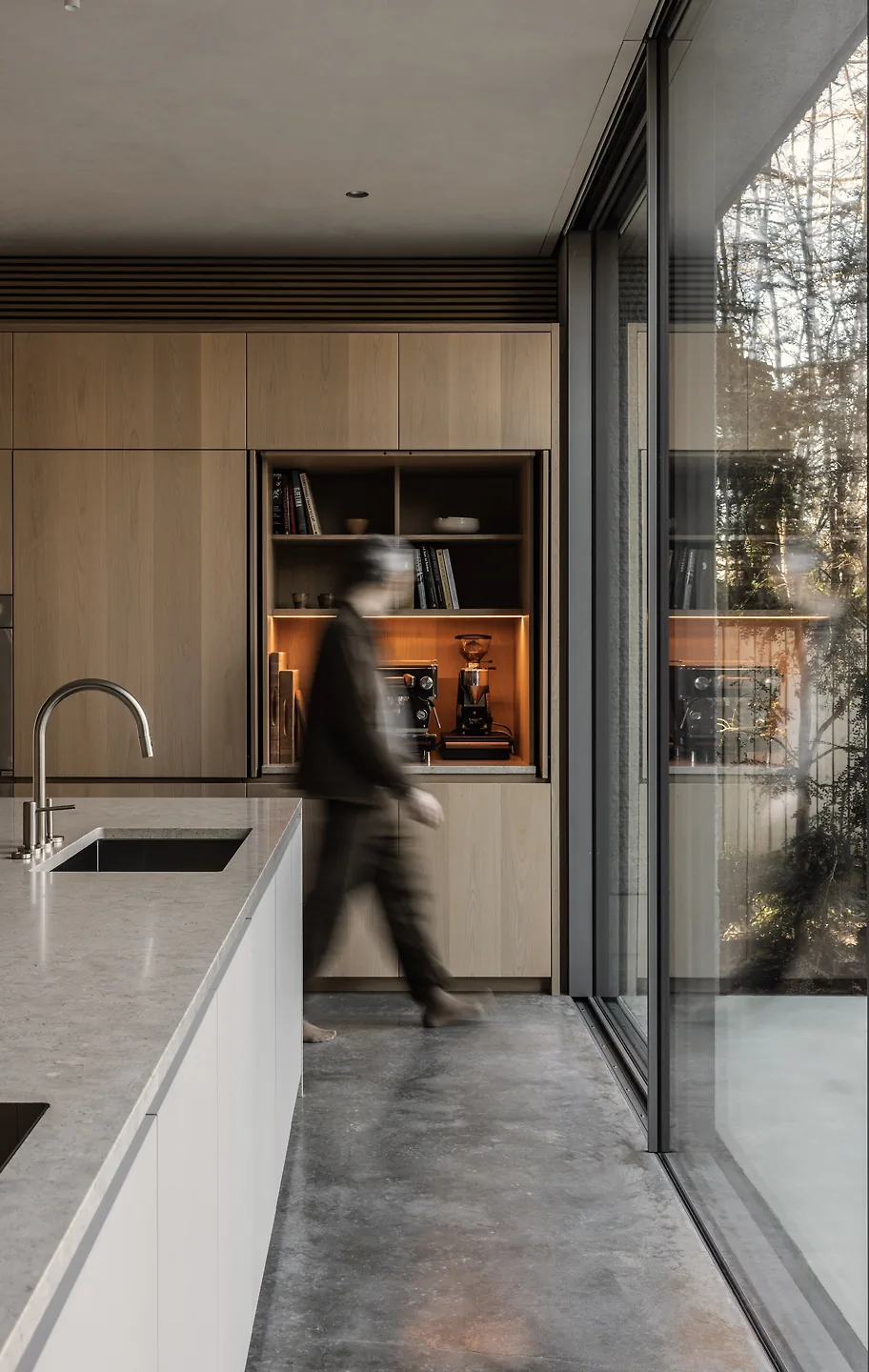
The “lantern” is inarguably unique and a testament to the bond that evolved between the homeowner and the designer. “The client-architect relationship is entirely built on trust,” Leckie says, adding that he and the homeowner first found a connection over a love of high-fidelity music. In response, the lower level of the house is designed to be the ultimate listening room, with a prominent sound system that acts as furniture in the meticulous space. Much of the home’s technology and appliances is integrated (the entire kitchen is near-seamless oak, and the drop-down movie screen is tucked away when not in use), but not the speakers. Leckie says one of the things he loves about the homeowner is that he is so focused on not just the aesthetic aspect of things but also the functional and performative aspect: “If the speakers had been built-in, they wouldn’t have functioned the way that he wanted.”
To get precise sound—the highest fidelity—the speakers are free-standing and conspicuous. Open built-in shelving displays favourite records. But other than furniture and albums, the interior is purposely sparse: it allows for a meditation on material that more maximalist spaces might lack. The natural concrete floor echoes the home’s exterior, and the light-oak millwork gives the home an organic, dynamic feel. The central wooden screen is the wow factor, but the drywall is limewashed to bring in a more subtle personality and warmth. “It breathes this imperfection into the space,” says the homeowner, who stresses that the goal was to eschew the more sterile aspects of modernity and minimalism. Belgian influences and architecture inspired much of the material palette.
“The higher the ambition of the client, the more successful the project can be.”—Michael Leckie
The kitchen opens to the backyard with wall-to-wall windows, another light-drenched element that street viewers would never suspect thanks to the site’s sloped topography. The homeowner opted out of a formal dining room, and instead, a generous breakfast nook hosts family meals. The island is about 16 feet long, so there is plenty of room for prep—and since it’s all in the same room as the hi-fi setup, even the most mundane kitchen activities can have their own top-quality soundtrack.
The lack of a basement also sets this home apart from its neighbours. Leckie explains that many Vancouverites are obsessed with square footage (understandably, when it’s become normalized for a built-in rental unit to support monthly mortgage payments)—but he often encourages his clients to stay above ground: “A basement is the least desirable square footage and the most expensive floor area to build.” He believes that if homeowners aren’t planning to use the space to supplement income, digging a basement usually isn’t the best use of their budget. So the natural end to the lantern’s light tunnel is that multifunctional ground floor. “It’s an approach that is counterintuitive to many,” Leckie notes. “I always encourage a client to build less square footage but build it better.”
While the lowest level is made for communal living, the rest of the home offers seclusion. “The entire base floor is very open and spreads from one end to the next, which I think sometimes betrays the fact that upstairs is quite compartmentalized,” the homeowner says. The house is essentially a grid made up of nine squares (with the middle column negative space), and the upper areas allow the family quieter, more solitary moments. There’s a library where they can settle in and read, and cozy bedrooms each with its own distinct daily light show, thanks to the way the sunshine filters through the oak lattice.
Even the bathrooms have a natural-light strategy. The primary ensuite, for example, is a deliberately moody, meditative space. The monochromatic palette gives it a spa-like vibe, with walls covered in waterproof charcoal plaster and a shou sugi ban (Japanese burnt wood) ceiling. But to keep it from being wholly dark, the Leckie Studio team designed a recessed skylight above the shower that gently diffuses light into the room below. At the end of particularly stressful days, it is a beautiful spot to retreat and relax. “It’s an incredible bathing experience that transports you, essentially, to a completely different space,” the homeowner says.
Much of the home feels like a gallery, with pieces not hanging on walls but serving daily functions on the floor. “Their art collection is primarily objects—so industrial objects, furniture, sculpture,” Leckie says. The downstairs living space has an original Pierre Jeanneret armchair from the 1950s. Immediately in front of that is an Axel Vervoordt Floating Stone coffee table (each starts with a chalk outline drawn by the iconic Belgian designer himself, then is hand-hewn into its final shape, the homeowner notes). There’s an early Zig-Zag chair by Dutch designer Gerrit Rietveld, an angled stool by French designer Pierre Chapo, and a timeless GA chair dreamed up in Sweden by Gunnar Asplund in the 1930s. The art you can’t sit on includes handmade ceramics and a Shōwa-period Japanese tansu chest. “I was very passionate about finding the right pieces that had a bit of history and life,” the homeowner explains.
It’s an interior design ethos that any architect would admire, and another reason the two were the ideal pair for this project. They were heavily aligned on the privacy aspect, too, personally and professionally. Now in the second decade of his eponymous studio’s work, Leckie says that some of his other projects have garnered lots of attention from the street, which can be disconcerting to clients. “This house was a little bit of a response to that phenomenon,” he admits.
“The higher the ambition of the client, the more successful the project can be,” he adds. Lantern House may be polarizing in the public eye. But regardless of whether strangers stop and stare or hardly notice it, regardless of the awards and attention the home gets in the media, it remains a beautiful, light-filled haven for the only people whose opinions truly matter. “We aren’t living in a concrete structure,” the homeowner says. “This is a very warm and cozy family home.”
Read more from our Spring 2026 issue.