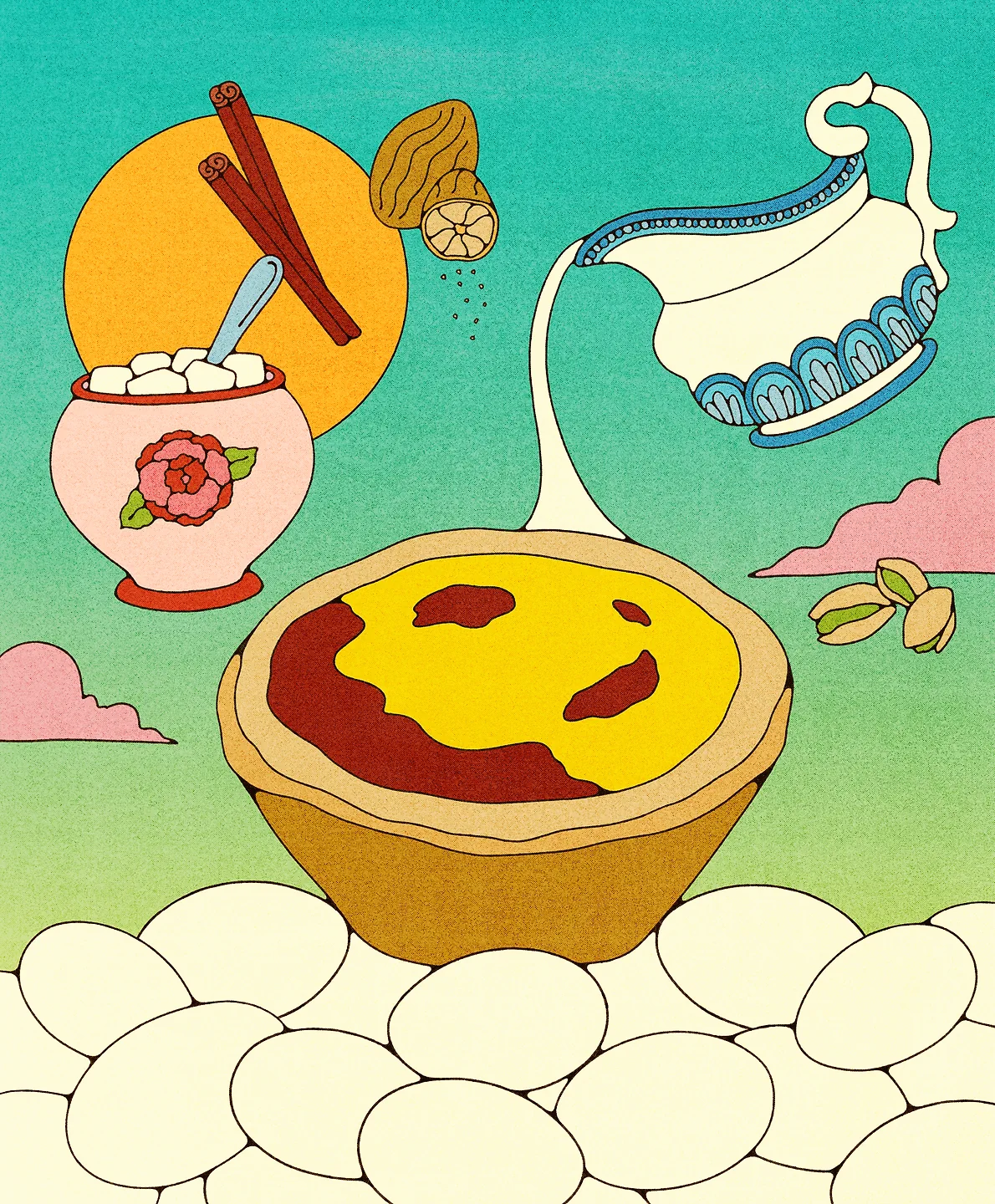


The scent wafting from the bakery intoxicating: a decadent mix of sugar and cream. Inside, dozens of egg tarts—round, caramelized, gleaming—are waiting for the taking. The shell is tender and crunchy—puff pastry with a bit more chew than expected. The filling, meanwhile, is a creamy, egg-forward custard that is sweet but not overly so. Here, in 1989, at the original location of Lord Stow’s Bakery in Coloane Village, the Macau egg tart was invented by a British man named Andrew Stow.
But the true origins of the popular treat can be traced back much further, combining centuries of influence from both the British and the Portuguese.
The custard tart, as the English call it, goes back at least to the Middle Ages, when the Anglo-Normans ruled. (Though some food historians say that the egg tart is so ubiquitous across Europe that no one culture or nation can claim it as its own.) Back then, they were called doucettes or darioles—a version was even served at the coronation banquet for King Henry IV in 1399. The earliest written mention of the English custard tart can be found in a 1390 cookbook called Forme of Cury. In it, a recipe for a dessert called daryols includes the familiar cream and eggs along with sugar, saffron, and salt baked in a coffyn: a crust that was most likely inedible and instead used as a serving container for the sweetness within. Today, England’s custard tart involves a shortcrust dough made of flour, butter, and egg, resembling a thin shortbread or pie crust. It’s filled with a set custard made from eggs, milk, sugar, and cream, and then baked and topped with a sprinkling of nutmeg.
While the original daan tat predates the Macau egg tart, the shortcrust dough used in the contemporary Cantonese version actually has a bit of Macanese influence.
Then there is the Portuguese egg tart—called a pastel de nata—that originated, like much of the country’s baking, in a monastery. Before the 18th century, monks at Lisbon’s Jerónimos Monastery in the parish of Santa Maria de Belém used egg whites to starch their habits, which left them with excess egg yolks. They turned them into their own version of a custard, mixed with milk, sugar, wheat flour, and cornflour, which they put in a puff pastry (a more involved process involving folds of dough and butter to create flaky layers). The custard caramelized beautifully in the oven, giving it a burnt, blistered look and signature rich flavour. Cinnamon was, and still is, often sprinkled on top as a final flourish.
The egg tart first made its way to China in the 1920s, when British businessmen brought the treat with them to Guangzhou (then called Canton). Local bakers tried to replicate the recipes using their own ingredients and techniques, resulting in the Cantonese-style egg tart known as daan tat (the word tat is itself a Chinese loanword from the English “tart”). While the British tart was modernized with the use of custard powder, Cantonese chefs without access to that innovation used all fresh ingredients. They also eschewed shortcrust in favour of a puff pastry that was commonly found in dim sum dishes. (Later, a shortcrust version was developed in China, allowing sweet-toothed locals to choose their preferred daan tat.)
“There are two types of dough that are usually made,” confirms Ken Harper, a traditional Macanese chef and culinary expert in residence for the Lusitano Club of California, which preserves and celebrates Macanese history and culture. “There’s one version where it’s a cookie-crust dough, and then there’s another version where it’s sort of a puff pastry dough.”
He adds that in modern times, “you see that same variation in Lisbon, as well.” Harper’s family heritage dates back to both Macau and Hong Kong; his great-grandmother operated a Macanese bakery in Kowloon from approximately the 1920s to the Second World War. And while the original daan tat predates the Macau egg tart, Harper says that the shortcrust dough used in the contemporary Cantonese version actually has a bit of Macanese influence.
“That cookie-crust dough that they use is very close to the Macanese empada dough, which is our Christmas pie,” he says. “It’s different than other European pie doughs because of the introduction of sugar and egg yolks.”
After the Second World War, Cantonese residents migrated to Hong Kong, which was a British colony until 1997, when it became a Chinese Special Administrative Region. It was there that the Chinese version of the tart was perfected and then proliferated throughout Asia. Nowadays it’s a popular dessert at dim sum restaurants, and it’s hard to find a Chinese bakery—far away in Hong Kong or at home in Vancouver—without its own version.
An excellent rendition can be found at Hong Kong’s Kee Wah Bakery, which opened in 1938. It began as a modest neighbourhood grocery store, but its founder, Wong Yip Wing, was forced to close the business during the Second World War, when the Japanese invaded. Ever resourceful, he made an oven out of an old barrel and sold sugar cakes and other delicacies. Today the bakery, which has multiple locations, is one of the most beloved and oldest family-owned bakeries in Hong Kong. Meanwhile, at the more contemporary Hong Kong chain Bakehouse, the daan tat has been modernized, incorporating a sourdough puff pastry shell around its vividly yellow centre.
And over in Macau, bakeries are continuously introducing new variations, such as a currently trendy rendition that is flavoured with pistachio. At The St. Regis Macao’s cocktail bar, a drink called the Macau Egg Tart uses dark rum, caramel, advocaat, and condensed milk to create a liquid version of the pastry.
But it’s the classic Lord Stow’s tart that remains the favourite, despite its existence relying on a happy accident. While Stow knew he wanted to have a Portuguese pastel de nata on his menu, in acknowledgement of Macau’s Portuguese colonial history, he didn’t have a recipe. After multiple attempts, he swapped the flour in the custard for fresh cream, and margarine instead of butter in his puff pastry. The result is a tart shell with a satisfying level of crunch and a filling that is less sweet and more eggy.
After they divorced, Stow’s ex-wife Margaret Wong set up her own bakery in Macau, called Margaret’s Café e Nata. She even sold her recipe to KFC, which now has egg tarts on its menus across China.
Many versions of the egg tart exist in Vancouver, too, each with its own dedicated following. At East Vancouver’s Union Market, locals can find a decadent pastel de nata—the café’s signature dessert. A perfectly sweet custard with a hint of vanilla and an alluringly brown top is wrapped in a crunchy, flaky puff pastry exterior. Over in Chinatown, Sun Fresh Bakery tops its eggy custard daan tat with a thin, elegant layer of jelly, which adds more texture than it does flavour (as well as aesthetic appeal), sitting pretty inside a dark, flaky shortcrust-style shell. In Gastown, Casa de Nata serves up traditional Portuguese custard tarts alongside seasonal and creative versions, including the on-trend pistachio flavour.
In Macau, to differentiate their egg tart from the Cantonese version, locals call it a po tat (for “Portuguese tart”). It’s become such an important symbol of Macau that it is listed as a piece of the region’s Intangible Cultural Heritage. As Harper notes, “Lord Stow’s seems almost like a cross between the Lisbon and dim sum style.”
Read more from our Spring 2026 issue.