

月落乌啼霜满天
江枫渔火对愁眠
姑苏城外寒山寺
夜半钟声到客船
The moon falls, crows cry, frost fills the sky;
Riverside maples, fishing lights, face my sorrow, awake I lie.
Beyond the walls of Gusu, from Cold Mountain Temple,
At midnight comes the bell, reaching the traveller’s vessel.
—Zhang Ji, “Night Mooring at Maple Bridge” (circa 755 AD)
I grew up in Shanghai in the late 1970s and early ’80s. There was no television, no internet, but we had poetry. Every child I knew could recite from the Three Hundred Tang Poems before school age. Not because we were prodigies—poetry was simply in the air, in our mothers’ mouths, in the way old people on the street would recite some lines to fill a silence.
Every evening before dinner, my mother would make me recite a poem like Zhang Ji’s “Night Mooring at Maple Bridge” in our kitchen while she was cooking. I was five. I had no idea what the poems meant, and my mother never explained. She had only one rule—recite the way a real poet would. Which meant rhythm: the falling and rising, the stopping and flowing, the breath that knows where to break and where to hold.
“Louder,” she’d always say. “Like you are singing.”
So I did. Perhaps I wanted to make my mother happy, or perhaps I liked how the words sounded in my mouth. After a while my voice knew where to rise and fall: on the word for moon, on the word for bell, on the pause between the temple and the vessel. That rhythm got into my bones before I learned reading or writing. A poem lived in the mouth before it ever reached the mind.
Then, at 10, came English.
I found it a peculiar language. The word “friend” has “end” in it—do you want to be friends or end the friendship? “Believe” has “lie” in the middle, which made me question if I should believe. “Woman” has “man” in it, as if she couldn’t exist without him. When we asked our English teacher, she told us to stop asking questions and memorize.
But English was hard to memorize. It had no rhythm our tongues could trust. So we did what children do—we became resourceful and slightly criminal. We wrote Chinese characters beneath the English words to capture their sounds.
“English” became 阴沟流水 ditch water flowing. The characters were chosen for sound alone: yin-gou-liu-shui mimics “English.” But the meaning! Every time I said the word, I saw a brown stream rushing down a Shanghai alley. Was this beautiful? Not remotely. Was it unforgettable? Absolutely.
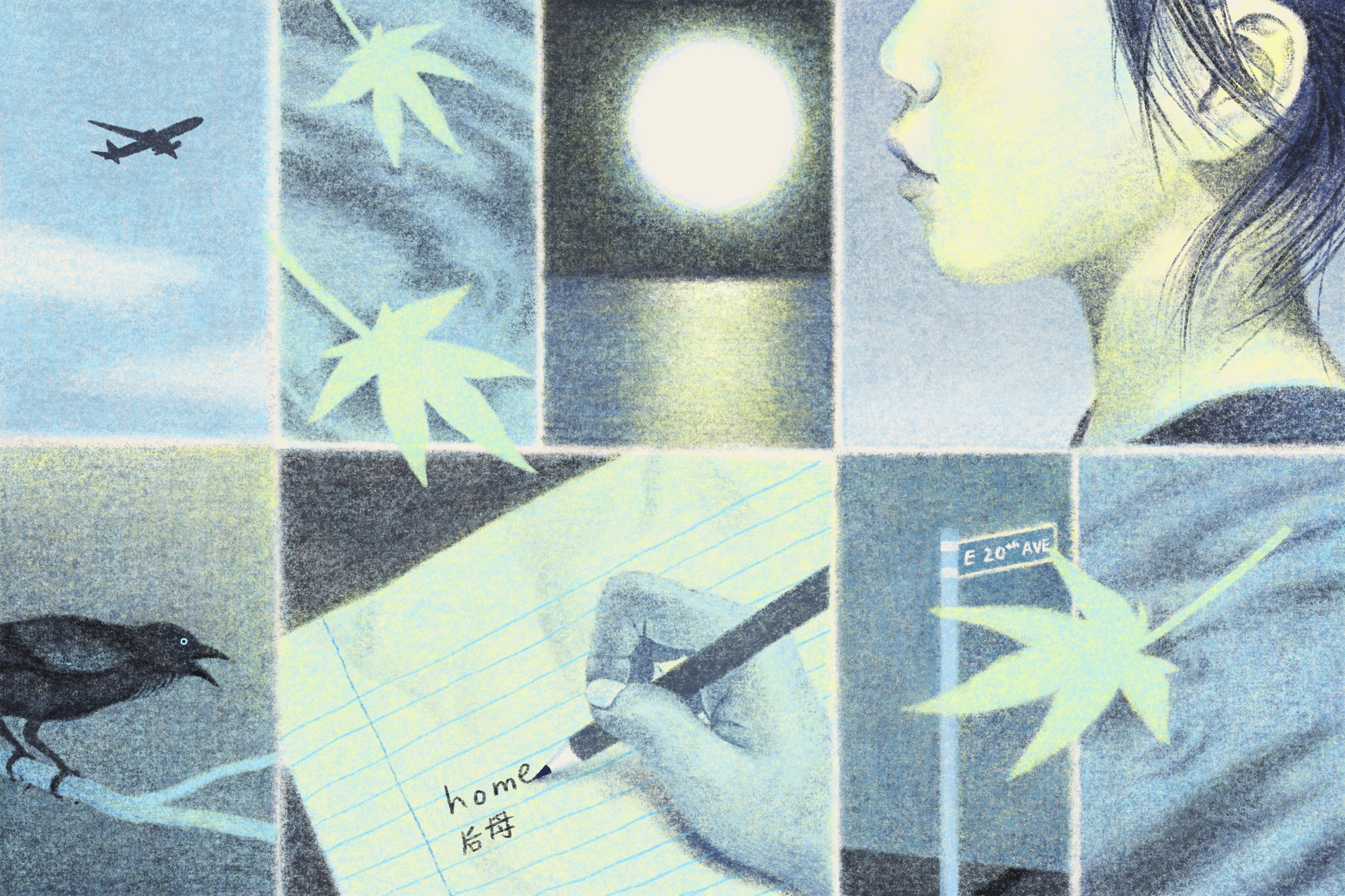
“Ambulance” became 俺不能死 I cannot die, the thought occupying every person inside an ambulance. “Home” became 后母 stepmother. Why should home be a stepmother? There were plenty of speculative theories, which is why I never forgot it.
That was how we learned English: through the ditch, the laughter, and the mild catastrophe of announcing “I eat lice for dinner” instead of “rice.” We shoved Chinese characters into English words. The fit was bad. The fit was glorious. And I had no idea that was already the act of making poetry.
I left Shanghai at 19. First America, then Canada. Two decades in Vancouver now. Somewhere along the way I started writing poems in English and discovered something unexpected: everything I thought was a disadvantage turned out to be exactly what poetry wants.
A native speaker learns a word as a child and never looks at it again. It becomes invisible, like furniture. But English has never become invisible to me. I still see the “end” inside “friend,” the “lie” inside “believe.” A poet’s job is to make ordinary language visible again, and I was doing that before I knew there was a name for it.
Chinese did not leave me when I crossed the ocean. The character for “bright” is 明—the sun and the moon standing side by side, two lights together. The same character means “tomorrow”—the promise that both will return. When I write “bright” in English, that character hums behind it, giving the word a weight it does not carry alone. A monolingual poet has one image at a time. I have two palettes, which means I can paint in more colours and spaces.
What lives in that space? Friction. Astonishment. Every translation is also a betrayal, and every betrayal leaves something behind. When a native English speaker writes “home,” they feel warmth or heaviness or longing. But when I write “home,” I also hear that 10-year-old in Shanghai who memorized it as 后母—stepmother. That is another layer, demanding to be felt. A writer with one language has Clarity. A writer with two has Collision. And I have learned that good poetry happens exactly where collision happens.
The moon fell in Zhang Ji’s poem. But the night did not fall silent. He saw the maples, the fishing lights. He heard the bell. That is what loss teaches you: when one thing falls, something else becomes visible.
It took me a long time to understand what this had to do with me. When I left Shanghai at 19, I felt my moon had fallen too. I lost the roof of my mother tongue. I lost the language I could speak without thinking. I lost that five-year-old girl who used to recite poems loudly in my mother’s kitchen. My moon fell straight into the ditch and disappeared.
But then—in those English words I had “mislearned” as a child—I began to see something again. The silhouette of the maples. The fishing lights, flickering in and out of sight. Once in a while, faintly, the distant bell arrives at midnight. And when I look into the ditch, I find moon’s reflection—
Broken, rippling, bright.
Still mine.
Read more from our Summer 2026 issue.