

He’d been around the world and studied far and wide—from New York to Japan and beyond—but something significant happened when Takao Tanabe returned to B.C. in 1980. “When he started painting the West Coast subject matter again,” says Audain Art Museum curator Kiriko Watanabe, “it feels to me that he found his happy place.” Those images form the climax to Takao Tanabe 100: Inside Passage, possibly the most comprehensive exhibition of Tanabe’s work ever assembled, commemorating the man’s 100th birthday in September (he’s still with us) and encompassing a career that stretches back more than seven decades.
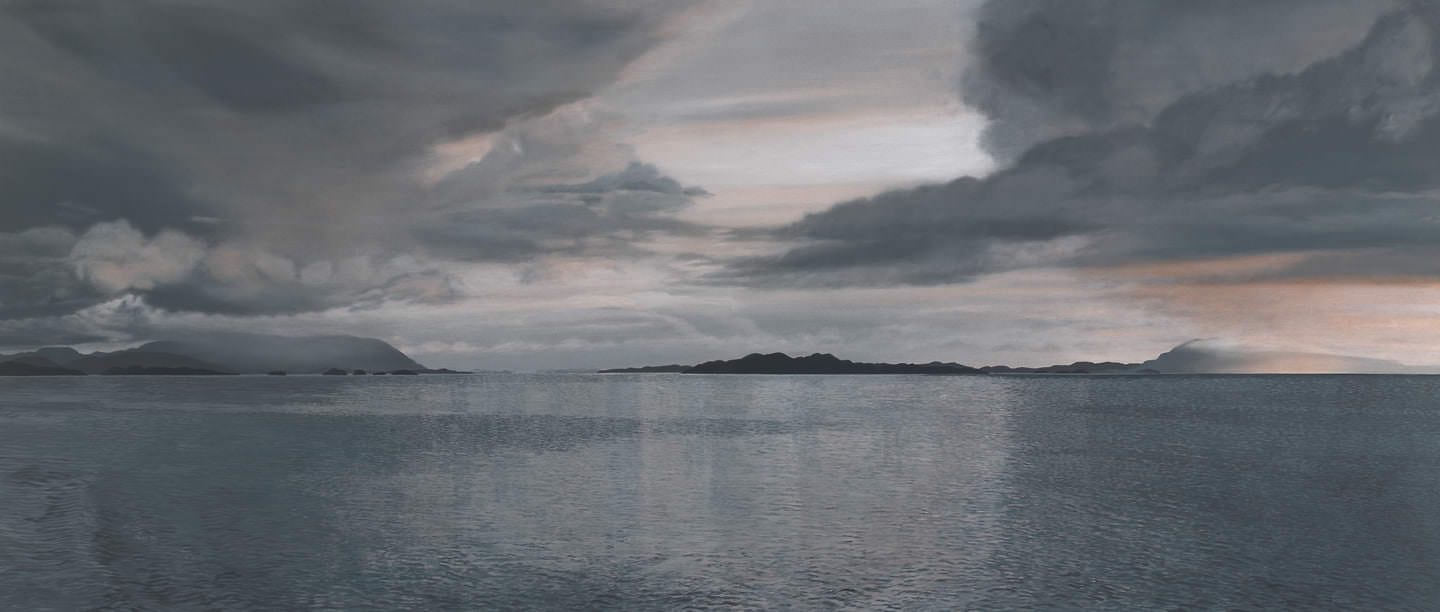
Tanabe’s time in Banff in the ’70s had already yielded his masterful Prairie landscapes, typified by moody efforts such as the astonishing Prairie Hills 10/78 (1978). But the work that proceeded upon his return to his home province—he was born in 1926 in the tiny fishing hamlet of Seal Cove, B.C.—marks the advent of the late style most strongly associated with the artist, in which infinite stretches of water and imposing land masses are captured somewhere between realism and a hazy, somewhat melancholy psychological space familiar to coast dwellers.
“I think he captures the feeling of the place more than anything,” Watanabe says. “In the end, to me, Tak’s paintings, although they seem calm, they speak volumes about what’s not being said. I would say the West Coast paintings are charged with emotions, whereas the Prairie paintings are stripped down to simplicity. And that’s where the clouds, the colours of the sky, the misty sky, the movement of water, the mountains, the land, the combinations need to be worked out to convey layers of visual expression, which would then spur certain emotional reactions in the viewer.”
Key works like Strait of Georgia 1/90: Raza Pass (1990) leave the viewer agog at their numinous beauty but otherwise arrive as marvels of technique, quietly gesturing toward a variety of the styles Tanabe tested on his journey through 20th-century art. And it was quite the journey. As Watanabe says, with a laugh, “He himself is part of art history. Over the years, by looking at our show, you can tell what kind of style was being explored by artists.”
Inside Passage presents a reverse chronological overview of Tanabe’s entire career, which begins with his emergence in 1949 as the Winnipeg School of Art’s star pupil. Four years later, an Emily Carr scholarship (conveyed to Tanabe in a surprise phone call from the Group of Seven’s Lawren Harris) took the artist to Britain and onward through parts of Europe, where the twin poles of nonrepresentational and landscape paintings begin to emerge. In New York, he would sample abstract expressionism and later the hard-edge style of the late ’60s, seen in works such as 1969’s Philadelphia or 1970’s Skeena #2.
There happens to be a small adjunct to the larger exhibition, called Vistas: From Takao Tanabe’s Travels, that collects Tanabe’s travel paintings, such as Machu Picchu (1990-2012) and Suffolk Village (1996-97). Watanabe explains that it was the artist’s “first wish” that she would turn a spotlight on a series that tends to be overlooked. “And I kept my word by treating it as another exhibition,” she says, “but it’s really to show Takao Tanabe’s amazing works in more depth.”
Tanabe was presumably eager to explore his own heritage with a visit to Japan in 1959, sponsored by a Canada Council grant. (Quite the irony considering his family’s internment at Lemon Creek in 1942.) There he adopted another vital tool through his study of calligraphy and sumi-e. Watanabe notes: “The way he applies his acrylic paint so thinly onto the canvas must have a very direct influence from sumi-e.”
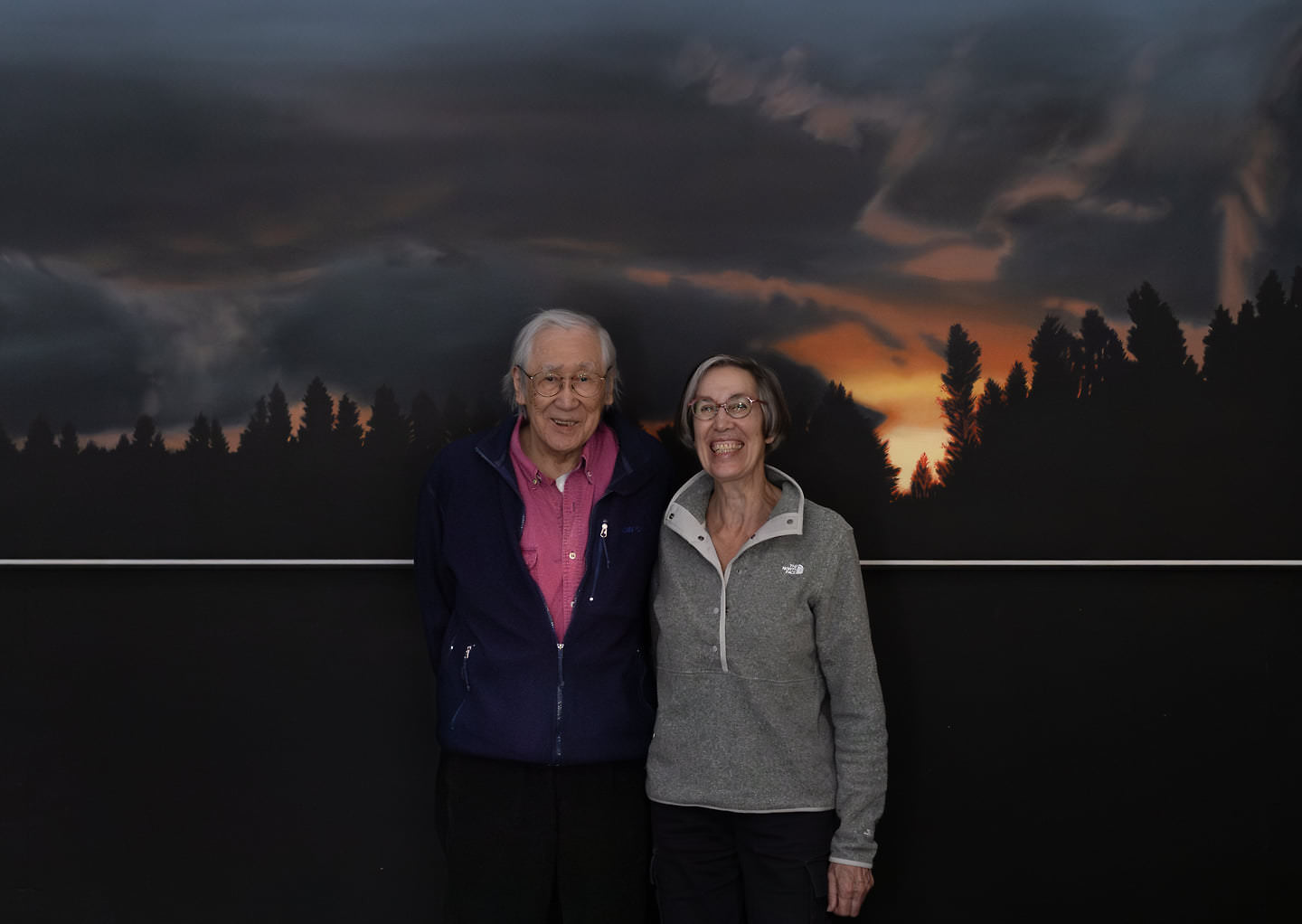
Takao Tanabe and his wife, Anona Thorne, in front of Errington Sunset, 2011 (2010-11). Photo by Kyle Graham.
Meanwhile the Japanese influence is also seen in Tanabe’s fascinating Emperor series, perhaps exemplified by 1964’s Emperor, Spring Night, which prompted accusations of obscenity when it was shown in Vancouver. It’s mildly suggestive (if you really want it to be), but the oil and graphite image actually depicts, so to speak, bollards jutting from the waters of Burrard Inlet. Watanabe suggests that “the circular shape seems to make reference to the Japanese Imperial system, or the sun, the rising sun—sort of. Interestingly, [Art Gallery of Greater Victoria curator] Steven McNeil mentioned that this makes reference to 19th-century portraits of Japanese people. I looked up some historical paintings of noblemen and geisha from that period, and I see how faces were painted in that elongated shape. It’s a less-shown series, but we’re bringing three or four to the exhibition. ”
We can speculate about the influences and inspiration folded into Tanabe’s work over the years, and he was certainly open to fashionable artistic movements early in his career. What’s fascinating about his golden era is its near imperceptible synthesis of all that came before, with its ongoing tension between the abstract and landscape. Watanabe points to an essay by National Gallery of Canada curator Jonathan Shaughnessy, to be included in a book to accompany this massive retrospective (partnered with the National Gallery of Canada and the Art Gallery of Greater Victoria). The author recalls being told by Tanabe himself that “it’s always hard edge.”
“He writes about how all of his paintings have sort of the hard-edge element, the way he looks at it,” says Watanabe, whose own perception of the work, fittingly enough, resides at the very opposite end of the Tanabe scale. “As I see it, it’s always landscape,” she says. “Wherever he was at any point of his life, New York, the Prairies, I think landscape influenced his painting style.” This is the dialectic that characterizes Tanabe’s entire canon, mediated by a constant, undeniable emotional resonance.
“You know, one thing I noticed from arranging to borrow from private collectors, they’re so attached to Tak’s paintings,” Watanabe says. “It’s become something for them to look at and find peace. For them to let go of these paintings for a long time was very difficult. When people go up the Sea-to-Sky Highway from Vancouver to Whistler and see the view of Georgia Strait, they say, ‘Just like Tak’s paintings.’ I think this is a huge achievement, to capture the ever-changing beauty of the West Coast in a manner that is almost definitive.”
On a personal level, the Audain curator is partial to Tanabe’s River paintings along with uncontested masterpieces like Inside Passage 1/04: Malacca Strait (2004). “You start thinking about a lot of things in your life. Nature is so part of our well-being, and this painting has that quality to make you look internally, about your life, about places you visit. Quite beautiful.” Indeed, Tanabe’s work is so transporting that it lends another, private motive to an exhibition three years in the making.
“I enjoy working in this building,” Watanabe says. “I think it’s one of the most beautiful art galleries in this country, and we’re fortunate to have forests around us. Our building is surrounded by mountains and trees. But I wanted to bring oceans to it. Because B.C. is not just about the mountains, but also seascapes. I wanted to see Tak’s majestic coastal waters and seascapes of British Columbia nestled in the mountains and trees of Whistler.”
Takao Tanabe 100: Inside Passage runs from June 13 to October 19 at Audain Art Museum. Read more from our summer 2026 issue.