

A picture of a bluebell wood captured at dusk hangs on a clinically white wall. Sprigs of lavender anchor the corner of the boxy room. Neither particularly calms my nerves as I read the sign on the door: Brain Scan in Progress—Do Not Disturb.
I’m about to test the NeuroCatch platform, a product of British Columbia’s life sciences and biomedical industry, which employs more than 20,000 people across 2,000 companies. Under that umbrella, British Columbia is increasingly punching above its weight in the growing field of neuroscience, with companies such as this one (part of NeuroPeak Physiotherapy & Performance Centre) tucked away on the 10th floor of a Surrey office block.
They service an increasing demand from those interested in getting ahead of any cognitive dips or concerns following sports injuries, for instance, or car accidents. Having lost my late mother to Alzheimer’s, I’m also wondering about the state of my own head. How bad are those slight memory blips or moments when my mind wanders? How can my neurons be better directed through neuroplasticity—the brain’s inherent ability to rewire new circuits—after being one of the millions dealing with the maelstrom of stress that comes with dementia care? In my case, that stress compounded by a protracted and painful medical wringer.
Despite my apprehension, I slow my breath as I let the technician squeeze my scalp into a type of fancy swim cap before squirting a syringe of cooling gel around five sensors down its midline. These nodes are set to record my brain waves. I’m asked about my mood today (chipper), how I slept last night (the usual menopausal 4 a.m. rude awakening), and any intake of stimulants (just black tea). Then I’m left alone—eyes fixed on an X plastered on the wall in front—while hundreds of words spool out into my earpieces over six minutes.
Even though I exert little conscious thought, the sensors pick up my neural activity at whiplash speed—the left anterior middle temporal lobe typically recognizes the onset of a word at 200 milliseconds. “Bread and butter,” for example, or “painting and hiccup”: how fast I register any dissonance between a pairing helps gauge how well I’m processing cognitively. My levels of basic attention and reaction to sound register through the speed and extent to which my neural activity responds to “deviant tones” (high beeps) that punctuate the flow of words.
“We can create these models that provide us with a way to understand the complexity of the brain and then potentially be able to use that to guide people’s behaviours.”—Randy McIntosh
The idea of discovering our brain’s baselines sparks fear and curiosity in many. That’s understandable, according to neuroscientist Ryan D’Arcy, NeuroCatch Platform chief inventor and co-founder of its parent company, also Surrey-based, HealthTech Connex.
“The brain is a funny thing, right? We’re all naturally inclined to be fascinated by it, but it’s also so mysterious,” he proffers, noting the organ holds about 100 billion neurons, each of which has thousands of synaptic connections. “That complexity can be intimidating to anyone.”
While used more as an indicator (they warn that it’s not to be used as a standalone diagnostic tool), the scan takes the objective brain response measurements and plots the results in a simple hexagon chart—the brain vital sign profile. Simply knowing your own shape could be half the battle—in medicine, the age-old axiom that you can’t treat what you can’t measure looms large for him. Why not move looking at the brain’s vital signs out of “the dark ages” to make it as ubiquitous as slipping a cuff on your arm to read your blood pressure or a pulse oximeter on your finger to check your blood oxygen saturation levels—and long before having a MRI, for instance, to confirm neurological conditions such as concussion or dementia?
“As a measuring stick, this can unleash ways to improve your brain,” D’Arcy says of the same technology that’s recorded 30,000 brains worldwide, including at the world-renowned Mayo Clinic.
Ongoing medical studies continue to debunk the original idea that the brain is crystallized and unchanging by the time we reach adulthood. Take the well-known 2000 study in England that found that the expert navigation skills of taxi drivers in the nation’s capital had changed the structure in their brain’s hippocampus. Neuroscientists stress that in terms of neuroplasticity’s rewiring, it can be as simple and as accessible as performing small steps that will lead to those larger positive changes.
I meet with Sylvain Moreno to tour Simon Fraser University’s Surrey campus and specifically the Circle Innovation lab, of which he is CEO. Its mission is to help businesses create innovative technologies around health care—including practical ways to use neuroplasticity.
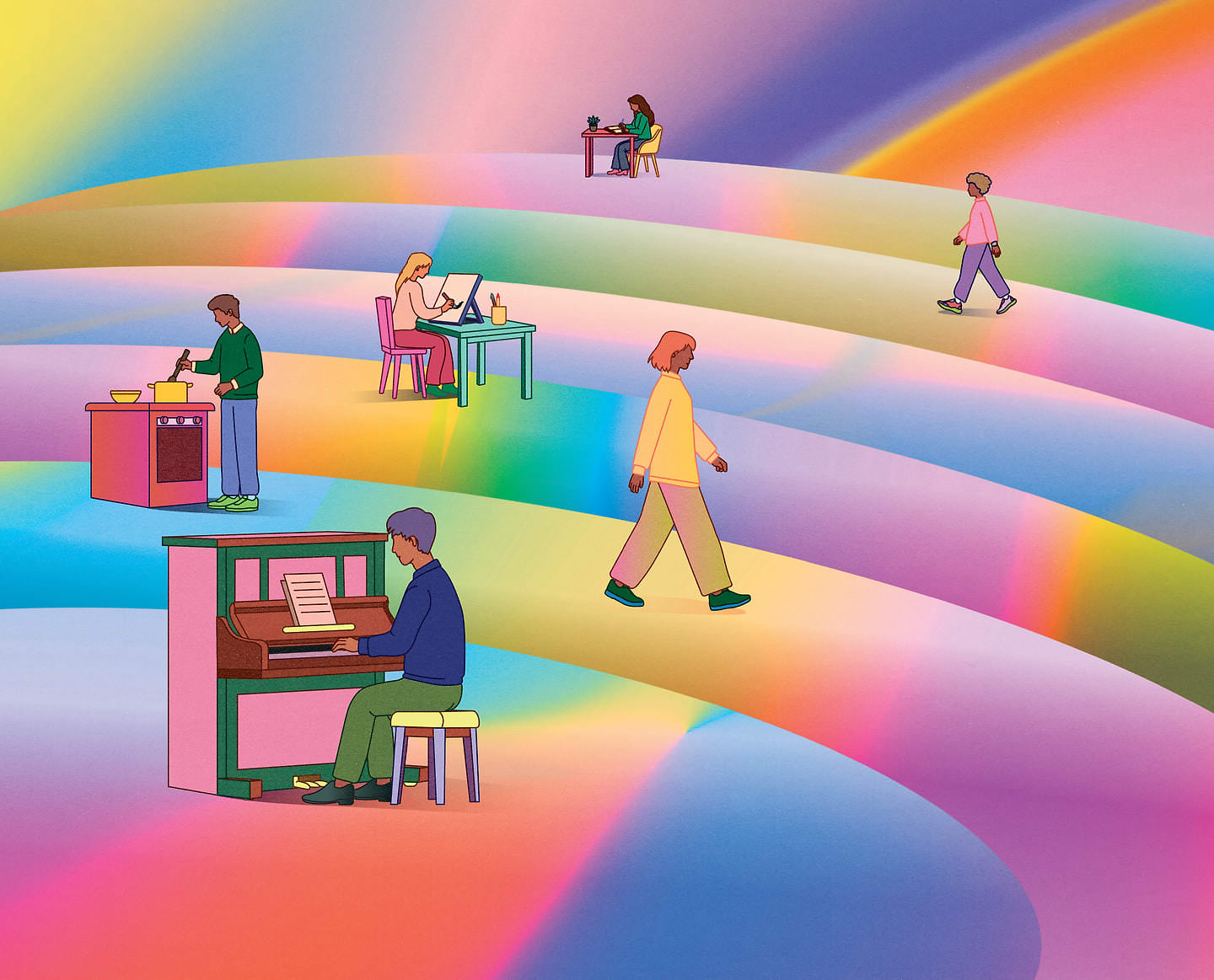
His advice is clear: generally, put in the incremental work—chop the vegetables, vacuum, and embrace other chores around the home, walk outside for as little as 10 minutes, do moderate exercise, take on knitting, learn music or other artistic activities. “You need to be in a sensory-motor type of loop to have your brain modified,” he explains. “Which means dancing if you’re listening to music. It can’t be passive.”
The evidence suggests that repeating those and other positive actions transform fragile connections into stable and efficient brain networks. Think of it as crossing a field, suggests Moreno, who is also an associate professor in neuroscience and director of the Computational Neuroscience Research Laboratory at SFU’s School of Interactive Arts and Technology. “Each time you take the same route, the grass gets pressed down a little more. When a connection is useful and reinforced by positive feedback, it is activated repeatedly. Over time, this repeated activation strengthens and stabilizes the neural pathway.”
While genetic factors are important early in life, as you age, Moreno stresses, you can effectively teach older humans new tricks. “It’s down to the environment and you deciding what you do that impacts the brain—it’s very empowering,” he comments. “Today there’s a renewal, a focus on aging well. People want to take their health and their behaviour in hand.”
The effects of these types of pathways in stimulating brain adaptation are tracked by use of The Virtual Brain (TVB) simulator, co-developed by Moreno’s SFU colleague Randy McIntosh. A veteran professor working in cognitive and computational neuroscience, McIntosh has uprooted a 30-year career in Toronto, including at the aging-focused Baycrest Health Sciences at the University of Toronto, to work as the director of the Burnaby campus’s Institute for Neuroscience and Neurotechnology. The so-called “digital twin” TVB software is based on expansive datasets worldwide such as UK Biobank that follows the health of half a million people. It allows scientists worldwide access to a free downloadable mock-up of the brain with the ability to look at the patterns around aging and pathological trajectories as well as map how changing connections in the brain might make it better or worse.
“We can create these models that provide us with a way to understand the complexity of the brain and then potentially be able to use that to guide people’s behaviours,” McIntosh says. If the brain’s system is built to adapt “until the last day you’re alive,” then, he believes, it’s down to compliance in making sure the changes benefit people. “It’s about what we are giving the brain. Are we giving it a cigar and scotch, or being in a forest, which is much better for you?”
Replace his talk of cigars and whisky with junk-food bingeing and burning the candle at both ends, and Catherine Roscoe Barr, the author of Feel Better Now: The Life-Changing Power of Simple Pleasures, might have had a brain scan two decades ago that showed troublesome geometry. To spend time with the Port Moody wellness coach, who has a neuroscience degree from the University of Lethbridge, you’d never know: through her 12-year practice, the effervescent champion of lifestyle and fitness has connected more than 2,000 clients with neuroplasticity’s hopeful findings. “I’m still in the trenches,” she insists. “Depression started in my teens, and I didn’t have the tools to self-regulate.”
Despite a role in fitness in her 20s, it took listening to American author and psychologist Rick Hanson at a Vancouver event a decade later for her true epiphany. Hearing him riff on the tenet that “neurons that fire together, wire together” resonated with Roscoe Barr.
From journaling “a disgusting document of rage and sadness,” Roscoe Barr began immersing herself in thinking positively. The goal: to use neuroplasticity to boost mood and to decrease stress. “I realized I was in the driver’s seat, that I could actually change my brain,” she recalls.
With a mantra that “facts inform actions,” she knows why it matters to take the stairs, for instance. “You’re increasing your heart rate and increasing your BDNF [brain-derived neurotrophic factor, a protein needed for brain cell growth],” she explains. “It can take 30 seconds, and it moves the needle.”
Her home is testament to these small steps to help feeling better: a vision board perches above her home’s workstation; a hammock and dumbbells sit close by. Boundaries are set: her phone is on Do Not Disturb from 5:30 p.m. to 8:30 a.m. and thrown into a kitchen drawer, which also helps to prioritize sleep.
As McIntosh points out, these are the hours when synapses that have emerged during the day are scaled back. “Some of the ones that are stronger, of course, stay there. The ones that are weaker get washed away,” he adds. “Everything you do in that day will somehow affect the brain—and I know that it sounds obvious in some respects, but in other respects people don’t internalize that.”
After my own year of “renewal and rejuvenation,” consciously embracing neuroplasticity’s small steps, friends comment on my mental uptick. It’s been achieved despite grief, the legacy of adhesions from radical surgeries, and possible “muscle memory” neural pathways from the eviscerating pain of stage-four endometriosis. I have managed to somewhat rewire and calm my brain, moving it away from being stuck firmly in the adrenaline-freighted fight-or-flight sympathetic nervous system. Mindfully, I book in regular movement including Pilates, yoga, and spinning, limit social media, take on only work and play that bring joy, and have an edifying word with myself when negativity invariably calls.
To keep on track, Roscoe Barr recommends a flexible framework: “If you don’t have time to meditate, take a deep breath.”
The run of NeuroCatch scans shows my cognitive processing is up to snuff, but I need to boost my attention and auditory reactions. Recalibrating my two-pronged nervous system so my body isn’t now stuck too far into the resting parasympathetic part (the so-called “brake”) means making sure I occasionally press back on the sympathetic “gas.” Finding grit, in other words, to say yes even when it makes me somewhat anxious: more challenging work, for example, or building new friendships outside the comfort of my longstanding inner circle—no mean feat in your 50s.
Along with this healthier equilibrium, there are specific therapies: breathing through a set of heavy vibrations on a ShiftWave chair at NeuroPeak and playing NeuroTracker, an online game noting where once-highlighted 3D orbs end up once they stop spinning. My subsequent scans show significant progress toward that hexagonal holy grail.
With life throwing up plenty of adversity, it seems promising that any bounce back could be all in the head. Neuroplasticity is the chance for the brain to change in the face of different challenges throughout our life span—it is not something you turn on or off.
“Grab the tiger by the tail,” D’Arcy exhorts. “Direct your brain—wire it to where you want it to be rather than where the world and life is wiring it to.”
Read more from our Summer 2026 issue.