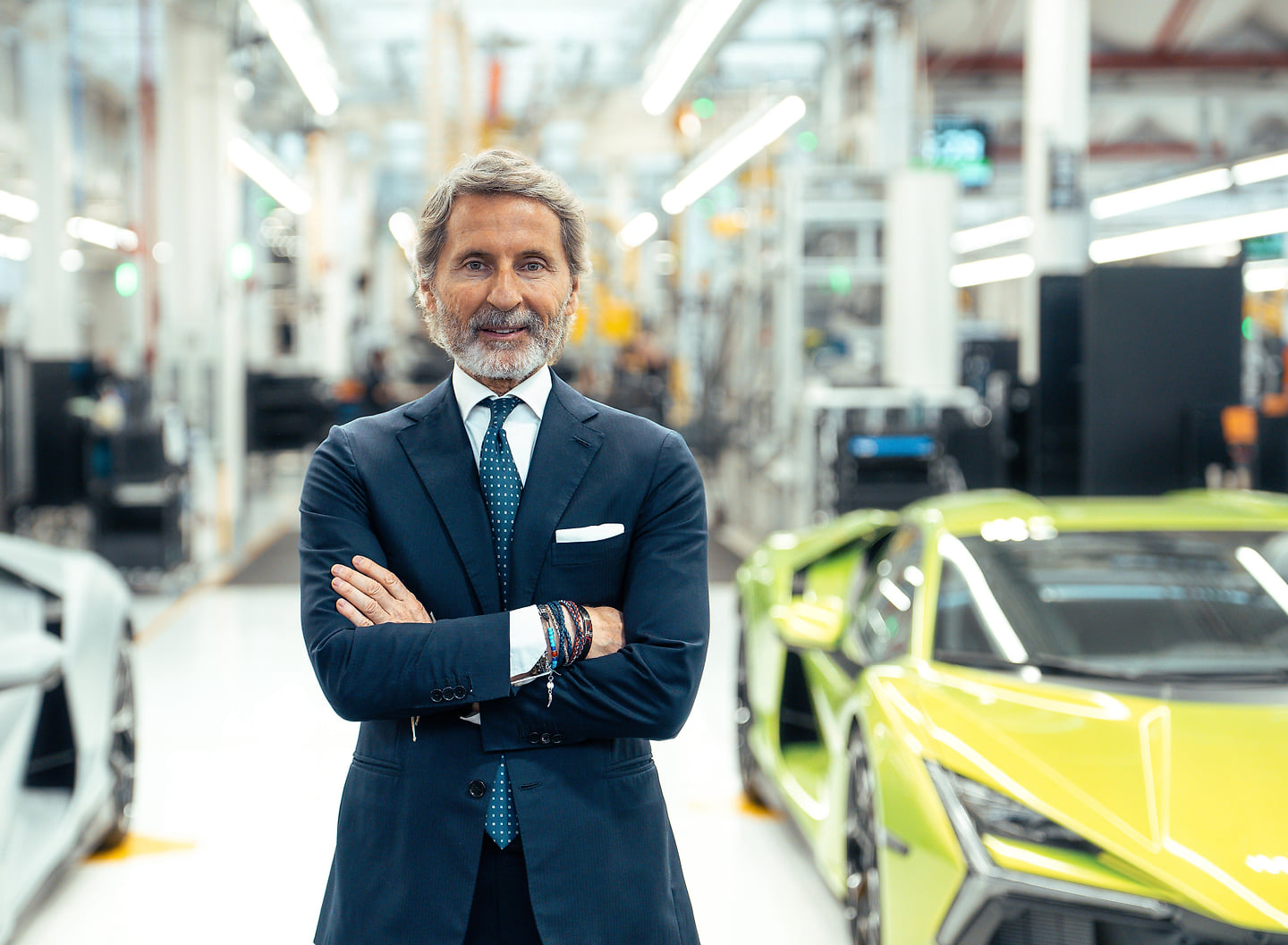


Stephan Winkelmann is the epitome of Lamborghini. Like the Italian supercar brand, which is owned by the Volkswagen Group, Winkelmann has ties to both Germany and Italy. Born in Berlin and raised in Rome, nowadays the chair and CEO of Automobili Lamborghini is working at the exotic automaker’s home in Sant’Agata Bolognese, Italy. It’s his second stint in the top job. He was president and CEO from 2005 to 2016 and returned as chair and CEO in December 2020.
He may have what many would consider the dream job, but his own early career hopes had nothing to do with cars. “I originally planned to pursue a career in the military, so I was not expecting to be in the automotive industry,” he says. “I wanted to become a professional soldier, and then I changed my mind and I reinvented myself.”
After studying political science in Rome and completing his degree in Munich, Winkelmann worked at a German financial institution before transitioning into automotive. He started his career at Mercedes-Benz and later held a string of high-ranking jobs including CEO of Fiat Auto Austria, Switzerland, and Germany; CEO of Audi Sport (then named Quattro); and president of Bugatti Automobiles.
Winkelmann was at the opening of the revamped dealership on West Second Avenue, which has a new state-of-the-art configuration room and one of the brand’s largest service centres in Canada.
“I was not born with the idea to work in Lamborghini,” Winkelmann says. Growing up in the heart of Italy, he preferred two wheels over four. “Honestly, I was much more into motorbikes in Rome. You could drive the bikes over here, and it was the greatest. This is the way we grew up. I was very much into motorbikes, but it was more the fun factor than an interest in the future in the business,” he says during an interview a few days after attending the grand reopening of Lamborghini Vancouver in September.
Lamborghini has 185 dealerships globally—five are in Canada. “Canada is an important market for us,” he notes. “Vancouver, in Canada, is very important. It is one of the wealthiest communities in terms of concentration, and it’s the one with ultra-high-net-worth individuals. It’s a market we count on.”
Winkelmann was at the opening of the revamped dealership on West Second Avenue, which has a new state-of-the-art configuration room and one of the brand’s largest service centres in Canada. The full lineup of hybrid vehicles, including its flagship V12 Revuelto HPEV, short for high-performance electrified vehicle, the stunning twin-turbo Temerario super sports car, and the fast and family-friendly Urus SE SUV, were also on display.
“For us, it’s always important to show up when we have an important market to showcase and visit. We have one shot to see the location, the setup, we can meet the owners and customers, and in a short period of time we get a good impression of what is going on in the market.”
Canada is one of Lamborghini’s top 10 markets in the world—approximately 300 cars were sold in Canada last year, Winkelmann says. “But it’s not so much about the volume, because it’s a huge country with five dealerships in Canada: Vancouver, Calgary, two in Toronto, and one in Montreal. Every market on its own is important to us. It’s the volume, but it’s also the one-to-one approach between our entrepreneurs, our dealers, and the customers.”
So far, there are no plans to grow the dealership network in Canada. “For the time being, five is the right number. We want to stay like this.”
While Winkelmann is focused on product strategy, product development, quality, and strengthening customer and dealer relationships, he faces unprecedented challenges as CEO this time around. Two of the biggest are the exchange rate from euro to U.S. dollar, and “the tariffs, which are higher than before,” he admits. Lamborghini’s largest market is the United States, and since its vehicles are made in Italy and not in America, the automaker faces hefty tariffs exporting them there. Initially, it was a 27.5 per cent rate on vehicle exports to the U.S., but that number has since dropped to 15 per cent, providing some relief.
“The uncertainty was, for sure, not the best for business in general. Now, we have certainty about what is happening, and therefore we see the opportunity, in short, in line with the treatment of the recovery of the market,” he adds.
Winkelmann is also weathering the storm of unpredictability when it comes to the future of electric vehicles. Since demand for EVs has dropped, the automaker is reconsidering earlier plans to bring its next vehicle, a grand touring car, to market in 2028 as an all-electric. “This is something that we have to decide very soon,” he says, acknowledging the urgency of whether to go with another hybrid car or the first fully electric model. “This is something we have to decide in the next few months.”
Currently, Lamborghini’s entire product portfolio consists of plug-in hybrids. The Revuelto features a 6.5-litre V12 mid-engine paired with three electric motors, which deliver more than 1,000 horsepower and a top speed that exceeds 350 kilometres per hour. The Temerario, the successor to the bestselling Huracán, is powered by a twin-turbo V8 engine with three electric motors. Together, they produce more than 900 horsepower, allowing it to hit 0 to 100 kilometres per hour in only 2.7 seconds. The bestselling Urus SE SUV has a 4.0-litre twin-turbo V8 mated to an electric drivetrain that delivers 789 horsepower and a top speed of 312 kilometres per hour. Recently, Lamborghini showcased its fastest and most powerful raging bull, the Fenomeno. It’s a limited-production supercar powered by a 1,080-horsepower 6.5-litre V12 engine mated to three electric motors. Only 29 will be built. The company has also unveiled a stunning concept vehicle called the Manifesto to mark 20 years of the brand’s in-house design centre, Centro Stile. While the vehicle won’t go into production, it does showcase the future of Lamborghini’s design direction.
Despite the tariffs and ongoing economic and political challenges, Lamborghini is still making money. “It’s a bit too early now to make a forecast for the end of the year,” Winkelmann suggests. “But I can definitely say in the first six months, our sales were up two per cent in comparison to last year.”
Lamborghini delivered 5,681 vehicles globally in the first six months of 2025, with the Americas region, which includes Canada, accounting for 1,732 units. That follows another record-breaking year for sales globally. In 2024, 10,687 cars were delivered—an increase of 5.7 per cent year over year. The company also reported revenue in 2024 of more than three billion euros, up 16.2 per cent versus 2023.
And there’s more good news. The new Temerario, which arrives in Canadian dealerships this winter, is already sold out for its first year of production. Buyers are getting younger, too. The average age of a Lamborghini buyer is now under 45. More women are also stepping into the brand, the CEO says. “The Urus was something to reduce the fear of owning a Lamborghini, but also being a family car—it’s a four-door car and very easy to drive—and this was helping to get more drivers, especially female drivers, into the brand.”
Winkelmann has come a long way since he bought his first car, a Fiat Uno. “Fiat Uno, which was born in the 1980s, was a very global car in Italy for anybody,” he said. While nowadays he only drives Lamborghinis or competitor cars to compare and test them, he has returned to his first love—motorbikes. “I restarted [riding] after years. I felt a bit stiff. I had to get used to it, because the traffic is not good. You have to be very careful. But you get into it pretty fast, and then you drive harder than you should.”
For Winkelmann, who turned 61 on October 18, 2025, retirement isn’t yet in the cards. But he has thought about the legacy he wants to leave. “I would be a liar if I said I don’t care,” he admits. Looking back, he hopes success hasn’t changed him.
“I’m not a different person than before working at Lamborghini,” he says. “I would like to be remembered in a way as somebody who started this company and left a very special piece of something, but this is not for me to decide.
“If I could choose,” he adds, laughing, “they could do a statue in the gardens.”
Read more from our Winter 2025 issue.