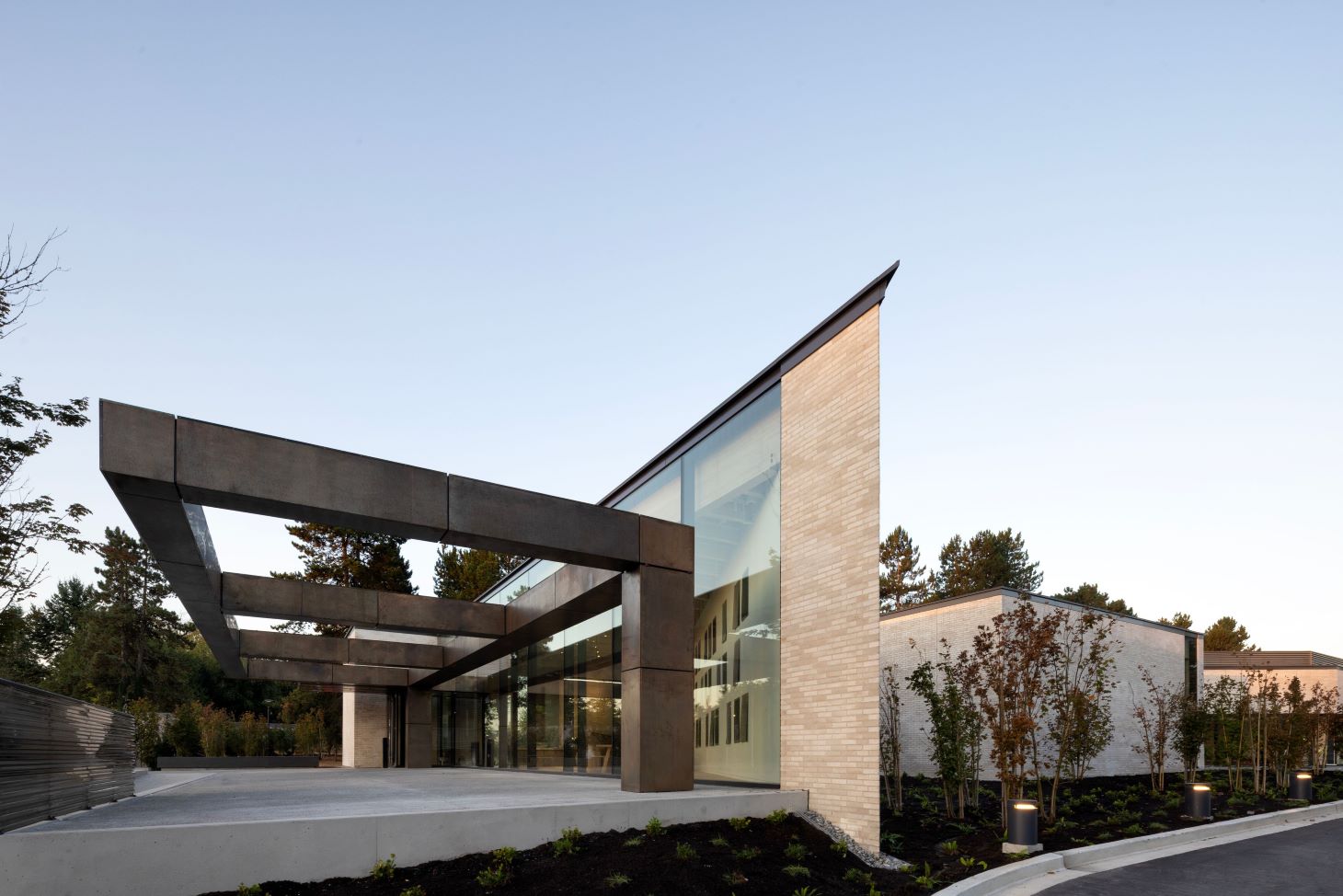


In Siamak Hariri’s view, every major project needs three key figures in order to come to fruition. A founding partner of the Toronto-based Hariri Pontarini Architects, he identifies the members of this holy trinity as the Champion, the Visionary, and the Captain. And in the case of the recently opened Marianne and Edward Gibson Art Museum at Simon Fraser University’s Burnaby Mountain campus, the architect says he knows exactly who filled each of those roles.
The Visionary, Hariri says, was Joy Johnson, SFU’s president and vice-chancellor, whose unswerving support ensured that the 12,100-square-foot, $26.3-million facility was built—and on a prime piece of real estate, no less, with an entrance adjacent to the campus’s main bus exchange. “She put this at the gateway of the entire university, and you have to acknowledge that that’s a daring act,” he insists. “She gave us enough land to spread out.”
The Captain, the architect continues, was Kimberly Phillips, director of SFU Galleries, who steered the Good Ship Gibson through occasionally stormy waters. And the Champion? That was Marianne Gibson, who was determined the new museum would be what Hariri calls “a love letter” to her late husband, Edward Gibson. Edward was a charter member of Simon Fraser University in 1965, serving as associate professor of geography, associate of both the School for the Contemporary Arts and the natural resources management program, and as director of the SFU and Teck Galleries.
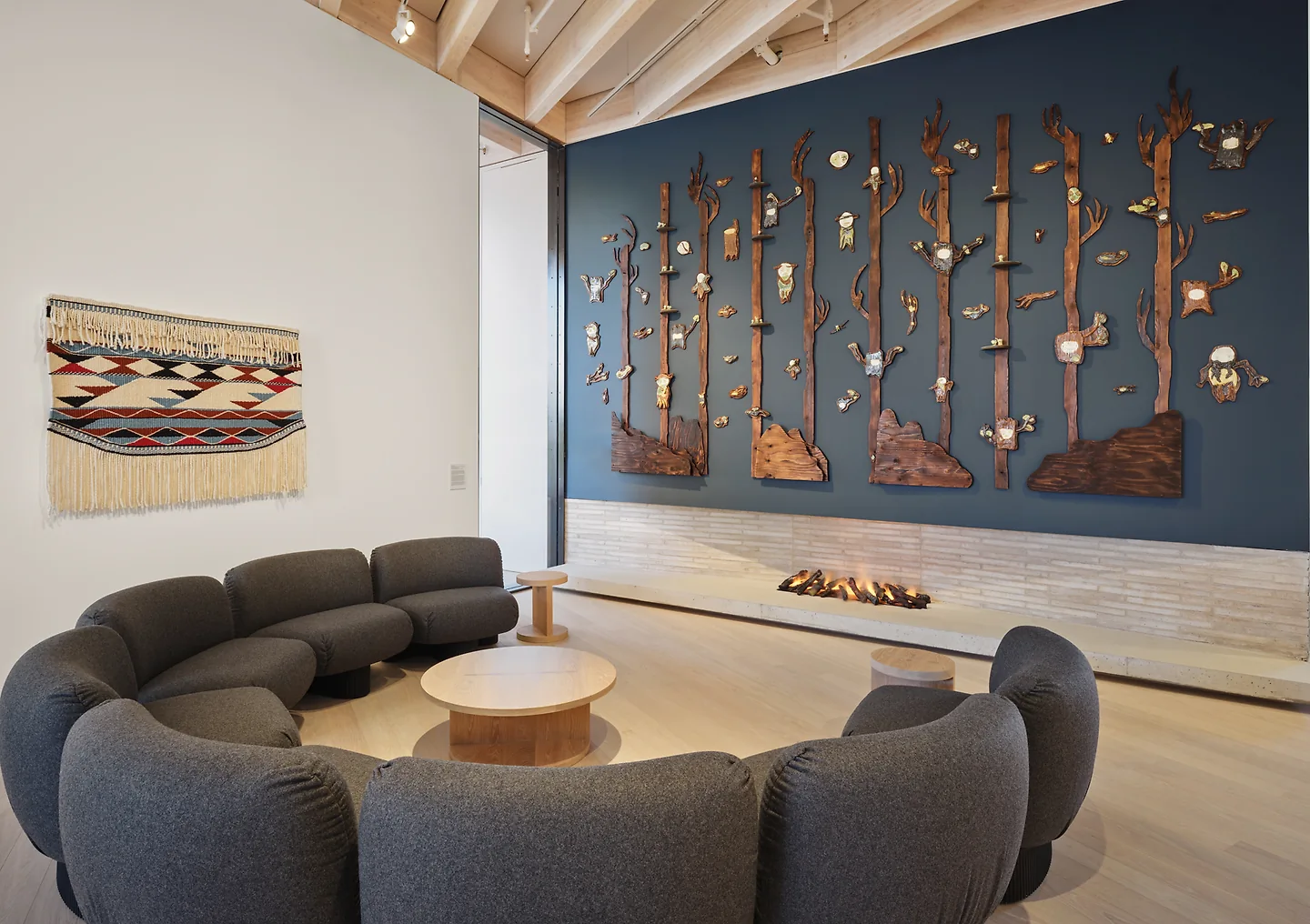
Untitled (2024) by Debra Sparrow (left) and Arboreal Time (2025) by Cindy Mochizuki (right) in Edge Effects. Photo by Rachel Topham Photography, courtesy of the Marianne and Edward Gibson Art Museum.
It’s a sunny morning in September at the Gibson Art Museum when Phillips leads a walk-through to introduce both the building itself and its inaugural exhibition. Edge Effects showcases works by artists including Liz Magor, Cindy Mochizuki, Germaine Koh, Pietro Sammarco, and Debra Sparrow.
Before leading the tour, Phillips asserts that visual art is embedded in SFU’s deepest DNA.
“It’s been a part of the university since its founding in 1965,” she explains. “This entire campus was built with an incredibly artistic vision, with an eye on how to create a different kind of learning environment for students, one that thinks first about connectivity and the ability for disciplines and thoughts to find one another across boundaries.”
Of Edward Gibson, who died in 2012, Phillips says that although he was a cultural geographer, “he also ran the art galleries, kind of off the side of his desk, because he believed in the capacity of art to open up conversations across disciplines.”
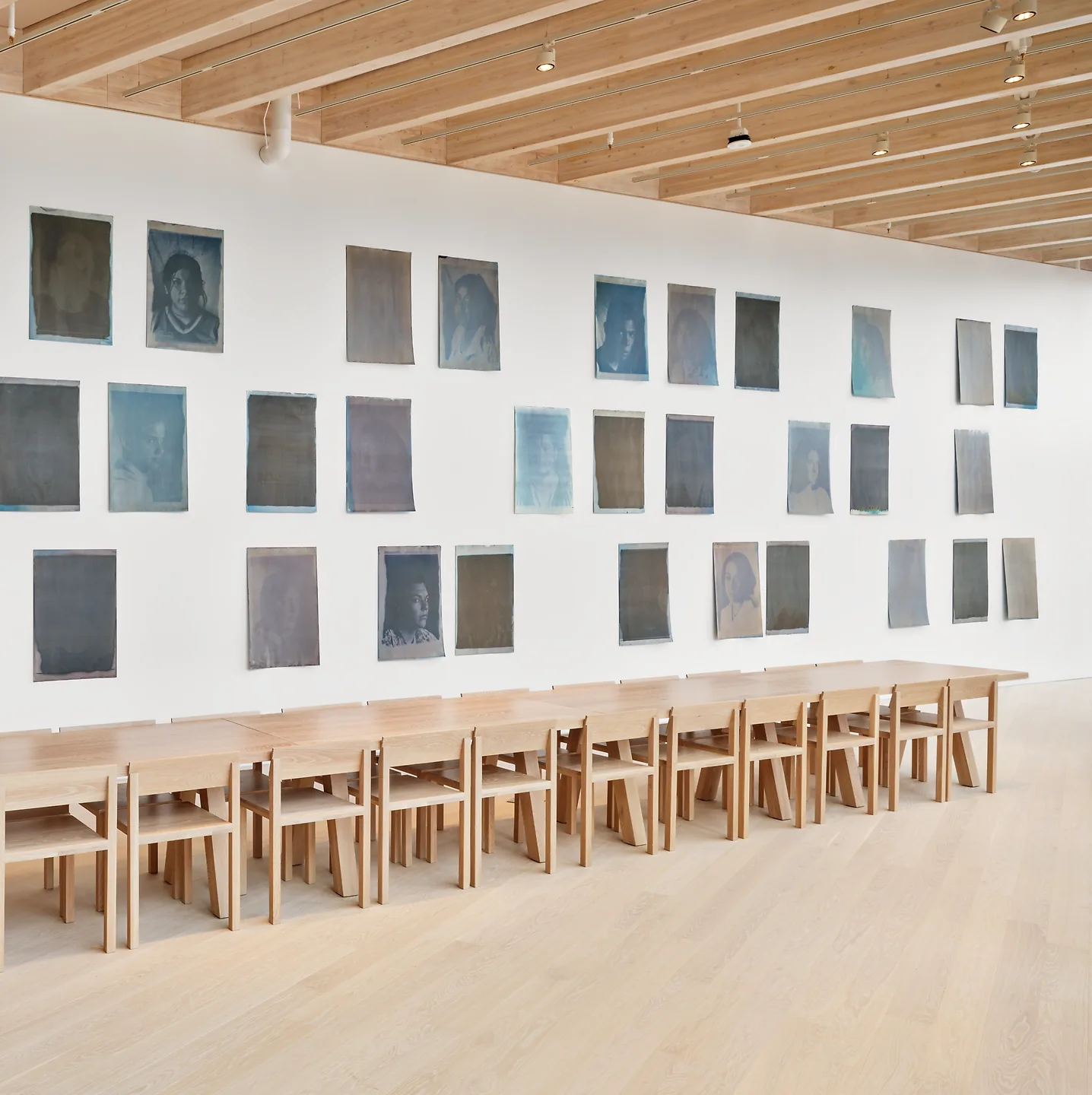
Blue Students/Alumnos en azul (1997), cyanotypes on paper, by Liz Magor in Edge Effects. Photo by Rachel Topham Photography, courtesy of the Marianne and Edward Gibson Art Museum.
She adds that, upon Gibson’s retirement in 1997, the university tasked the outgoing geography prof with creating a report about the status of the university’s art collection and the potential future of visual arts at SFU.
“In that report, he described what he imagined would be possible—meaning a new art museum on the Burnaby campus,” Phillips continues. “And he said that this art museum would be a place to hold and care for the SFU art collection, which is an incredible body of work that now numbers up to about 6,000 works, focused on artists from this region predominantly, across all different media. He also said an art museum could be a space for different disciplinary ideas to come together: a kind of open and unruly container for bringing together lots of different thoughts and questions across disciplines.”
“We want people to feel encouraged to spend different kinds of time … to feel like they can slow down, they can sit and hang out in spaces.” —Kimberly Phillips
That “open and unruly container” is intended for use by not just students and faculty but also by the broader community. The Gibson’s high-profile location and its design draw visitors in, and not necessarily just to look at what’s on the walls. The very first space one encounters upon stepping through the front entrance is the Arya & Hamid Eshghi Forum. With its high ceilings, wall of windows, and long table with chairs, this is a bright, inviting spot that looks and feels a little like an artisanal café and a little like the world’s most design-forward study hall.
Farther in, visitors will find a semicircle of cozy seating arranged before a hearth, above which hangs Arboreal Time, a whimsical, semipermanent installation of porcelain-and-pine sculptures by Mochizuki depicting kodama, or tree spirits.
“We want people to feel encouraged to spend different kinds of time,” Phillips notes. “We want people to feel like they can slow down, they can sit and hang out in spaces. They don’t have to sort of wander through and then just exit because there’s nothing else for you to do and nowhere for you to make yourself comfortable.”
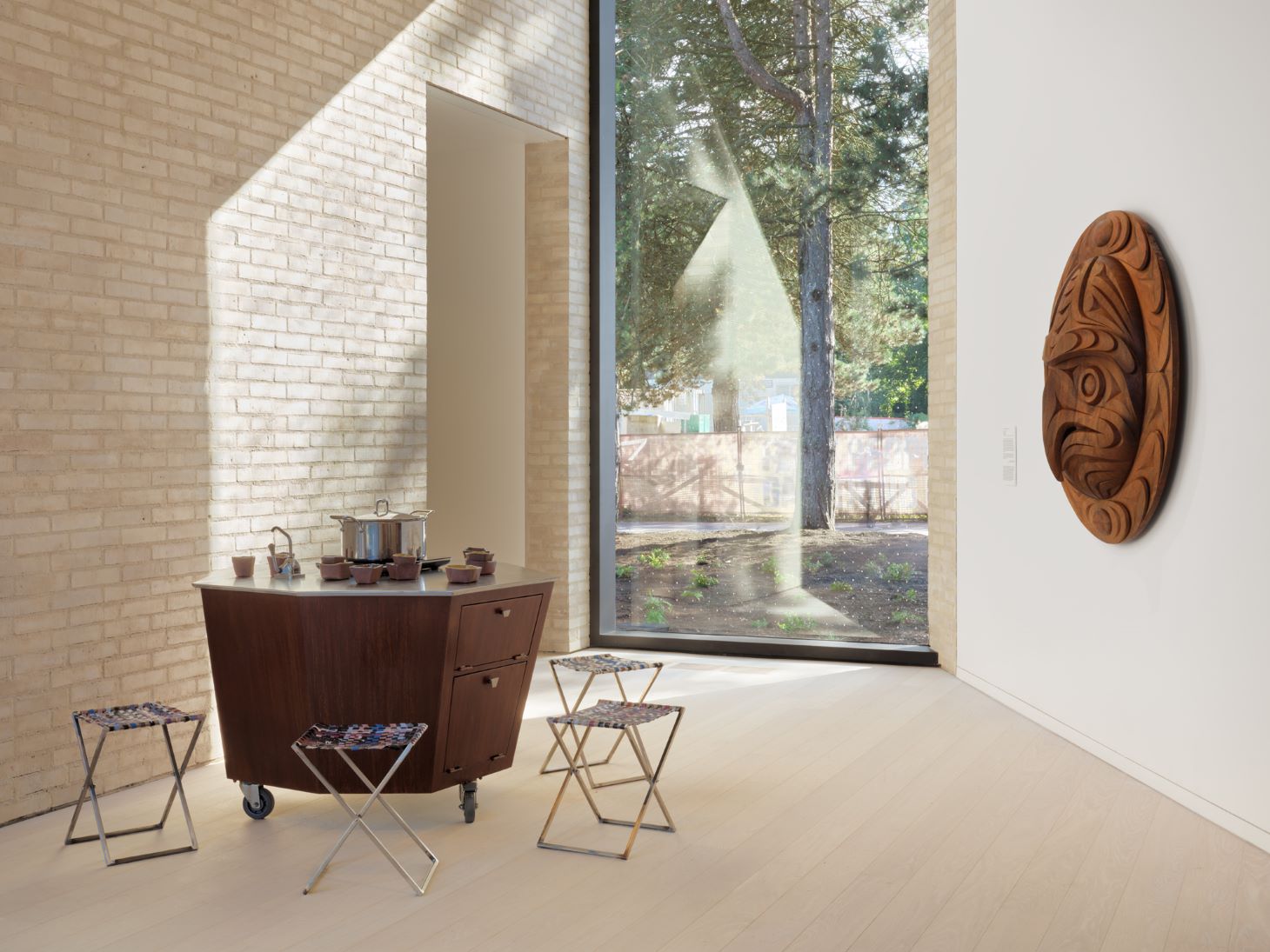
Soupson (2025) by Germaine Koh (left) and Salish Owl (2018) by John Marston (Qap’u’luq) (right) in Edge Effects. Photo by Rachel Topham Photography, courtesy of the Marianne and Edward Gibson Art Museum.
The Gibson is just the latest addition to an institution that boasts its share of iconic buildings. In 1963, architects Arthur Erickson and Geoffrey Massey won a competition to design the new university. When Simon Fraser University opened only two years later, students must have felt as if they were stepping into another world. A masterwork of concrete brutalism, SFU drew inspiration from everything from Japanese minimalism to Cairo’s ancient Al-Azhar University, where expansive courtyards blur the distinction between interior and exterior.
Erickson and Massey’s design doesn’t compete with the natural splendour of its surroundings. As the official Erickson website explains: “By spreading the building out and cutting it into the hillsides in terraces so that the University would hug the summit, the building and mountain appear to be part of each other. By extending out in the form of terraces, the edges of the complex dissolve into the land form.”
Hariri, whose firm worked in conjunction with Vancouver’s Iredale Architecture on the Gibson, says all involved were abundantly aware that they were standing—or rather, building—on the shoulders of giants: “You don’t want to speak down to the fact that Erickson has done this great masterpiece. I think we want to be able to say we also will hold our own presence.”
The museum echoes the past without aping it. Its straight lines and minimal ornamentation nod toward the austerity of brutalism, but materials such as brick, B.C.-sourced mass timber beams, and floor-to-ceiling windows seem to ground the building and tether it to the surrounding forest. “The building should feel as though it’s intimate,” Hariri insists. “It hugs you. It connects you to the trees. Everywhere you go, you always feel like you have a connection to light, to the trees.”
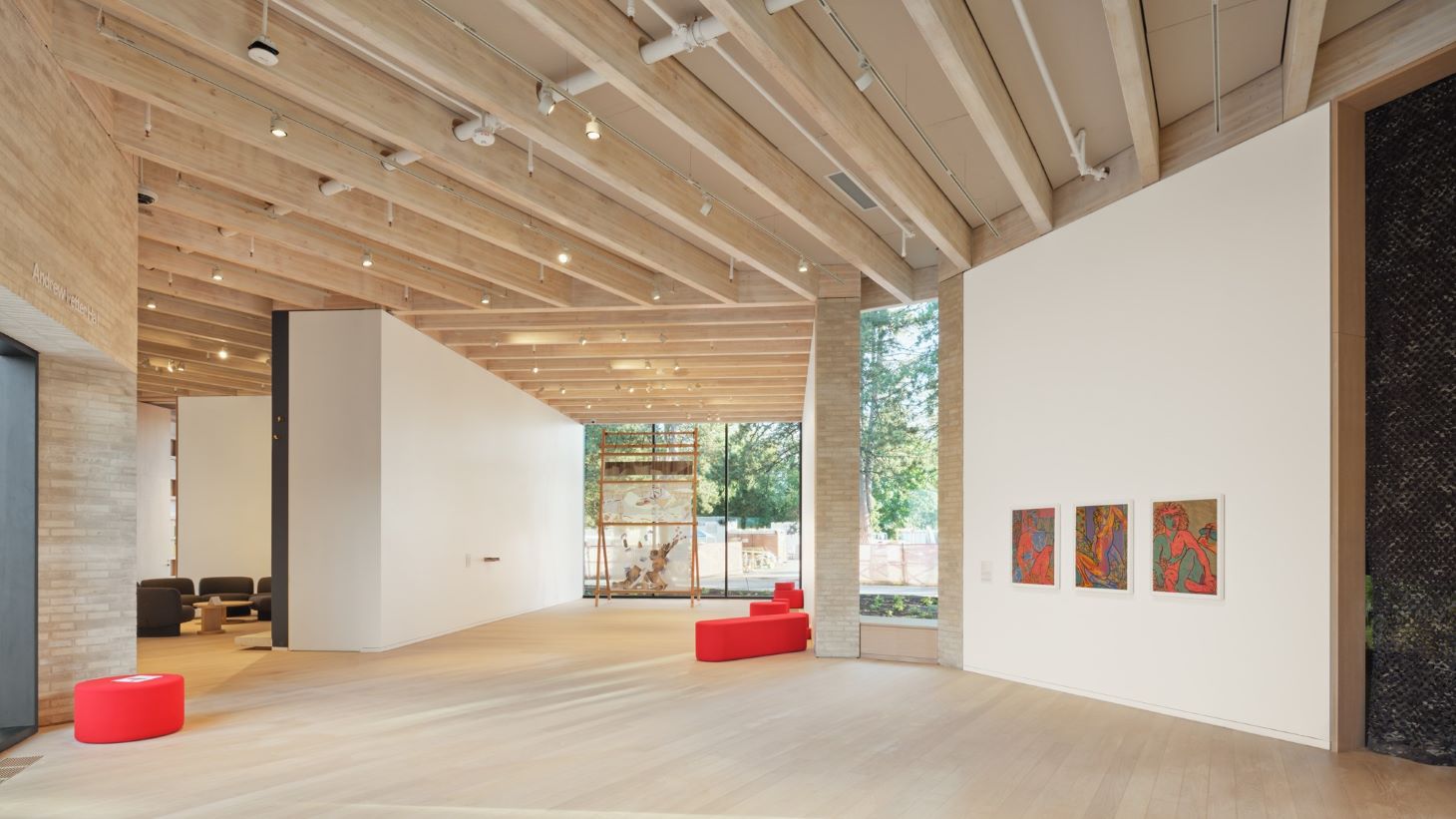
Installation view of Edge Effects, picturing work by Lorna Brown, and Sameer Farooq with Jared Stanley. Photo by Rachel Topham Photography, courtesy of the Marianne and Edward Gibson Art Museum.
The architect echoes Phillips’s hope that members of the SFU community, particularly students, will want to spend “different kinds of time” at the Gibson. The art is nominally the main attraction, but the space itself is intended to serve different functions for a wide variety of users.
“Okay, so you’re in the residence across the street,” he posits. “You get your coffee, and then you go across the street, and you sit down, and you study with a friend. That’s the idea. And you happen to be in your sweatpants, and yet you’re in an art museum. Pretty cool, right? And then after three, four years, you kind of go, ‘Damn, I really loved being around that Haida art’ or that Gordon Smith or whatever. The idea is that you just learn that having art around you made a big difference in your life.”
His hope is that immersing students in a visually enriched environment as part of their daily lives on campus will help foster a deep appreciation for art “by osmosis.” It’s a mission that’s more critical now than ever, he argues.
“I really believe that beauty is an extremely important antidote to the kind of coarseness that we’re seeing. Beauty is very resilient. It brings out the highest qualities. When you bring forth a space of beauty, you see that people take care of it. I’ve seen it with my own eyes. They act differently. It reminds us that we’re noble. It’s important. That’s what art does. And so in that sense, the whole idea was to create, really, a place of beauty.”
That mission was fully accomplished, at least in the opinion of its very own Champion, Marianne Gibson.
“She said, ‘You know, they told me I was just going to get a box,’” Hariri recounts. “And when she saw the design, she said, ‘You gave me a butterfly.’ Beautiful line, and I’ll hold that forever.”
Read more from our Winter 2025 issue.