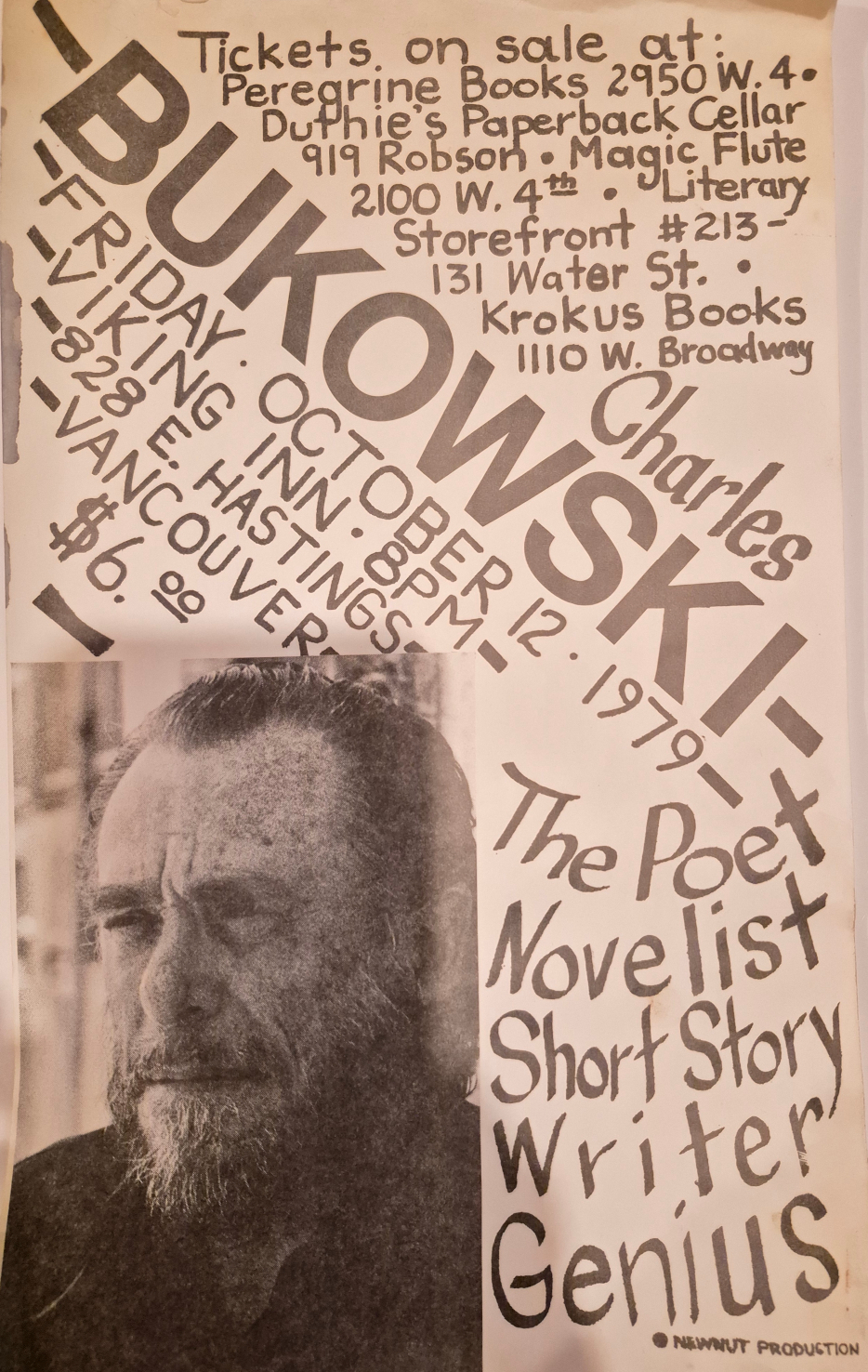


When Charles Bukowski arrived on stage at the Viking Inn, an East Hastings venue usually reserved for weddings and punk rock concerts, on a fog-drenched night in 1979, he may already have been drunk. He was certainly in that state by the end of the reading after draining more than two bottles of red wine. A portion of the audience was in the same condition. Bukowski set an antagonistic tone early in the proceedings, staring out at the crowd with a wolfish grin and exclaiming, “You guys paid six dollars to get in tonight, and you think I’m the fool.”
Of course, in those days six dollars meant more than it does today. Even so, that was cheap to view a legend. The poetry reading, held October 12, 1979, would turn out to be a historic moment in Vancouver’s literary history. A recording of the event is titled There’s Gonna Be a God Damn Riot in Here. The title comes from an utterance Bukowski made during the reading. Riots and poetry don’t normally occupy the same realm, but in this case the title is a fairly accurate description. The event was raucous and rowdy, with a series of profane verbal exchanges between Bukowski and the audience. At times, physical violence seemed imminent.
I had no inkling of what was to transpire when I arrived. I was there simply because I was a Bukowski fan and curious to see what he looked like in person. Before the rise of social media, there was no way to view a writer unless he made an appearance on television, an unlikely occurrence at the best of times, and with Bukowski, a near impossibility. He wrote about prostitutes, sex, drinking, gambling, and fighting in prose and poetry that was lifted straight from his life on the mean streets of Los Angeles. Everything was viewed through the eyes of Bukowski’s alter ego, Henry Chinaski, a cantankerous, middle-aged alcoholic. Much of the material was funny, but it was also often grim. Bukowski’s world was populated by a lurid parade of damaged people. But there was no denying that he knew how to write. His stories are raw, direct, and devoid of artifice. They drop you right into the action.
My pal Hugh and I loved his work. I had his novel Post Office, a memoir of Bukowski’s 11 years spent working with the U.S. Postal Service. I also owned two of his collections of short stories—Notes of a Dirty Old Man and Erections, Ejaculations, Exhibitions, and General Tales of Ordinary Madness. I remember devouring them quickly, amazed at how different they were from my usual reading fare.
We got in line early to snag good seats. The Viking Inn, a big, white, fortress-like building with heavy wooden doors, had been selected by the event’s organizer, Dennis Del Torre, a Bukowski aficionado and local taxi driver. He managed to sell 650 tickets. I remember being surprised by the size of the crowd. I thought of Bukowski as a cult writer. This was a large cult.
“I dropped tickets off at all the bookstores in town and put up posters. Every so often I would swing round and collect the cash,” recalls Del Torre, who spent eight months preparing for the event. I’ve reached Del Torre by phone from his home on Vancouver Island. Tracking down the retired landscaper required more effort than he had to expend to reach Bukowski. He simply penned a letter to Bukowski’s publisher. They struck a deal, a $1,000 fee, plus airfare and a room at the Sylvia Hotel. Bukowski covered the cost of bringing his girlfriend, Linda Lee Beighle. Del Torre and his wife met the pair at the hotel upon their arrival, and they went to a club where Bukowski danced, a rarity according to Beighle. He was clearly in a good mood.
The night of the reading, Del Torre hosted the poet for a spaghetti dinner at his apartment. He remembers him as “kind and insightful. He didn’t have a massive ego or anything like that.” A few hours later, we got a different Bukowski. He walked in and took a seat at a wooden table that was empty save for two bottles of red wine. He wore a navy blue short-sleeved shirt, dark pants, and black horn-rimmed glasses that rested on a bulbous nose. In an absurd touch, two large white paper bells dangled above his head, leftover decorations from a wedding.
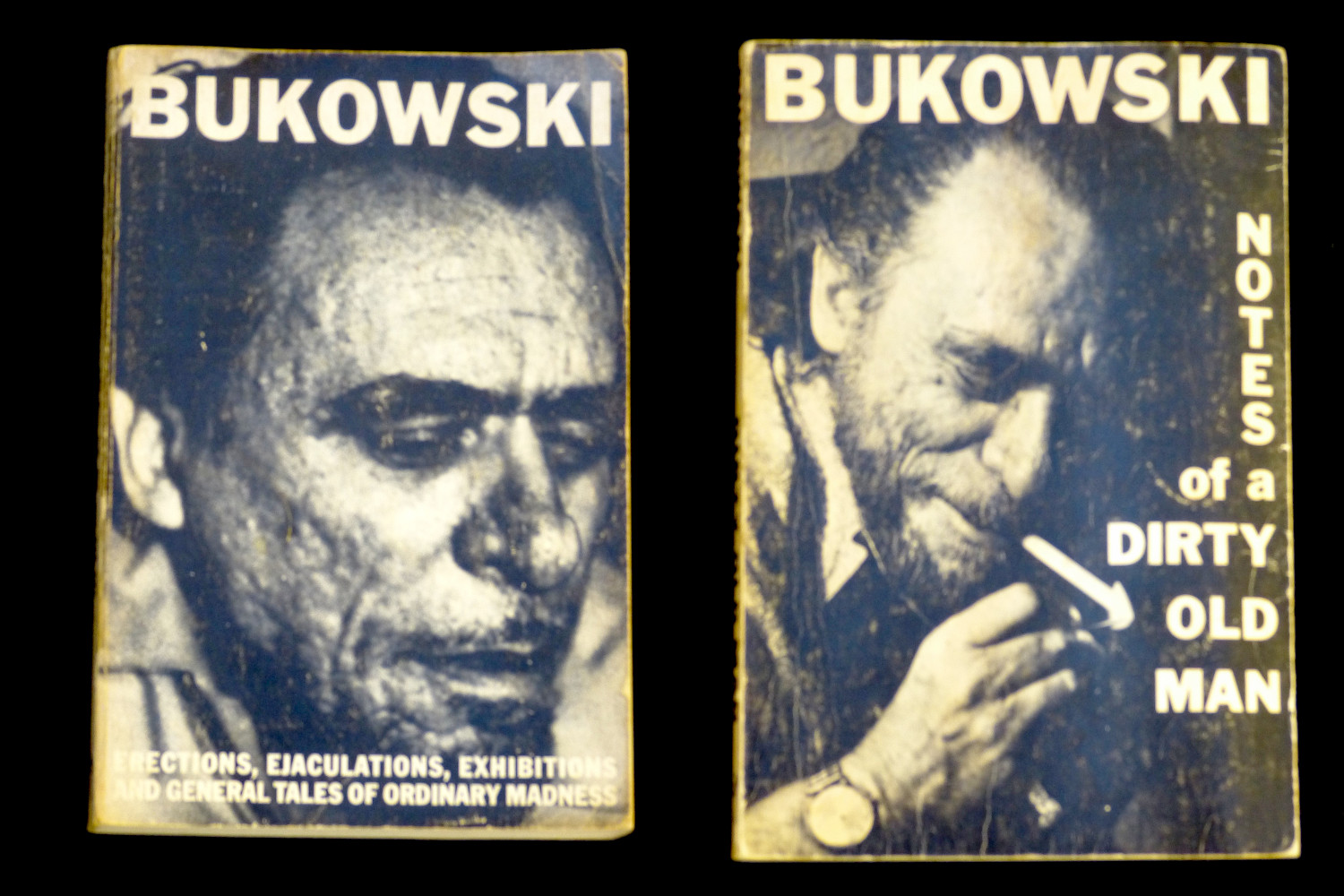
Well-read volumes from the author’s personal library.
I remember being disappointed by his appearance. I was expecting someone larger and more intimidating. Bukowski wasn’t an especially big man. He had hunched shoulders and walked with a shuffle. His voice was jaded and world weary. He looked like the kind of guy you might see working in a shoe repair shop. His pockmarked face actually looked less menacing than on the jacket covers of his short story collections, from where, as Vancouver Sun writer Scott Macrae put it, “he stares out with self-conscious brutality, as though the pits and mounds of acne were a private joke with which to bludgeon the smooth-faced people and their rewards.”
I can recall details of his physical appearance quite clearly and the turmoil that ensued, because I recently watched the video of the reading. That such a film exists is a bit of a marvel. There were supposed to be two copies, but one was mistakenly taped over by Rogers Video, while a second disappeared into a forgotten shelf in Bukowski’s archives for 25 years before it was discovered in 2006. This marked the last time Bukowski performed outside the United States, and it was the second to last video made of one of his readings. It is widely regarded as his most notorious.
As he reads, Bukowski makes repeated references to the money he is earning and his newfound success. His first poem, “The Secret of My Endurance,” describes the cozy life he now enjoys in a seaside California home replete with rose bushes, a two-car garage, a beautiful woman, and a young boy he keeps in a cage who writes his poetry.
That is followed by a poem about a woman with a lapdog that performs illicit acts and then one about how his ideal woman would have a body shaped like a submarine, then another that recounts a flying dream in which he unleashes a load of excrement on people below. ”I’m dedicating that to my audience,” he says.
After each poem, Bukowski takes another swig of wine, which he drinks from a small, plastic, orange cup. He also chain-smokes bidis, thin Indian cigarettes with a stronger nicotine kick than American brands.
Although the crowd seems infatuated with him, Bukowski has a different take. “You guys come here to see blood. You don’t want to hear poetry,” he hisses. At the 14-minute mark, a woman shouts, “Why are you here on a night when there is a World Series game?” Bukowski snarls, “Who the fuck cares?” He begins to deride baseball as a worthy topic of interest, which prompts a guy in the crowd to launch into a crazy rant about how baseball is the greatest game ever invented. He jumps up on his chair to make sure everyone hears him. Bukowski peers into the darkness and remarks, “What are you on, baby? Let me have some of that.”
I had not been to many poetry readings, but I had a strong suspicion this was not typical. From their look and demeanour, it was clear that some in attendance might be the sort of wounded souls who inhabit Bukowski’s prose. He taunted them over the rippling clamour. “I’ve met tougher lesbians in cheap bars than the whole gang of you.”
Bukowski’s early life had been a struggle. Born in 1920, beaten regularly and savagely by his German father, he graduated from Los Angeles High School and attended Los Angeles City College for two years. Afterward he drank, wandered, lived in rooming houses, worked at a string of dead-end jobs, married, divorced, and was treated for a near-fatal bleeding ulcer in 1955. After leaving the hospital, he began to write. Against all odds, he eventually secured a degree of mainstream success to the point where he was portrayed by Mickey Rourke in the 1987 semi-autobiographical film Barfly. By the time of his death in 1994, he had produced six novels, four nonfiction books, 13 short story collections, and 31 books of poetry.
Midway through the reading, we stop for an intermission. Bukowski chats and signs books for some audience members, while others rush across the street to the Astoria Hotel to buy alcohol. Hugh returns 10 minutes later with a six-pack. Judging by the clanking sound of the bottles behind me, he is not alone.
Interestingly, this was Bukowski’s second reading in Vancouver. The first was arranged in 1976 by local writer Ted Laturnus, who recalls that he and a buddy were in a bar when the idea of calling Bukowski surfaced. Laturnus reached him through directory assistance. “He answered on the first ring,” he tells me. “He said, ‘Chinaski here.’” Bukowski agreed to venture north for a fee of $500. It was the first time he had left the USA. The reading at the Western Front drew 200 people. The crowd was better behaved than the one in 1979, and so was Bukowski, who was relatively sober.
Afterward, Bukowski attended a party at Laturnus’s Kitsilano apartment. He signed books and added squiggly drawings of himself with an enormous erection, while making salacious comments. Laturnus was amazed at how many women were openly flirtatious. “Here is a guy who was overweight, ugly, and not very polite, and yet he was somehow irresistible to a lot of women.” Bukowski eventually left with a pretty young lass. Meanwhile, Laturnus and the other male guests struck out.
Del Torre attended the first reading, which he remembers as “mind-blowing.” The loss of a recording of that event prompted him to bring Bukowski back for an encore. But this time, the poet demanded a $1,000 fee.
When the reading resumes at the Viking, Bukowski barks at Del Torre to bring him another bottle of wine or he will close the show. Del Torre’s wife can be heard shrieking, “For Christsakes, Dennis, get him another bottle.”
Someone makes a request, “No, I hate that shit,” Bukowski replies. He derides the people who came up seeking his autograph during the intermission, calling them “slithering whores.”
“What kind of beer are you drinking now?” he is asked. “I’m drinking imported beer,” Bukowski says. “I’m sorry to leave you guys behind in the dregs of society. I’ll send you a postcard.”
The heckling gets more forceful. At one point, a bottle is flung at Bukowski. It misses. One of Del Torre’s buddies restrains the hurler. Del Torre has no security, just as he has no liquor licence. Moments later, Bukowski threatens to kill a guy in the crowd. He is growing more inebriated. “As I get drunker and drunker, you get superior. You get an edge. Because you need it,” he says.
It’s difficult to tell what compels Bukowski to toss abuse at his fans and engage in combative banter. He appears to view this as some sort of test, a trial to be endured. At times, it seems as if he is vocalizing his inner fears. “You’re going to get your wish. The old man’s going to drop. He won’t be able to finish his poems. He’ll beg mercy of you.”
Near the end, a hint of vulnerability slips through. He complains about two women who are chattering to his right, an occurrence he claims is common at his readings. “If they hate my stuff so much, why are they here?” he asks.
“Shut up!” someone yells in support. “Read your poetry,” another pleads. “Okay, but If I start my poem, and I hear this man’s voice rising above the sound of my poem, I’m going to go over and kick his ass right out of this God damn hall,” Bukowski shouts.
Amid the chaos, he pushes through, ending the session with a serious poem about all the women he has known. “That’s all,” he mutters, slumping in his seat. A wild burst of applause erupts. Bukowski nods in acceptance, then stands, proclaims that this is the last reading he will ever give, and exclaims, “Now go fuck off into your nowhere.”
Hugh and I exit the building, trying to make sense of what we have just experienced. Outside, Hugh stands in the swirling fog holding the remains of his six-pack. “So that was Bukowski,” he says.
“Yeah,” I reply. “That was him.”
Read more arts stories.