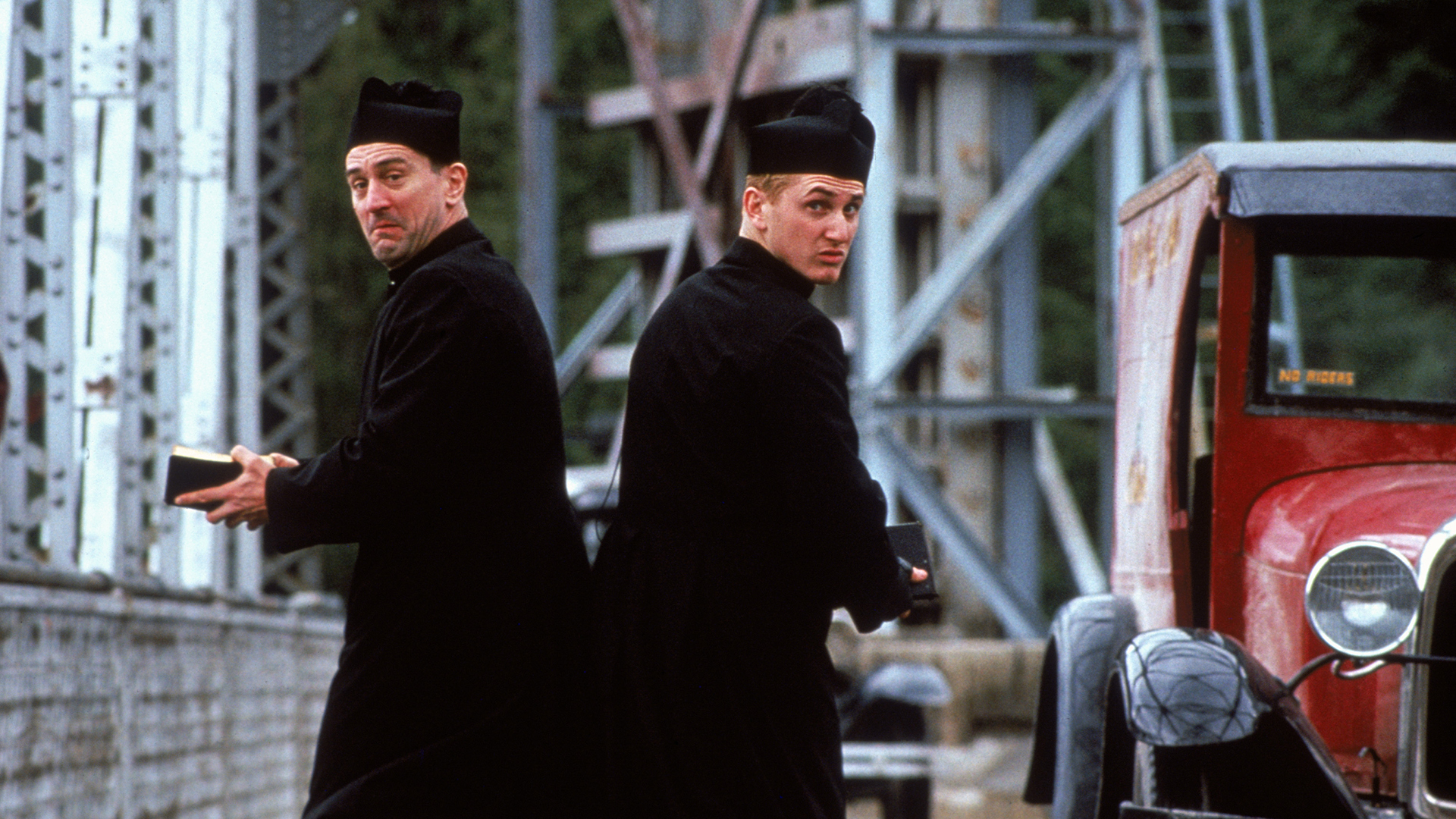


How many films from the 1980s can boast a cast and crew as accomplished as We’re No Angels? Stars Robert De Niro, Sean Penn, and Demi Moore were supported by John C. Reilly, Wallace Shawn, and Vancouver’s Jay Brazeau. Director Neil Jordan (who would later direct The Crying Game and Interview With the Vampire) worked from a script by Pulitzer Prize-winner David Mamet. Production designer Wolf Kroeger built an entire Depression-era town on the bank of B.C.’s Stave Lake, the largest film set ever constructed in Canada at the time.
Far from the classic one might expect, We’re No Angels bombed at the box office. Popular opinion holds that critics hated the film, taking issue with De Niro and Penn’s comic acting—or overacting. Whether it’s funny or not might come down to taste, but We’re No Angels remains a fascinating collision of talents and a unique chapter in Hollywood North history.
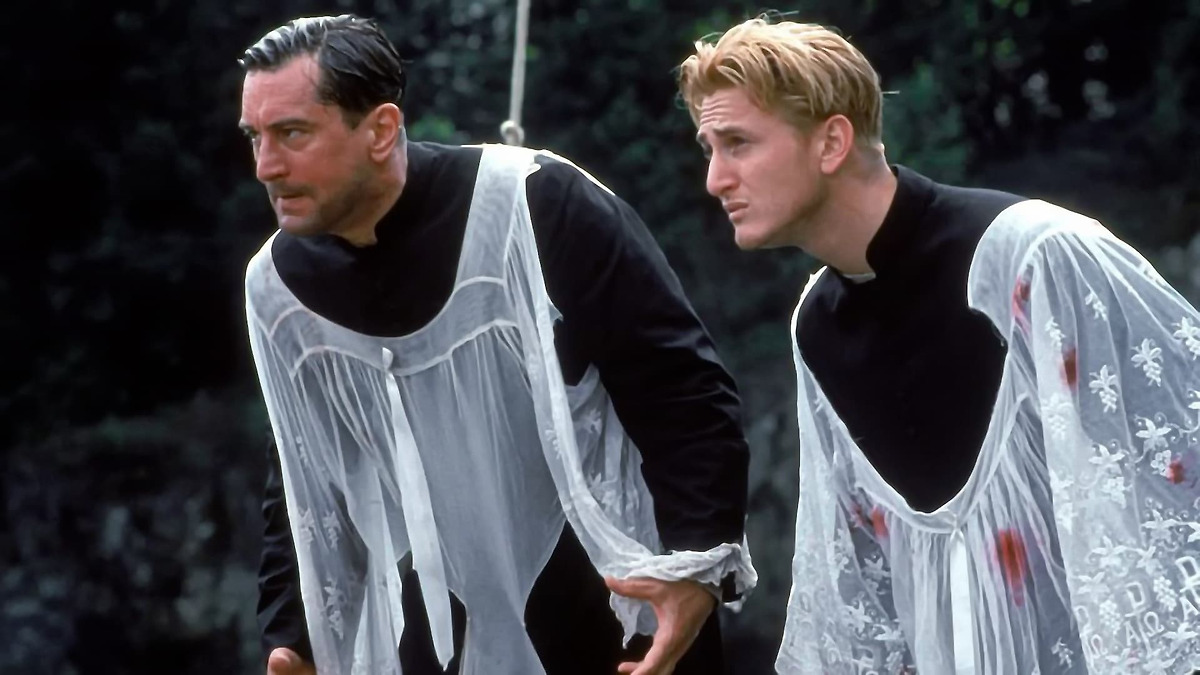
De Niro and Penn.
Angels came about because De Niro and Penn were looking to work together. “I like him and respect him, and he likes and respects me,” De Niro told Moira Farrow in 1989. “So we said let’s find something to do together.” The actors approached Art Linson, producer of The Untouchables—also written by Mamet—to find them a project.
While ostensibly a remake of the 1955 film starring Humphrey Bogart and Peter Ustinov as Devil’s Island escapees, the 1989 We’re No Angels would retain only the title and the jailbreak idea. In David Mamet’s screenplay, Ned and Jim (De Niro and Penn) escape from a hellish New England prison. Fleeing north, they’re mistaken for visiting Catholic priests at a monastery in a border town On the other side of a heavily guarded bridge is Canada and freedom. Ned and Jim’s only chance is to join the annual religious procession across the bridge.
While the dim-witted Jim finds himself drawn to the monastic life, Ned woos Molly (Demi Moore), a sex worker whose deaf child could be the perfect means of getting them in the parade and out of the clutches of the warden (Ray McAnally) and sheriff (Jay Brazeau).
Related stories
- The Story Behind Vancouver Cult Classic Skip Tracer
- How Two Stephen King Adaptations Brought the King of Horror to B.C.
- In 1982, B.C. Played Host to a Bizarre, Daring Gun Heist on the Set of First Blood
The Winnipeg-born Brazeau was a fixture of Vancouver theatre and TV at the time. On tour in Spokane with a play when he learned of the casting call, Brazeau enlisted his castmates and locals to help him film his audition. “They faxed me the script, and I hired a couple of actors in the show to read the parts off camera. This guy in the boonies of Spokane, we invaded his living room, and I did my own little Canadian audition.”
Mamet’s script called for a 1930s-era town near a lake, a bridge, and a monastery. Finding a location that met these criteria proved impossible. “We would find a suitable town, but there wouldn’t be a suitable river or bridge,” Linson later recalled. “When we found this great river and bridge in British Columbia, we said to ourselves, well why not just build a town right here?”
At Stave Lake near Mission, Wolf Kroeger, who’d worked on Year of the Dragon and First Blood, began construction of the town of Brandon. In 45 days, with 200 builders and a $2.5 million budget, Kroeger’s team built 23 buildings from scratch , including a shantytown, chapel, meat market, and blacksmith’s shop. What’s more, “a monastery with a domed roof more than 25 metres in diameter was built out over a 40-metre pier.” The result was touted as the largest movie set ever built in Canada.
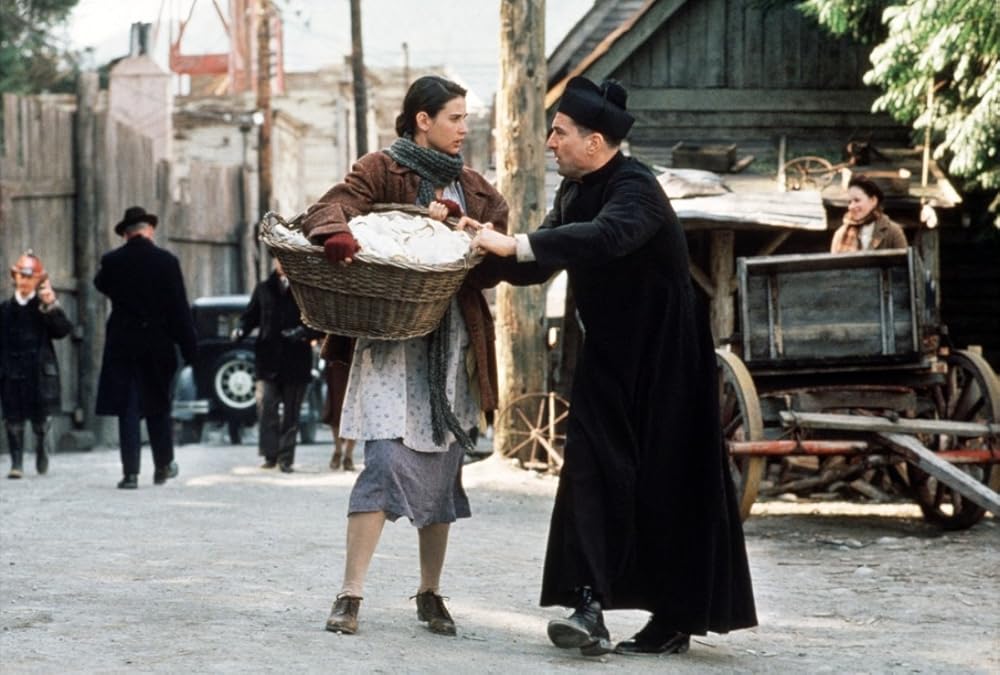
Demi Moore and De Niro.
Despite high winds damaging the set, filming began at the Brandon site in February 1989. When asked about working with De Niro and Penn, Brazeau told The Province, “Just like everyone else, they have good days, bad days; they’re doing a job.” De Niro’s intensity was hard to match: “He’ll never do anything that’s not honest or anything that’s fake.” Penn at the time was going through a public breakup with Madonna and often kept to himself. Yet Brazeau recalled that at the film’s premiere in New York, Penn gave him “the most sincere handshake of the night,” and the two wished each other luck.
When We’re No Angels tanked at the box office, blame was placed on De Niro and Penn’s exaggerated performances. “Pug-faced, slack-jawed and marble-mouthed,” Variety called them. Yet reviewers as often as not praised the two. Siskel and Ebert both gave the film a thumb’s up, with Siskel gushing that Angels “confirms Robert De Niro’s position not only as one of the finest dramatic actors but also one of the best comic actors, and Sean Penn is really good.”
More recently, Indiewire’s Jim Hemphill made a full-throated defence of the film: “Elegantly structured, gorgeously mounted, and anchored by De Niro and Penn’s hilarious performances, We’re No Angels comes close to being a kind of classic.”
Classic is a stretch. Enjoyment of We’re No Angels probably depends on a viewer’s tolerance for the stars’ more-isn’t-enough style of comedy. Decades later, De Niro would make comedic breakthroughs with Analyze This and Meet the Parents, both of which grossed over $100 million and spawned sequels. Penn would return to B.C. to direct the compelling crime drama The Pledge, starring Jack Nicholson. And Jay Brazeau would become one of the best-known character actors in the country, appearing in Vancouver-shot indie features including everything from the pitch-black Kissed to family franchise starter Air Bud.
As for the town of Brandon, there were talks of selling the set off or turning it into a tourist attraction. Ultimately these didn’t pan out. The set is the true star of We’re No Angels, a mixture of Hollywood North engineering and Pacific Northwest beauty. “After we started screening the movie at previews, people started asking us where the town was located because they wanted to visit it,” Linson said. “We had to tell them that the only way they could visit this town was to go and see the movie again because we’d taken it all down.”
Read more arts stories.