

This story is the 22nd in our series on the hidden history of Vancouver’s neighbourhoods. Read more.
The Arbutus Club has earned a reputation as an exclusive hangout for Vancouver’s elite. Founded in the 1960s by E.V. “Billie” Mitchell, the first-ever female president of the Canadian Figure Skating Association, the club has a membership that reportedly includes Mayor Ken Sim and Canucks owner Francesco Aquilini. The clubhouse itself is a low, unobtrusive, concrete building you could easily miss while strolling by on the nearby Arbutus greenway, but it establishes the little fold in the Burrard peninsula known as Arbutus Ridge as an oft-overlooked seat of power and privilege.
Bounded by West 16th Avenue to the north, West 41st to the south, East Boulevard to the east, and Mackenzie Street to the west, Arbutus Ridge is a neighbourhood whose name might prompt even longtime locals to ask, “Isn’t that a golf course on Vancouver Island?” This well-heeled area, which did once have a golf course, has escaped the flak and stereotyping that have followed other westside neighbourhoods by blending in well with its surroundings.
Arbutus Ridge’s relatively short history begins in 1888, when 2,100 hectares, including much of the neighbourhood, was handed over to the Canadian Pacific Railway. The uninhabited land was largely marsh, criss-crossed by the branches of fish-laden MacDonald Creek. The fog created in the marsh earned it the name Asthma Flats (humidity can aggravate asthma). Crossing the marsh meant walking along a boardwalk that later became Trafalgar Street. The area gained its name from CPR land commissioner Lauchlan Hamilton, who gave tree names to many of the city’s north-south roads. In a 2013 Vancouver Courier article, Andrew Fleming noted that of “the leafy West Side neighbourhood’s grand total of 5,143 trees, not one of them is an arbutus”—although he did find one specimen on private property.
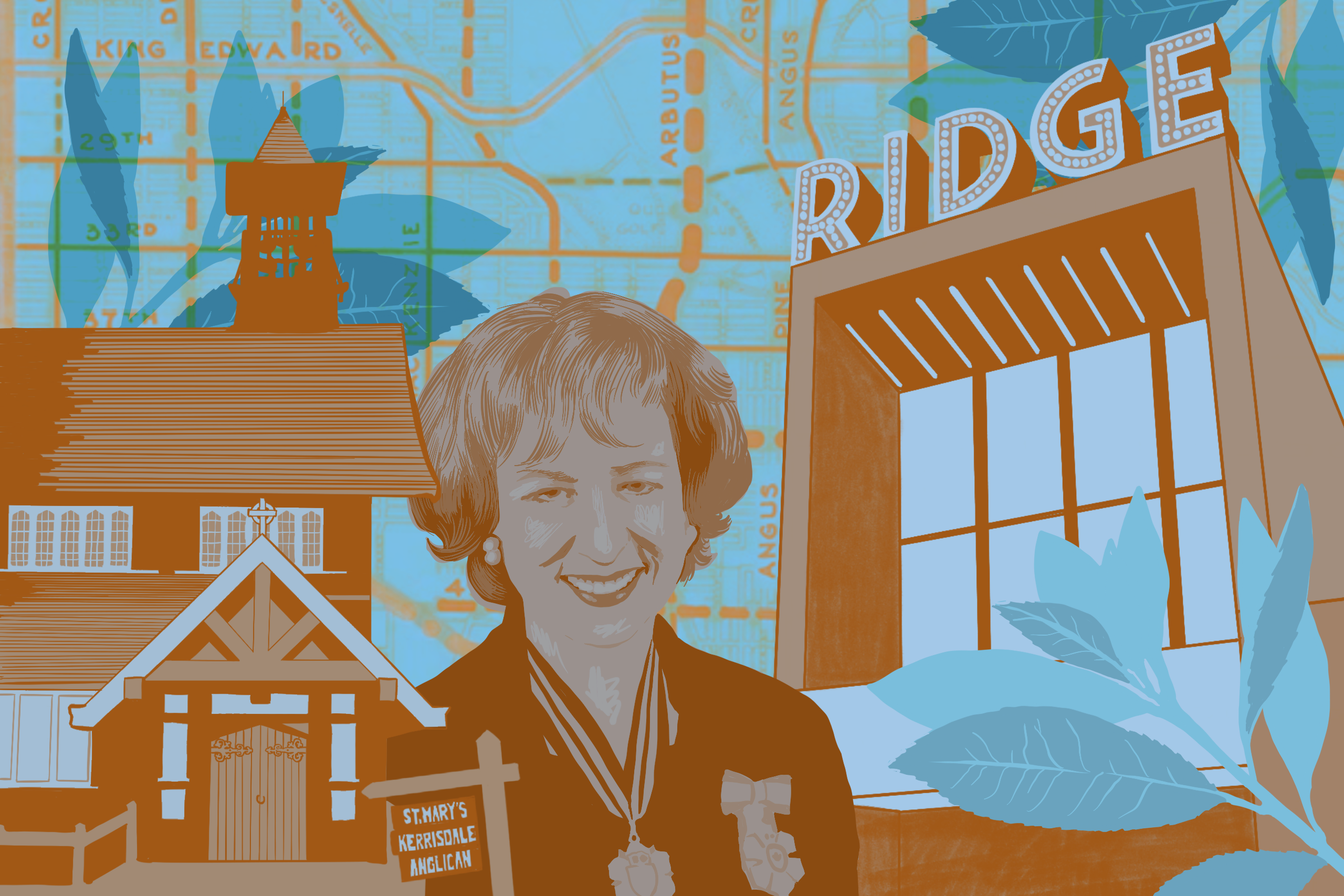
Development started on firmer land, on the western edge of the neighbourhood, in Mackenzie Heights starting in 1912, when the area was still part of the city of Point Grey. As with homes in neighbouring Dunbar and Point Grey, the comparatively large building lots made the area appealing to middle-class homeowners (and later, developers). St. Mary’s Church, on West 37th, built in 1913, is one remnant of that initial era of settlement. As with many of the homes still standing from that time, it was designed in the arts and crafts style.
Before car culture made cross-city shopping more accessible and residential-only zoning dominated the west side, a business drag developed on Mackenzie Street around West 33rd. In recent years, this type of grandfathered small business has been touted, as in a 2017 Vancouver Is Awesome article by Christopher Cheung that lauded local business people such as baker Earl Morris, who once ran Kerrisdale’s Red Onion (its sign can be found in Bigsby the Bakehouse’s bathroom) as well as “Christos Kaskamanidis, the 79-year-old neighbourhood barber who gives haircuts and plays you the accordion.”
As Mackenzie Heights built up, the flatlands were used as farmland in the 1920s. In a 1981 edition of Milk Break, a B.C. dairy-industry publication, Earl Webster remembered working at the Arbutus Farm Dairy on West 33rd and Arbutus in 1924. “I did two routes daily—six hours on, six hours off—for two years straight without missing a day, supplying milk to Vancouver’s doctors and lawyers living in Shaughnessy,” he recalled. “We had 38 cows at that Arbutus farm; once we lost one for seven days and found it in the bushes nearby, after it had given birth to a calf.”
In 1925, a few blocks east of Webster’s farm, other Vancouverites were playing, not toiling, on a newly established nine-hole golf course. Leased from the CPR to prominent local businessmen, Quilchena golf course expanded to 18 holes in 1927 and remained open until 1957, when the city purchased the site from the CPR to use as park and school land. The golf club relocated to Richmond.
The flats, which welcomed tarpaper shacks in the 1930s, were turned into a proper westside neighbourhood in the 1940s and 1950s when sand was transported from False Creek to solidify the ground. Houses built in a more modest bungalow style subsequently sprang up. The children in these families often went to Prince of Wales Secondary, which moved to its current location (on former golf course land) from the present-day site of Shaughnessy Elementary, farther east, in 1960.
One of its graduates in its first years at this new site was Kim Campbell. Before she became the 19th prime minister of Canada, she was the first-ever female student council president in the secondary school’s 43-year history. Described in a 1963 Vancouver Sun article as a “pretty strawberry blonde who thought some new ideas were needed,” Campbell captured 50 votes out of a ballot count of 100. Asked whether she was intimidated by the male members of the council, she responded: “There are some pretty big boys on it, but I’ll have a big gavel.”
The teens who voted for Campbell likely would have hung out at Ridge Theatre, which had a long, noble run as repertory theatre and featured a balcony level “crying room” for cineastes with infants, and the Varsity Ridge bowling alley, which welcomed 15,000 kids a year at birthday parties. (Technically, both amenities fall just north of Arbutus Ridge, but they belong to this neighbourhood more than to Kitsilano.) Both opened in 1950 and fell in 2013 to a supermarket and condo development.
The area’s other major retail area is Arbutus Village Square shopping centre, or Arbutus Centre, which opened in 1974 with attractions including Sarah’s Tea, Coffee, and Spice Shop, a Bootlegger outlet that sold Levi’s to a younger clientele, and Windmill Toys and Gifts, which imported 80 per cent of its stock, mainly from Europe. This mall was torn down and is being rebuilt in phases, with 125 new homes opened in 2021, and a total of 674 eventually promised by the city.
In the 1980s and 1990s, the neighbourhood—Mackenzie Heights, in particular—was beset by teardowns and rebuilding in by then a mature community. In a 1990 Vancouver Sun feature, columnist Denny Boyd visited the area with Michael Kluckner. The local historian and visual artist told Boyd about the first house built in the area: “It used to be called Playfair house, 2 1/2 storeys, leaded windows, wooden steps and a veranda, built on two legal 10-metre lots.” Boyd writes that the house sold in 1988 for lot value and was demolished, with “two modern, boxy view houses,” one of which was occupied by the purchaser. The other was flipped for profit. “The purchaser, demolisher and current resident,” Boyd revealed in the article’s final sentence, “is New Democratic Party leader and former Vancouver mayor, Mike Harcourt.”
Today, census data show Arbutus Heights to be an aging, well-off neighbourhood with a large East Asian presence. A city report also notes more “income polarization and a higher low income rate than the city overall.” On a related note, the Arbutus Club was in the news in 2025 when its workers went on strike for fair wages. The disparity between the elites and plebes in this west side neighbourhood is, unfortunately, no rumour.
Correction: The original version of this story stated that the Arbutus Centre had been rebuilt. At publication, its second phase has not in fact been completed.
Read more Vancouver neighbourhood stories.