

This story is the 24th in our series on the hidden history of Vancouver’s neighbourhoods. Read more.
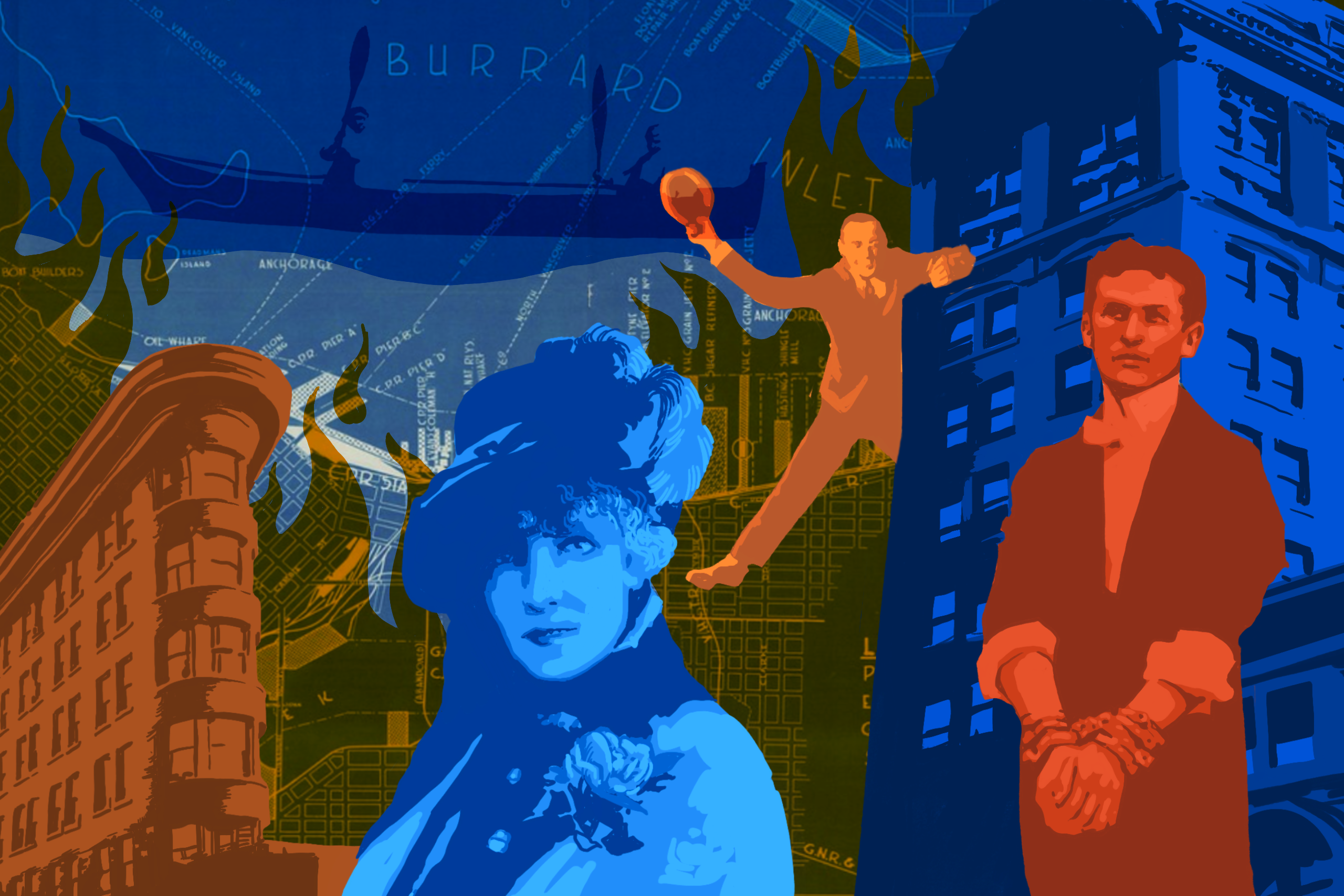
Before Vancouver was built, it first burned down. On June 13, 1886, only a couple of months after the city was incorporated, sparks from a clearing fire—intended to create space for the CPR roundhouse at the north end of False Creek—started a blaze that moved east on a dry, windy day. Within hours, the city was swallowed in flames, forcing people to escape by canoes, boats, and rafts. Approximately 1,000 buildings burned down, and about 20 people died.
The original Granville townsite had formed in 1870 about a kilometre west of its sawmill, Hastings, established five years earlier. At its heart, Water Street, which then ran along the shoreline, intersected with Carrall and Powell Streets at what is now called Maple Tree Square. (The entire area was known in the Squamish language as K’emk’emeláy, or “the place of many maple trees.”) Nearby was the Globe Saloon, owned by Jack Deighton, whose long-winded, “gassy” conversational style gave the area its name. Among its residents were people of Portuguese, Chinese, African (via the United States), and Hawaiian descent.
By the day after the fire, lumber was being brought to the city’s ruins to rebuild. One saloonkeeper was selling glasses of whisky using a sack of potatoes as his counter. “Lives were lost and buildings destroyed,” Daniel Francis notes in Becoming Vancouver, “but the assets that had brought about the creation of Vancouver in the first place remained: a capacious harbour, a plentiful supply of rich timber, and a railway connection to the East.”
While no longer the centre of city life, Gastown remains part of the city’s downtown, along with, in reality, a constellation of neighbourhoods hemmed in by False Creek to the south and its harbour to the north. Parts of this area, such as Yaletown and Coal Harbour, initially served the city’s resource-extraction roots before filling with the condo developments that populate the downtown core. The history of this area tells the story of the city’s maturation and the response by its planners and developers to sociopolitical trends of the last 140 years.
Before Granville, what’s presently known as the downtown peninsula was heavily forested and occupied by the Coast Salish peoples, who harvested trees for their homes and tools and feasted off mussels from the water. Fur trading and a gold rush brought European settlers to British Columbia (a British colony from 1858 to 1871, when it became the sixth province of Canada), but it was the Canadian Pacific Railway’s railroad terminus that made Vancouver its centre.
The city grew quickly, from 1,000 inhabitants in 1886 to 27,000 in 1901. Much of that early growth was in Gastown, where many buildings survive from the rebuilt city’s first decade. Among the first constructed after the fire was the Byrnes Block, on Maple Leaf Square. Also know as the Alhambra Hotel, the brick building boasted a chimney pot for every room. More recent, but probably the most distinctive building in Gastown, is the narrow, triangular Hotel Europe at 43 Powell Street. Built in 1908, it evokes New York’s Flatiron building (completed only six years earlier) but also sparks déjà vu from its appearances in movies such as Legends of the Fall and Neverending Story.
While Gastown remained vital in Vancouver’s first half-century because of its proximity to commerce, its hotels and saloons lent it a seedy air. The heart of the city moved to the more respectable Downtown Eastside but then migrated west in the first half of the 20th century. This shifting of the city’s centre felt inevitable, because the land west of Carrall Street was owned by the CPR, which was given 6,000 acres of real estate in exchange for choosing Vancouver as its westerly terminus over Port Moody.
The CPR’s influence on the early city—right down to its name, which was chosen over Granville by general manager William Van Horne—cannot be understated. It built its railroad station at the base of Seymour Street in 1914 and opened up trans-Pacific trade in the blocks to the west, where the Vancouver Convention Centre and cruise ship terminal are currently found. The CPR also erected the first Hotel Vancouver at Granville and Georgia Streets in 1888—it would be replaced with a new building in 1916 and then moved to another at Burrard and Georgia in 1939—and a nearby opera house on Granville Street that welcomed actress Sarah Bernhardt the year it opened, 1891. In the early decades of the 20th century, Granville Street established its lasting place as the city’s entertainment hub, with venues such as the Orpheum (which began as a vaudeville house) and the Commodore Ballroom opening in the 1920s.
Entertainment in those boom times didn’t only happen inside these new buildings but also often from atop them. In 1918, Harry Gardiner, the “Human Fly,” climbed the Sun Tower building—which, at 17 storeys, was then the tallest skyscraper in the British Empire—as a crowd gathered to watch him at Pender and Cambie. Five years later, before a performance at the Orpheum, Harry Houdini hung upside down in a straitjacket from the same building before 10,000 gawkers. (In the age of viral video, high-altitude feats of daring have returned to the city.) In 2001, when Timothy Taylor, who kept an office in the 1905 Dominion Building, published his novel Stanley Park, he described this about the liminal neighbourhood (caught between the city’s rougher areas and its central business district): “Crosstown smelled like pot and moved like a trance. Crowds spilled out of the Cannabis Cafe and Fabrek’s Falafels, and the streets were full of young travellers and rivulet-headed, round-headed young women in hip-huggers. The neo-hippie. The zippie. The raver. The punk.”
Meanwhile, on the fringes of this urban core, industry predominated. While Coal Harbour, now the home of luxury apartments and a busy airport for float planes, was named for the coal found on its shores, its quality was too poor to be worth mining. However, in early years, the area hosted a seaplane factory and herring fishing operations, along with a community of Hawaiians. With its terminus built, CPR repair and construction operations were transported—along with some single-family homes—from 170 kilometres to the east in Yale, B.C., to a stretch of north False Creek that took its name. Yaletown became an industrial area of sawmills and warehouses, the latter retrofitted as lofts, offices, and restaurants since the 1970s.
Between Yaletown and Robson Street, the area fed by the Granville Street bridge is now best known for its residential towers, but it has a history of mixed use, including auto repair garages, dance clubs, and single-family homes. One prominent survivor from this raucous era is The Penthouse, the cabaret and burlesque joint opened in 1947 by the Filippone family, which has welcomed celebrities including Ella Fitzgerald, Frank Sinatra, and Sammy Davis Jr. but is now trending for its clever, sometimes topical marquee messages such as “Forever Neighbours, Never Neighbors” in 2025 during the height of U.S.-Canada tensions.
The Great Depression followed by the Second World War stalled development downtown and led to decline that lasted decades. One proposed renewal effort in 1968, Project 200, included a series of new highrises and a freeway that wrapped around Gastown and along the waterfront. The project died after community protests quashed plans for the freeway. Around that time, entrepreneurs and developers saw untapped opportunity in the area’s heritage. Their efforts culminated in Raymond Saunders’s Gastown steam clock, privately funded by local merchants and built on Water Street in 1977, which has become a major tourist draw.
The 1970s saw the unveiling of Arthur Erickson’s Law Courts Complex, a sprawling “horizontal highrise,” which later ushered in the development of Robson Square and the Vancouver Art Gallery’s move to its current location at the old provincial courthouse. That decade also saw the former Hotel Vancouver building demolished to make way for the Pacific Centre Mall and the Eaton’s department store, in a windowless building described as a “great white urinal.” The mall diminished commerce nearby on Granville, and the area became dominated by sex shops, strip clubs, and arcades. Other downtown landmarks, including the city’s two major stadiums, BC Place and Rogers Arena, and the central branch of the Vancouver Public Library designed by Moshe Safdie, arrived in the 1980s and 1990s.
In addition to enduring memories of Expo Ernie and the McBarge, the 1986 world’s fair added Science World and Canada Place to the face of downtown while priming its site on north False Creek for development. As Expo 86 faded into memory, the city’s transformation, guided by a philosophy later known as Vancouverism and attributed to city planner Larry Beasley, took hold. The downtown core would be inhabited by people living in glass highrises in former industrial areas such as Yaletown and Coal Harbour. They, in turn, would keep the streets lively at the end of the workday. They’d shop and hang out within walking distance of their homes. Meanwhile, zoning by-laws would protect their views of the mountains and water and keep their homes quiet by concentrating night clubs on Granville Street, whose ongoing decline prompted a 20-year renewal plan in 2025 to make the area more pedestrian and family-friendly.
While this plan has been largely viewed as a success, the downtown core has also been a source, and site, of conflict. The infamous Stanley Cup riots of 1994 and 2011 stemmed from combinations of inebriation and group nihilism. Other events—the 1918 general strike, a dockworkers strike in 1935, and a mass occupation of the post office, Hotel Georgia, and the Vancouver Art Gallery in 1938—were sparked by economic unrest. Others arose from sociocultural clashes. The Zoot Suit Riots in the summer of 1944 were a series of brawls between a gang of flashy “zoot suiters” from the east end and merchant seamen on Granville Street, while the 1971 Gastown Riot saw the arrests of 79 protestors (out of a group of 2,000) who were demonstrating for legalized marijuana use.
On Valentine’s Day 2022, the most striking act of protest occurred at the city’s birthplace when a statue of Gassy Jack Deighton—heralded by those who raised the statue in the 1970s as the city’s founder but derided by others for marrying a 12-year-old Squamish girl—was covered in red paint and toppled in Maple Tree Square during the annual Women’s Memorial March.
was 12 years old when she was wed
To Jack
Through an arranged marriage by her Aunt
Cease Wyss writes in her “Ode to Madeleine Deighton.”
She had left Gassy Jack Deighton
By Vancouver historical records she was
A Woman Disinherited
By Skwxwu7mesh records She was a Powerful Woman.
Perhaps these protestors learned from the city’s history that, to build again, what currently stands first must be cleared.