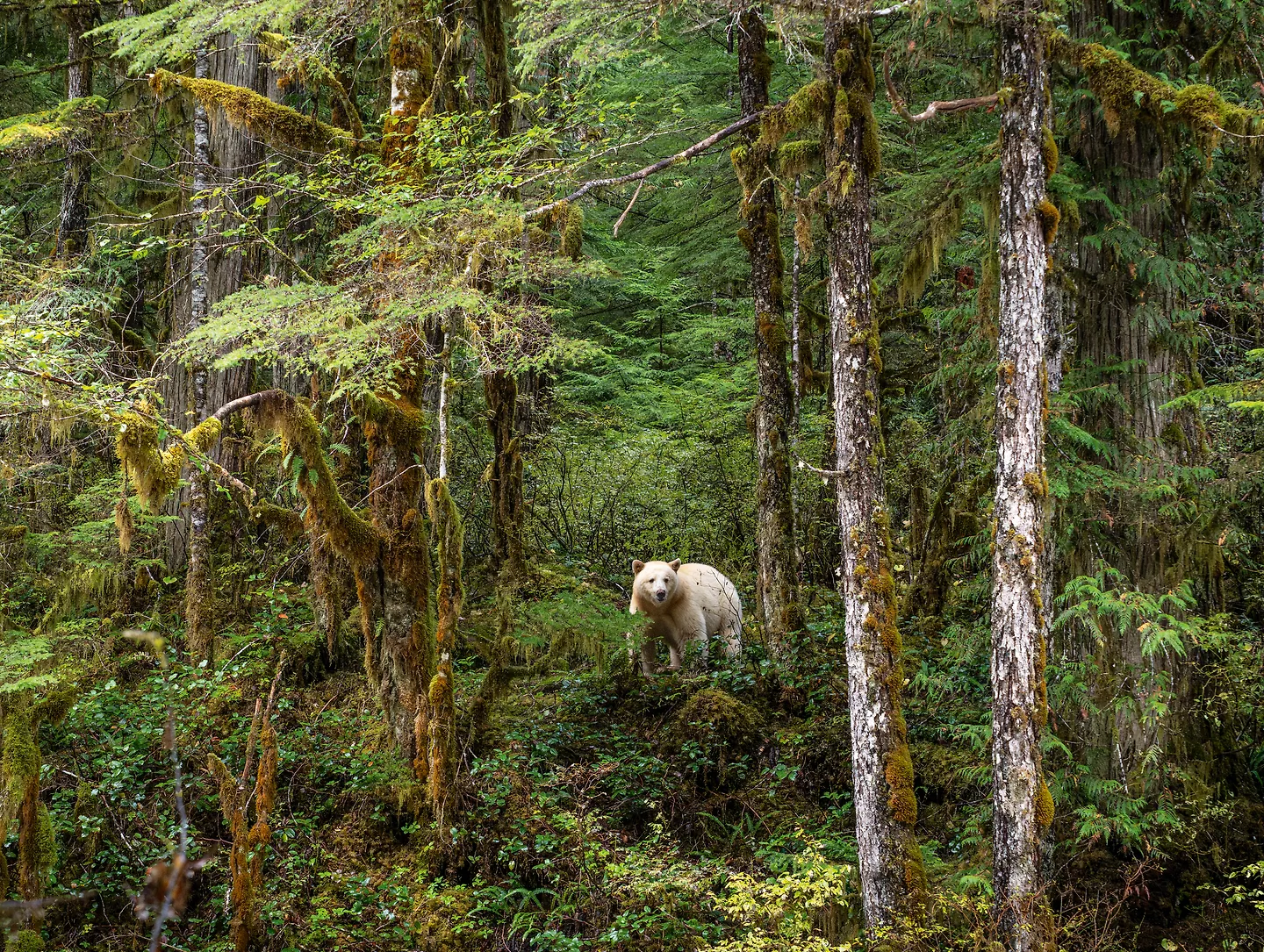


“In a moss-draped rain forest in British Columbia, towering red cedars live a thousand years, and black bears are born with white fur,” teased a subhead in the August 2011 issue of National Geographic. The article, by Bruce Barcott, was a global introduction to British Columbia’s hallowed spirit bear, a rare white version of the Kermode bear—itself a coastal subspecies of the American black bear—also known as ghost bear or moksgm’ol to the Kitasoo Xai’xais Nation.
It was a sentence designed to get attention, yet one needed little convincing to crack into a piece based on stunning images from internationally renowned Canadian wildlife photographer Paul Nicklen. After the surreal cover of a spirit bear climbing through a Pacific crabapple tree accompanied by the tantalizing cover line “The Wildest Place in North America,” the feature’s opening spread combined harmonious familiarity with complete visual dissonance.
Against a dark-green palette, the bear, salmon clutched between paws like a dog on a bone, affected an arresting chiaroscuro, as if all the light in the forest were being drawn to its singular being. In this alone one sensed magic and myth. If you were a nature-addled kid a world away, yearning for a type of wildness absent in the small, wooded pockets dotting the British countryside, here was desire incarnate. A symbol. A compass point.
An obsession, even.
Such was the effect on a teenaged Jack Plant, who’d long fed his biophilia by turning logs in pursuit of bugs, fishing with his father, and consuming countless hours of BBC nature documentaries at his childhood home in England’s South Downs. His imagination captured by the spirit bear, he would track this lodestar to its source with a 2014 visit to Spirit Bear Lodge in Klemtu, a remote Kitasoo Xai’xais community on the Central Coast. Here, everything, as he puts it, “fell into place.”
Given their rarity (likely less than 100 in existence), Plant had little hope of seeing the fabled creature during a scheduled two-day tour. Indeed, he was on his way home—on a day that also happened to be his 21st birthday—when a fellow passenger claimed to have spotted something ashore. Though no one else had seen it, the boat stopped anyway. Minutes later, a white bear broke free of the trees. Magic, indeed.
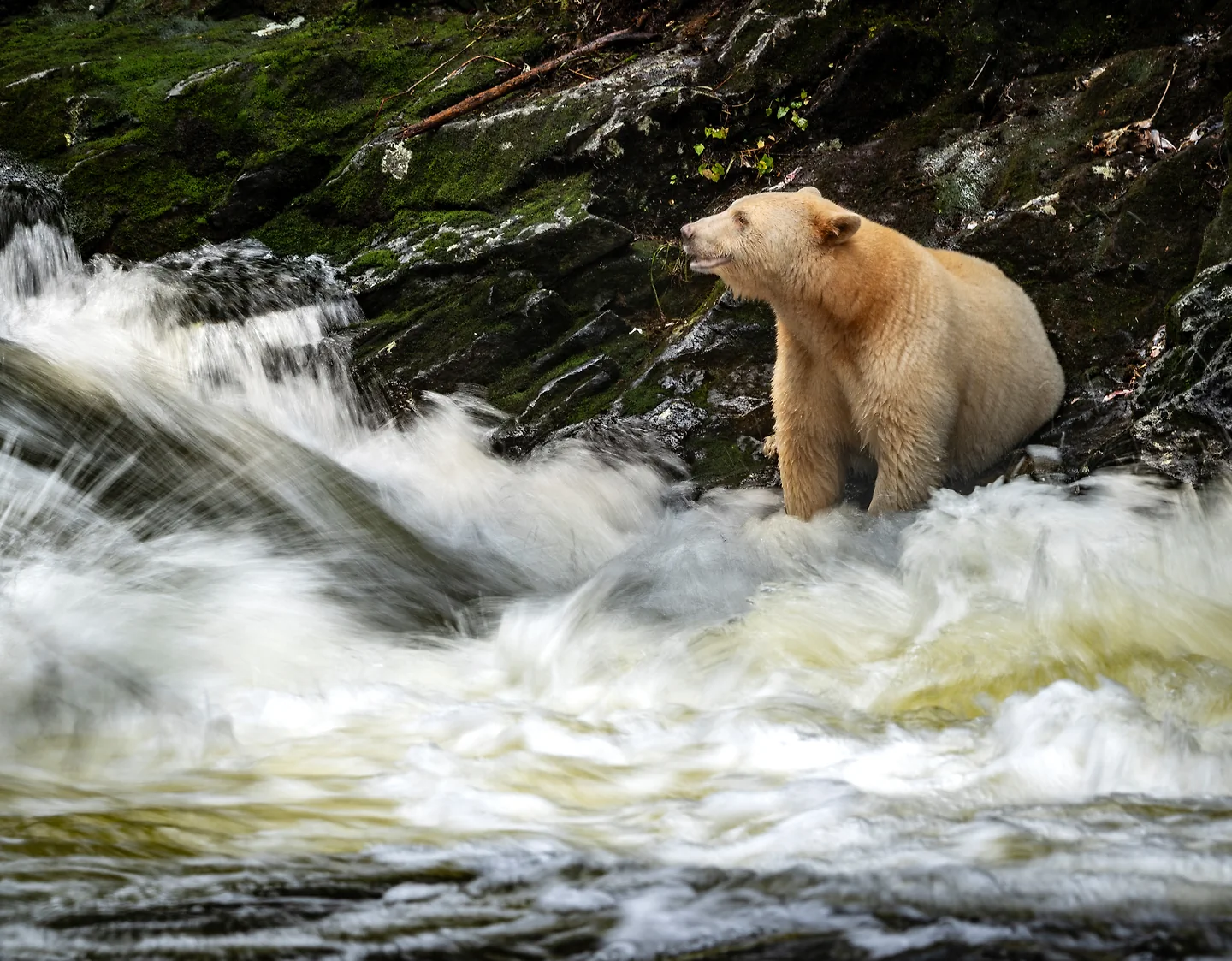
Plant originally went to the rainforest not as a photographer but as an observer. He watched one spirit bear mature from one to eight years old.
“So my first trip into the rainforest, on my birthday, and there he is,” Plant recalls with considerable animation. “And I thought, I have to find a way to spend a lot of time here.”
He quickly figured that out, becoming a guide for the lodge’s photo-focused clientele and ultimately picking up a camera himself to document the same majestic creatures, as well as the mountains, seascapes, and life in Klemtu. A decade into a photographic journey marked in equal measure by dedication and humility, Plant’s debut book, Spirit of the Great Bear, offers, as Nicklen himself says in the foreword, “a love letter to the living, breathing world.”
Brimming with stories both verbal and visual, it lands as a wise man’s compendium of wonder. As a result, I’m not sure what to expect of a young person possessed of such old-soul sagacity when I sit down with Plant on a foggy January afternoon in Squamish, where he resides. The reason for Nicklen’s praise, however, is soon clear. Fresh from the gym, the 32-year-old is clear-eyed and upbeat, with a calm, quiet demeanour that doubtless serves him well both in craft and in nature. For his first interview as an author, Plant is equally unsure how things might unfold. Will it delve into science, he asks, careful to note he’s not a biologist. I reassure him I will only go as deep as he has in his book, where he notes that the mutation behind white fur is a recessive variant of the melanocortin 1 receptor gene—the same variant responsible for your red-headed friends and slobbering yellow lab.
My starting point is more obvious: Plant’s preternatural images. As residents of B.C., we enjoy the perk of abundant wildlife, photos of which are everywhere. What immediately stands out in Plant’s portraiture, beyond obvious technical prowess, is its level of intimacy, as if he weren’t just pointing a lens in a bear’s direction but is with them in some unquantifiable way.
Is this because he originally went to the rainforest not as photographer but as an observer (“Jack didn’t come to take pictures,” Nicklen notes. “He came to listen”), acquiring knowledge of individual animals’ character and habits that transmuted into photos? “Absolutely,” Plant agrees. “For example, I watched one of the spirit bears in the book grow up from a year old to eight years old.”
Presenting himself in the same spot almost every time, Plant spent abundant hours observing this bear—which, in turn, was observing him. “I learned which direction he’d come from, where he liked to jump in to chase salmon, where he usually caught one, where he liked to eat it,” he says of a bear who likely knew equally much about his own behaviour.
“My style became more artistic. That was the point I started to feel my images become more emotional or perhaps more intimate.” —Jack Plant
While Plant’s photography benefitted greatly from what animals taught him, he also learned from human mentors. Doug Neasloss, chief councillor in Klemtu, was first to train him how to be around bears. Kitasoo Xai’xais hereditary chief Ernest V. “Charlie” Mason, a boat skipper for Spirit Bear Lodge, was “like a grandfather,” ceremonially adopting Plant as family and giving his blessing to the book before he died in 2025. “A lot of people taught me how to navigate the rainforest and drive boats, but Charlie’s local knowledge was beyond anyone’s,” he says. “Our relationship developed through that, and listening to his stories, and visiting him in Klemtu, watching him sing in the Big House.”
Importantly, there was also Paul Nicklen.
During his first year in the rainforest, before he became a photographer, Plant drove into a bay only to find another boat, which soon radioed him requesting a chat about bears. “So we tie our boats together, and out comes Paul,” Plant recalls. “I instantly recognized him. I was like, I know who you are. We had this great chat, and then we said goodbye.”
Two years on, after he’d been shooting for a year or so, Plant got an email from Nicklen looking to meet up in the same bay. “I said, absolutely. So we met and talked bears and things. He also interviewed me on camera. It was my first time, and I totally choked. My words just didn’t come together.”
Nevertheless, Nicklen had taken a liking to Plant, offering an internship with his conservation charity, SeaLegacy. Plant put in a few months before returning to the rainforest, to take “some of my better photos,” but with the ultimate friend and correspondent in his pocket to help critique the work.
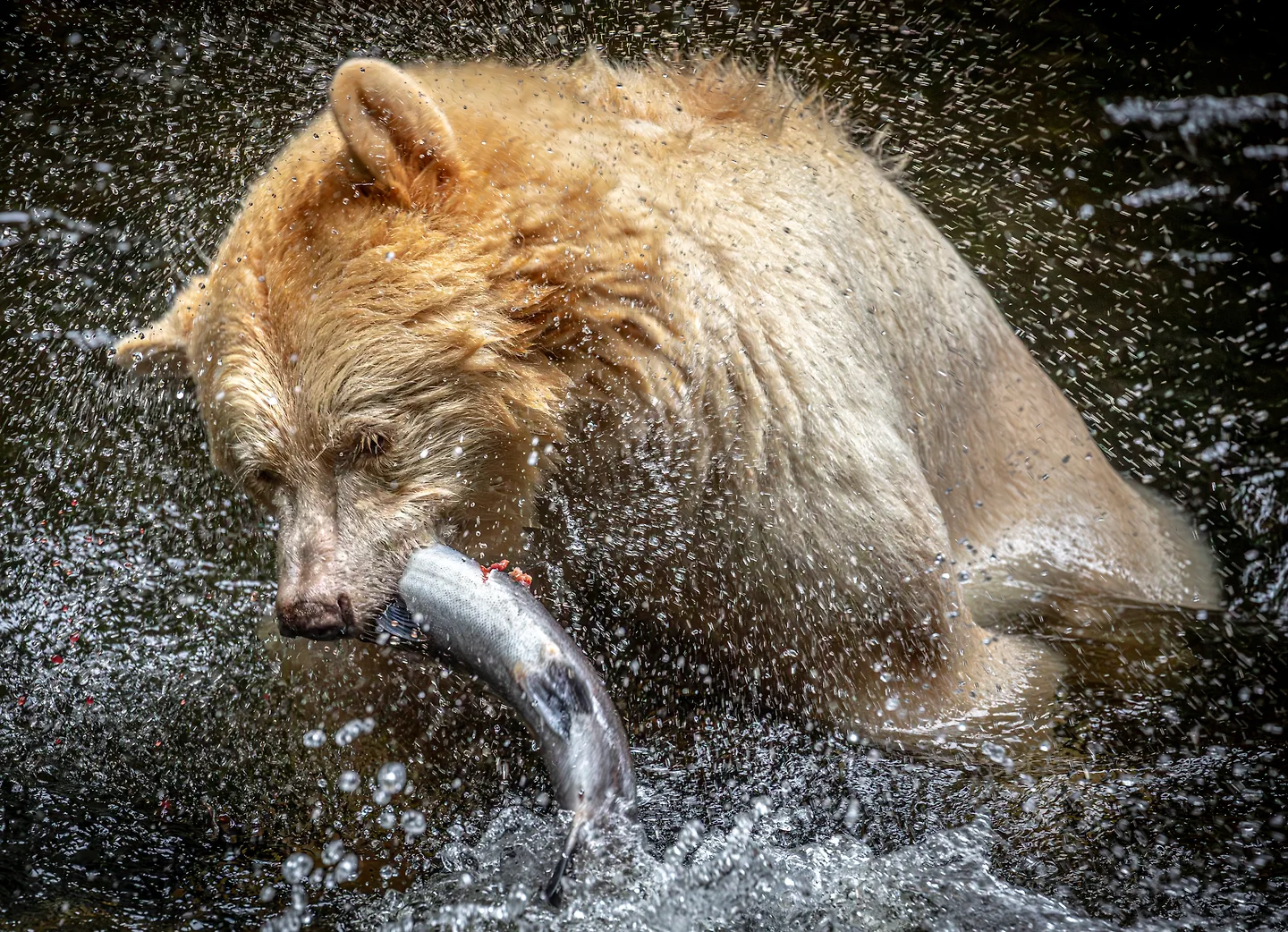
Studies confirm that spirit bears catch more salmon than black bears during the day, when white fur is less visible to the fish.
Plant sees this watershed as key to his development. “I think my style was very journalistic at the beginning. The first few years, I was really just trying to take a good photo of an animal that was in focus,” he says. “But as I hung around people like Paul Nicklen and Cristina Mittermeier, and looked at photos from people like David Yarrow and Steve McCurry, my style became more artistic. That was the point I started to feel my images become more emotional or perhaps more intimate.”
That seems inevitable given a task that in some ways reverses much of what wildlife photography serves to do—in this case turning the extraordinary into the ordinary versus the other way around. For the spirit bear is not, in the end, a mythological being but a bear doing bear things. And for which there may be evolutionary reason for the high-frequency persistence of its white-fur gene variant: salmon.
Though there is much speculation about the gene’s origins—for example, an adaptive leftover from glacial times, or that coastal incursion by grizzlies might drive Kermode populations onto islands where the variant spreads more readily—a 2021 University of Victoria study confirmed earlier work showing that white fur appears less visible to salmon, helping bears fishing during daylight catch a third more salmon than their black-bruin counterparts.
Like Plant, British Columbia has obsessed over its spirit bears. Long a hushed secret among First Nations, the white Kermode emerged more fully into provincial consciousness in the new millennium, becoming B.C.’s official mammal and a mascot emblem of Vancouver-Whistler’s 2010 Olympic Games (Miga was a mythical sea bear combining characteristics of the orca and spirit bear). There was also Spirit Bear: The Simon Jackson Story, a 2005 independent Canadian film based on the real-life campaign by Spirit Bear Youth Coalition founder Simon Jackson to save the bear’s habitat—Great Bear, the world’s largest intact coastal temperate rainforest at 6.4 million hectares.
Saving this great swath was almost always the reason spirit bears made headlines during those decades: impacts from logging had yet to be meliorated by a 2016 agreement with the provincial government, controversy was growing over open-net salmon farms in the area, and perpetual threats remained from hunting, since even black bears can carry the recessive variant that gives rise to spirit bears. Most prominent in the eyes of First Nations and environmental organizations, however, was a proposed plan to build a pipeline from Alberta’s tar sands to the coast—directly through the Great Bear Rainforest, creating a supertanker route that would see hundreds of enormous, crude-carrying vessels ply these storm-tossed waters annually.
Indeed, the August 2011 issue of National Geographic contained a second feature by Bruce Barcott, “Pipeline Through Paradise,” to which Nicklen and colleagues in the International League of Conservation Photographers contributed. Publicizing the threat posed to the rainforest, coastal environments, and Indigenous inhabitants by a crude oil spill was, in fact, Nicklen’s original motivation for proposing the spirit bear story, and juxtaposition of the two pieces ultimately had the desired outcome. Plant writes in his book: “The proposed plan to build the pipeline and the oil tanker traffic that would come with it were eventually shut down. I find this to be a pivotal moment in Canadian history, a time when First Nations voices were truly heard and a hard-fought battle was won.”
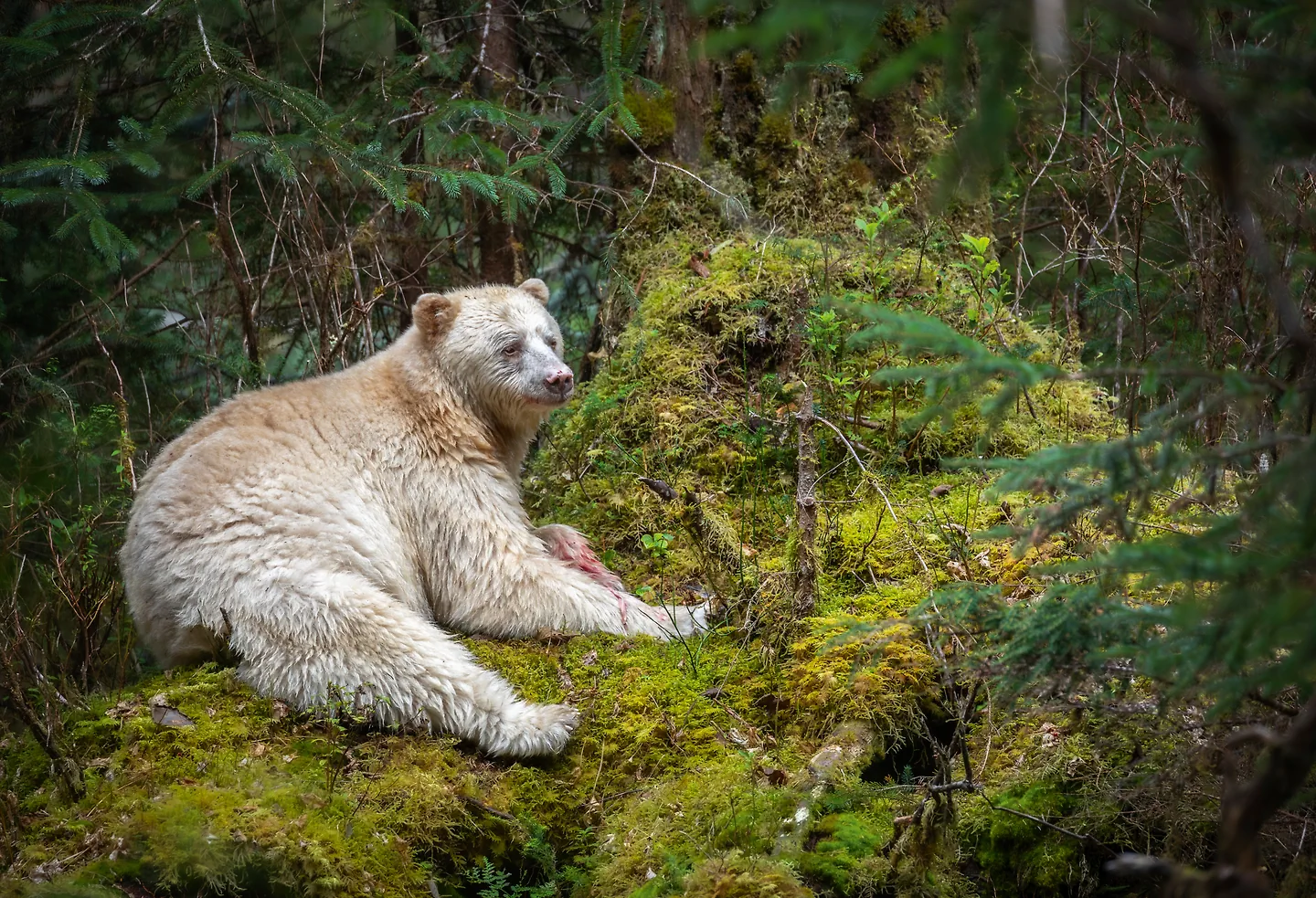
A spirit bear lying on moss.
And yet, today the spectre of that same pipeline has been rejuvenated as an MOU between the federal government and the province of Alberta. Flying recently over the torture of fjords, islands, and glaciers of the Great Bear Rainforest on a clear winter day, I found it hard to believe anyone could contemplate running supertankers through the area. Of course, these are but two-dimensional considerations to start—mere lines on a map with no sense of the human or environmental cost on the ground.
And so perhaps this is what a book like Plant’s provides: a reminder that the myriad phenomena of the natural world we casually file under the banner of biodiversity are actually tripartite: ecosystem diversity, species diversity, and genetic diversity. All three make the Great Bear Rainforest and its denizens wonders worth preserving—and portraying.
As Plant pens in a coda to his most riveting story: “There were no words. Only photographs.”
Read more from our Spring 2026 issue. Photographs from Spirit of the Great Bear © 2026 Jack Plant. Reprinted with permission from Figure 1 Publishing.