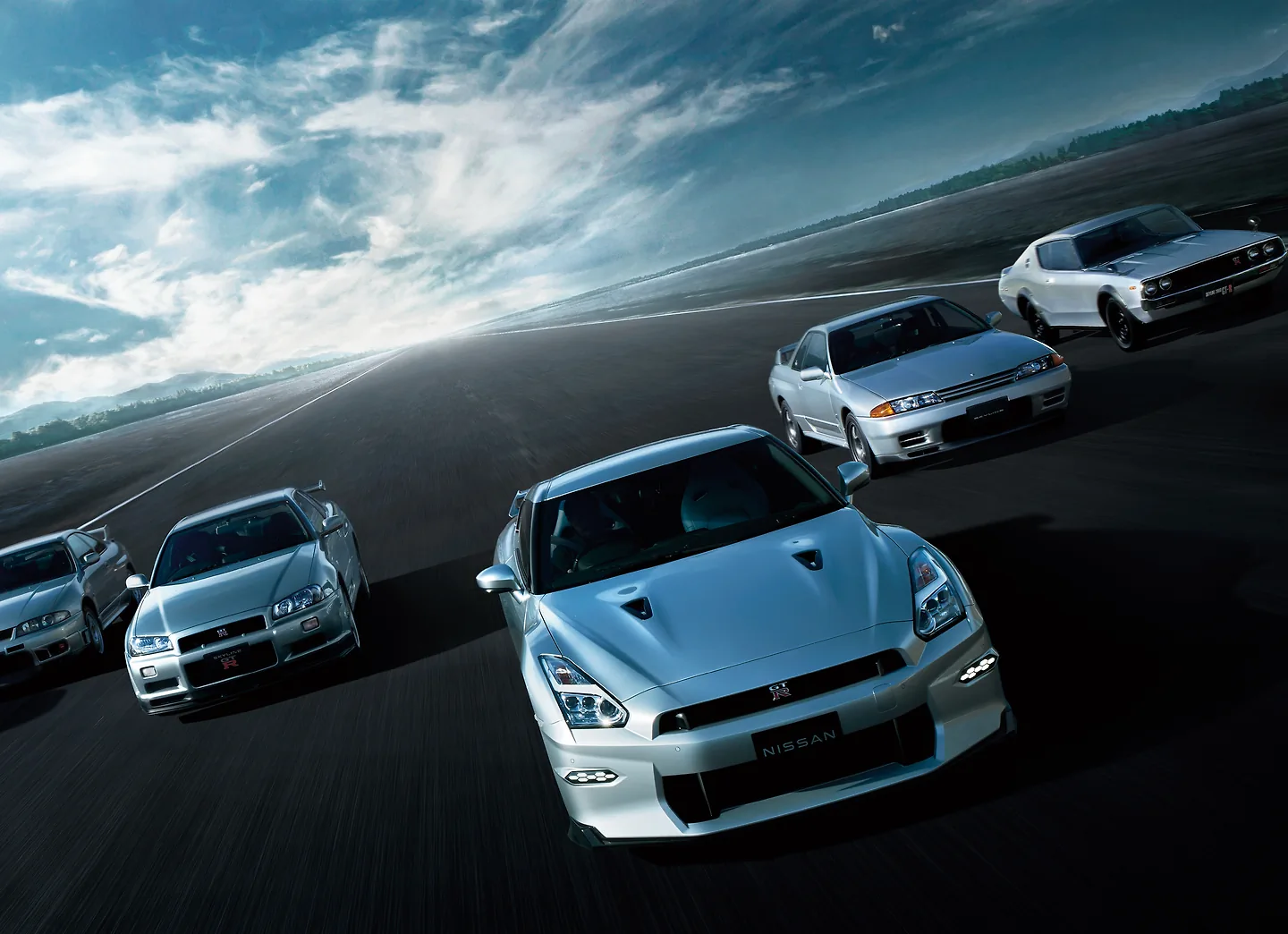


The final Nissan GT-R rolled off the line in August of last year, resplendent in Midnight Purple metallic paint. A colour once restricted to royalty, purple was a fitting hue for a faded emperor of speed, a car that carried the banner for Nissan for a scarcely credible 18-year run. We will likely never see anything like it again.
This final version is a T-spec example, one of the designations that are nearly indecipherable to anyone but the GT-R’s most enthusiastic fans. Because of the car’s long production run, and the even longer history of the badge, these are legion, each capable of rattling off every glacial-paced year-by-year change.
But here are the salient details. The last GT-R has a complex powertrain that uses a rear-mounted gearbox and all-wheeldrive. Its computerized brains give it the ability to transform driver input into physics-defying grip like something out of a Japanese anime. Yet its heart, a twin-turbocharged, 565-horsepower V6 built of lightweight, balanced, forged internal parts, is handcrafted. A single master craftsman—a takumi—assembled it, placing a single hand on the block while it first spun to life on the engine dyno, feeling for that essence of speed.
In an age when electrification and software dominate discussion in the automotive industry, the GT-R stands with a foot in the future and the past. A technological game-changer on its release in 2007, it has aged without losing relevance, still capable of putting out numbers that leave the competition scratching their collective heads. Nissan says that the GT-R badge will return, probably fitted with battery packs and other cutting-edge driveline enhancements. However, there is nothing in the current development pipeline, and the company’s financial woes are well documented. For the foreseeable future, Nissan’s flagship will rely on the echo of its legend.
Any discussion of the GT-R must begin not with Nissan but with the Prince Motor Co. In the postwar period, as mobility needs in Japan expanded beyond bicycles and a train network, a wide variety of car companies came into being. Prince was one such company, starting out building rudimentary electric cars, then taking its name from Crown Prince Akihito in 1952, the man who later became the 125th emperor of Japan.
Prince was a bit like BMW or Mercedes, offering more luxury and sporting intent than the plainer, mass-market fare from Toyota or Nissan. Seeking to burnish that reputation, the company’s engineers pulled the oldest trick in the book, taking the big inline-six from its largest sedan and stuffing it into the nose of the smaller Skyline. It’s what Pontiac did to create the GTO and the recipe AMG used for its early cars.
The result, the Skyline GT-B, was a slightly ungainly-looking car with a long nose necessitated by the length of that straight-six. However, it would become an unlikely hero. At the 1964 Japanese Grand Prix, the crowd rose to its feet and cheered as Prince Skyline GT-B racing number S54 successfully passed a Porsche 904 Carrera GTS to lead the race. In the end, the Prince didn’t win, but it had showed that Japan’s best could go toe-to-toe with the world.
The 1960s were a time of great change in the Japanese automotive industry, which faced pressure to consolidate. Toyota snapped up a small company called Hino, which produced the ancestral pickup to the Tacoma. Nissan acquired Prince, and thus the Nissan Skyline was born. Again, the nameplate would go racing, but this time as a Skyline GT-R.
These early cars are called Hakosuka, which simply means “boxy Skyline,” suka being short for Sukairain (“Skyline”). Their success in racing was immediate and dominant. On March 20th, 1972, driver Kunimitsu Takahashi gave the Skyline GT-R its 50th win in less than three years, drifting the car around the Fuji circuit in a torrential downpour. If you lived in Japan, the Skyline GT-R was the hero car you dreamed of.
Nevertheless, through the 1970s, the Skyline GT-R wasn’t well known outside Japan. This side of the Pacific, the Datsun 240Z did much the same job, generating its own legions of fans. Further, when the fuel crises of the decade hit Japan, Nissan paused the nameplate. There would still be Skylines, but no GT-R until the end of the 1980s.
An Australian magazine referred to the GT-R as Godzilla on wheels, and the name stuck.
That reborn Skyline GT-R, known by its chassis code R32, was an entirely different beast than its venerable battle sedan ancestor. During its development, Nissan went to the trouble of illicitly buying one of Porsche’s 959 supercars through a front, shipping it to Japan, and tearing it apart to learn how its clever all-wheel drive worked.
The production car again featured inline-six power but this time with twin-turbocharging. Official power levels were listed as 276 horsepower, but this was a fib. At the time, Japan’s auto industry had an unspoken agreement to not build a car with more than 280 ps (a metric measurement of horsepower). The Skyline GT-R was probably making closer to 300 horsepower, and that was before owners cranked up the boost.
Power was sent to the ground through Nissan’s ATTESA all-wheel drive, which was, if anything, even cleverer than the system used in the 959. Using electronically controlled differentials, it was capable of sending as little as two per cent or as much as 50 per cent of power to the front wheels, pivoting like a rear-wheel-drive car under throttle or scrabbling for every fraction of grip.
In touring car racing, it was nearly unbeatable. An Australian magazine referred to the GT-R as Godzilla on wheels, and the name stuck. Eventually, the car was simply banned from racing for being too good.
Again, the R32 Skyline GT-R was initially mostly a hero in Japan, but this time something was different. In 1997, the very first Gran Turismo game emerged for the Sony Playstation, and soon a global audience was able to drive the car virtually. By 2004, thanks to Canada’s 15-year exemptions on importation, fans were bringing them across the Pacific. You could spot them in the classified ads for as little as $20,000.
Those days are long gone. The R32, R33, and R34 Skyline GT-Rs are all highly sought after by collectors, with the last-of-breed R34 fetching particularly large sums. It was notably featured in one of the Fast and Furious movies, firmly establishing the GT-R’s rise into mainstream consciousness.
The outgoing GT-R, the R35, dropped the Skyline name on its debut. It was no longer a specially developed version of an existing platform but something purpose built. The inline-six was gone, a handcrafted 3.8-litre V6 in its place, each bank of cylinders getting its own turbocharger to force-feed it the oxygen it would consume with furious hunger.
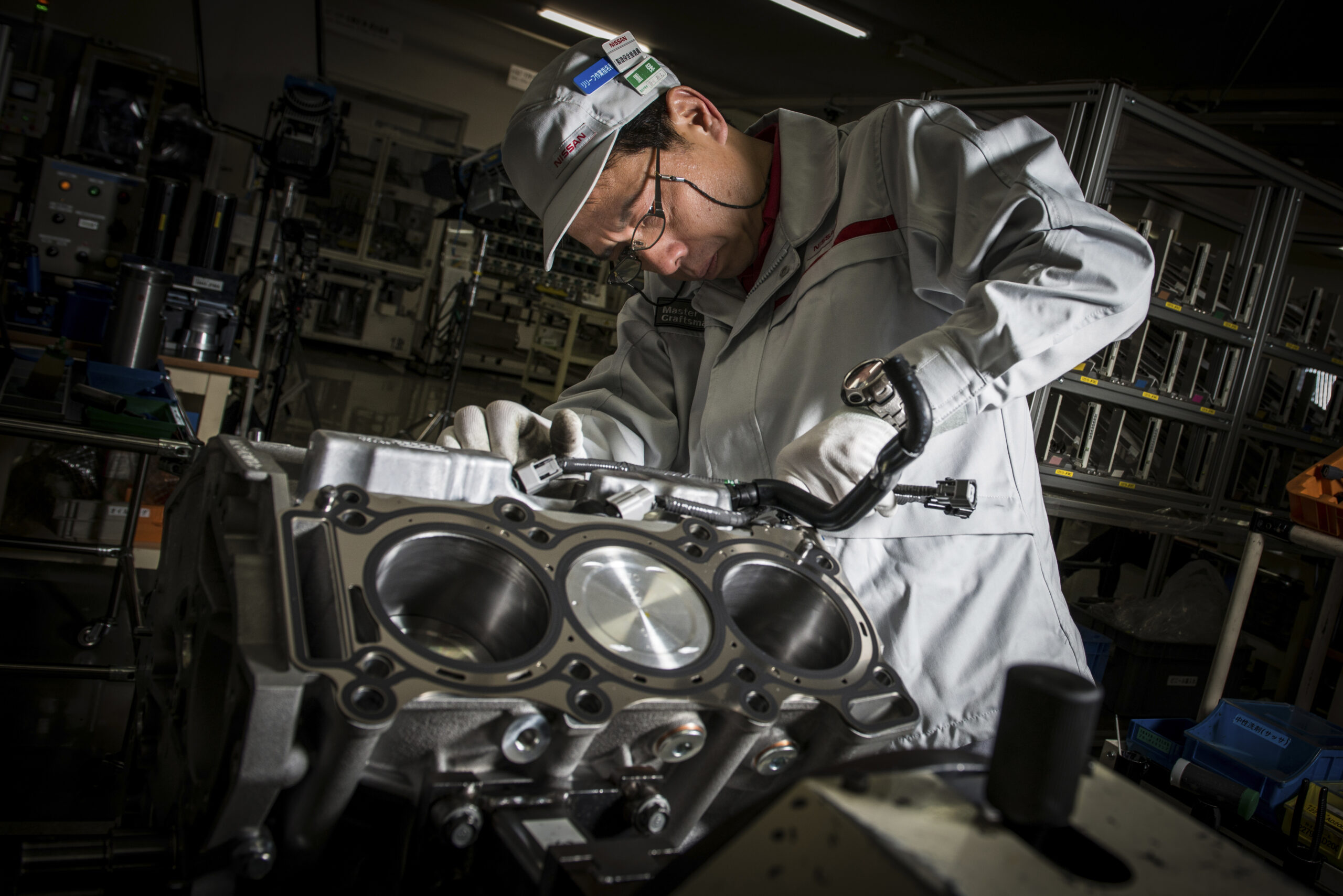
Hiroyuki Ichikawa, one of Nissan’s takumi craftsmen.
The program to build these engines sits at the centre of what makes the GT-R so special. Nissan collected a handful of engine assembly specialists—takumi—and assigned them to build engines in a specially pressurized clean room in the company’s Yokohama home plant. As with AMG’s V8s and V12s, it would be one person, one engine.
One person because the program included a couple of young female apprentices. The four or five takumi worked alongside these, helping train them. If a new GT-R again incorporates a hand-built combustion element, these apprentices may take their place building those engines. Incredibly, over the entire run of the R35 GT-R’s nearly two-decade production run, at least two of the takumi were present from beginning to end. The program is not discontinued either, as replacement engines and spare parts are still being issued.
This human touch was placed inside a high-tech cradle like a Gundam pilot in a mech suit. In fact, that’s really what a GT-R feels like to drive: putting on a giant robot suit. The old cars were snorty and slidey, halfway between a 1970s BMW and a Datsun. The turbocharged 1990s cars screamed to redline on a tsunami of boost.
The R35 never does the cliché of shrinking around you. It always feels big, fast, juddering with impatience at slow-speed manoeuvres. It wants to go fast. So you give it its head, and it thunders around the track, pulling lateral-gs that seem to bend physics. Early on, some critics complained that the car offered a driving experience too much like a video game. With respect, a video game does not generally kick you in the kidneys and then try to pull your head off in a corner.
A GT-R is not an engaging, nimble dance partner. It is monstrous, brutal, awesome in the old sense of the word. As the last of its type thunders out of the gates of a Yokohama factory, you have to wonder if anything Nissan makes in the future will be capable of picking up the mailed fist of a gauntlet this car has finally laid down.
Read more from our Spring 2026 issue.