

Standing at the edge of a quiet meadow ringed by forest and framed by the rolling green foothills of the Selkirk Mountains, I try to imagine the scene local guide Dave Fredrickson is building for me. Holding an old black-and-white photograph at arm’s length, he tilts it slightly, then gestures toward a distant ridge.
“Over 260 internment shacks lined streets that ran in that direction,” he says. “There was the United Church, a Buddhist temple, stores, a bathhouse, a school.”
I close my eyes and try to picture it: streets where there is now grass; doorways opening onto what has become wildflowers and wind. Eighty years ago, this farmer’s field was known as Lemon Creek—one of the largest Japanese Canadian internment camps in British Columbia.
Over the past few hours, as I’ve explored the Japanese Canadian Legacy Trail—a self-guided route linking former internment sites across roughly 60 kilometres of the Slocan Valley—I’ve begun to piece together unfamiliar details of a story I somehow thought I already knew. Developed by people who live here, the trail reflects a shared belief that this history is too large, and too important, to remain contained within commemorative events or textbooks. Instead, it invites anyone moving through the valley to encounter what happened here at their own pace—on foot, by bike, or by car—through the landscape itself.
In the tense days following the attack on Pearl Harbor, fear and suspicion hardened into policy along Canada’s west coast. Japanese Canadians—fishermen, farmers, business owners, homemakers, elders, children—were declared “enemy aliens.” More than 22,000 were forcibly uprooted from their homes and held in brutal conditions in Vancouver’s Hastings Park livestock buildings. From there, they were loaded onto trains and sent more than 150 kilometres inland.
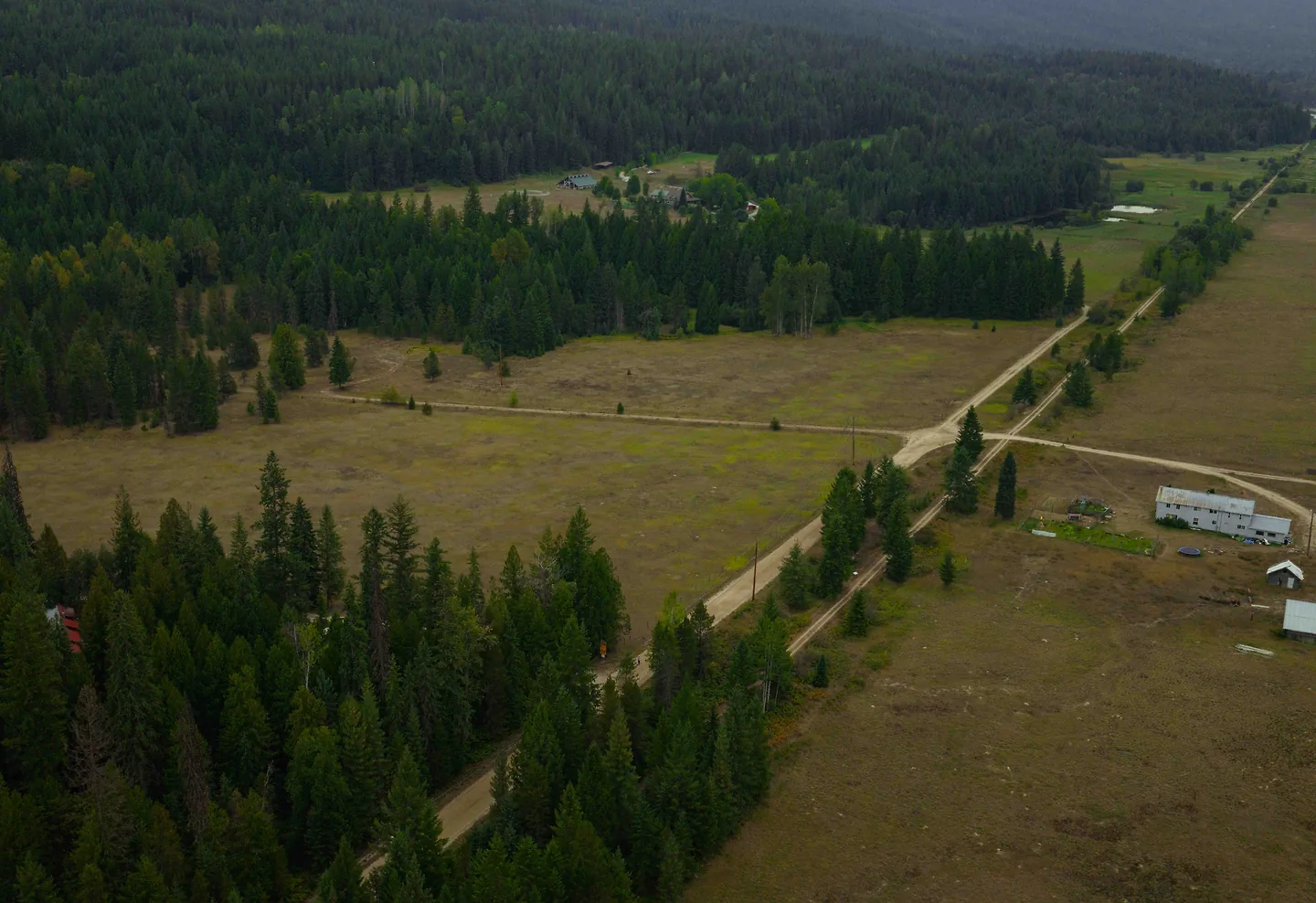
Aerial view of Lemon Creek today. Courtesy of Arrow Slocan Tourism Association.
The men went first. When they arrived at remote destinations such as Lemon Creek, they were ordered to clear land or build and repair housing so their families could eventually join them. Within months, nine West Kootenay communities were transformed. In some places, abandoned mining towns were repurposed as makeshift prisons. In others, former coastal fishermen turned their boat-building skills toward survival, using green lumber to assemble rough cabins—14 by 28 feet—each designed to hold two families.
Meanwhile, personal possessions—cars, homes, farms, fishing boats, businesses, even children’s toys—were confiscated and sold by a government office chillingly called the Custodian of Enemy Property.
I turn away from the meadow and walk toward the abandoned Nakusp and Slocan Railway branch line. The railway that once carried as many as 2,200 captive internees to Lemon Creek is gone now, reborn as a popular multiuse trail. Gravel crunches underfoot as I follow its gentle grade. The setting—traditional Sinixt territory—is undeniably beautiful. Forests of fir, hemlock, maple, and alder climb steep mountainsides capped with lingering glaciers. A short walk brings me to the point where Lemon Creek itself tumbles beneath an old railway bridge on its way toward the clear, deep-blue waters of Slocan Lake.
Back at the former camp, an interpretive panel offers fragments of context. One quote stops me cold. “I went to Lemon Creek with my mom and visited that field,” Leslie Komori writes. “There really is nothing there. Nothing to mark four years of thousands of people’s lives.”
Nothing. Yet not quite nothing.
Fredrickson explains that the effort to sweep away the past wasn’t accidental—it was policy. When news of Japan’s surrender reached the camps in August 1945, it did not bring freedom. Many internees were held for another year or more, and an official ban prevented Japanese Canadians from returning to the coast until 1949.
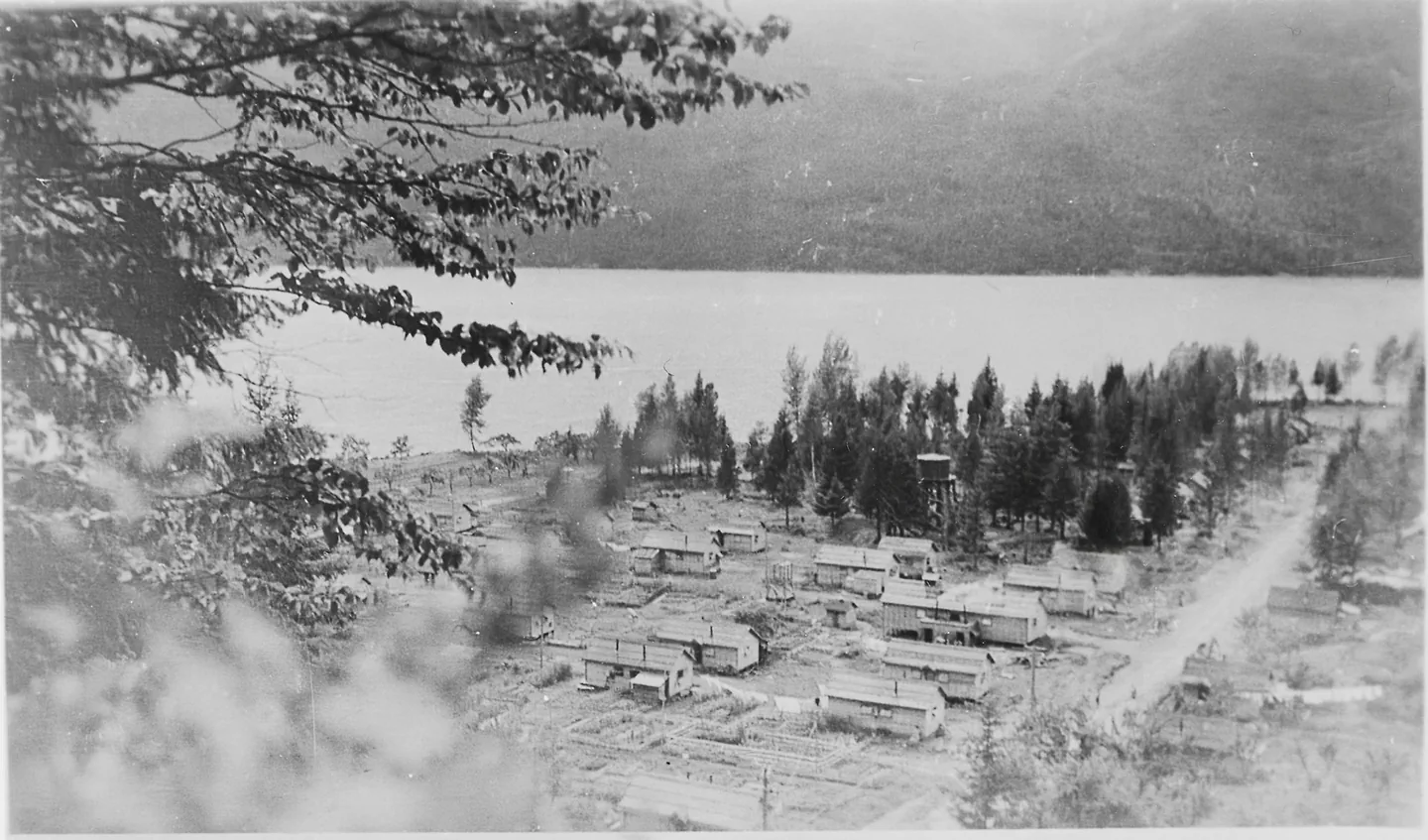
An archival image of the Orchard neighbourhood in New Denver. Courtesy of the Nikkei National Museum.
Families were forced to choose between two harsh options: move east of the Rockies to unfamiliar towns and cities or “repatriate” to Japan—even if they had been born in Canada and spoke only English. It is a choice that feels unimaginable, until you realize how quickly fear made it seem reasonable.
So Lemon Creek remained open until mid-1946. Then, not long after the last families left, the schools, stores, homes, and gathering places were dismantled and hauled away. It was as though the camp had never existed.
Fredrickson points to a small shack in a neighbouring field. “Some people think that may have been the RCMP hut,” he says. “If it was, it’s all that’s left.”
If Lemon Creek speaks through absence, New Denver tells its story through what remains.
“When I first moved to New Denver in 1981, I had no idea the Japanese internment camps had even been here,” Kohan Reflection Garden volunteer Ray Nikkel tells me. He was surprised to find that the town’s grocery store stocked an unusually wide selection of Japanese food.
Over time, he became friends with his—by then elderly—Japanese Canadian neighbours. New Denver was an outlier, used as a holding station where elderly or unwell former internees were permitted to remain after the war, and their stories slowly surfaced. “It was outrageous what happened to them and what they lost,” Nikkel recalls. “They were so gracious. Even after everything they went through, they gave the town a gift—these flowering cherry trees.”
“We can also learn about moments of resilience and community and friendship.
And maybe we might ask ourselves what we would do if it happened today.”
—Kimiko Yoshino
When New Denver later discussed how to develop a stretch of lakeside land, the idea of building a Japanese-style garden felt natural: a place to honour survivors and educate the public about Japanese Canadian heritage. “There’s the local history,” Nikkel says, and then there’s the bigger part. “If it’s forgotten, then it’s easy for it to happen again.”
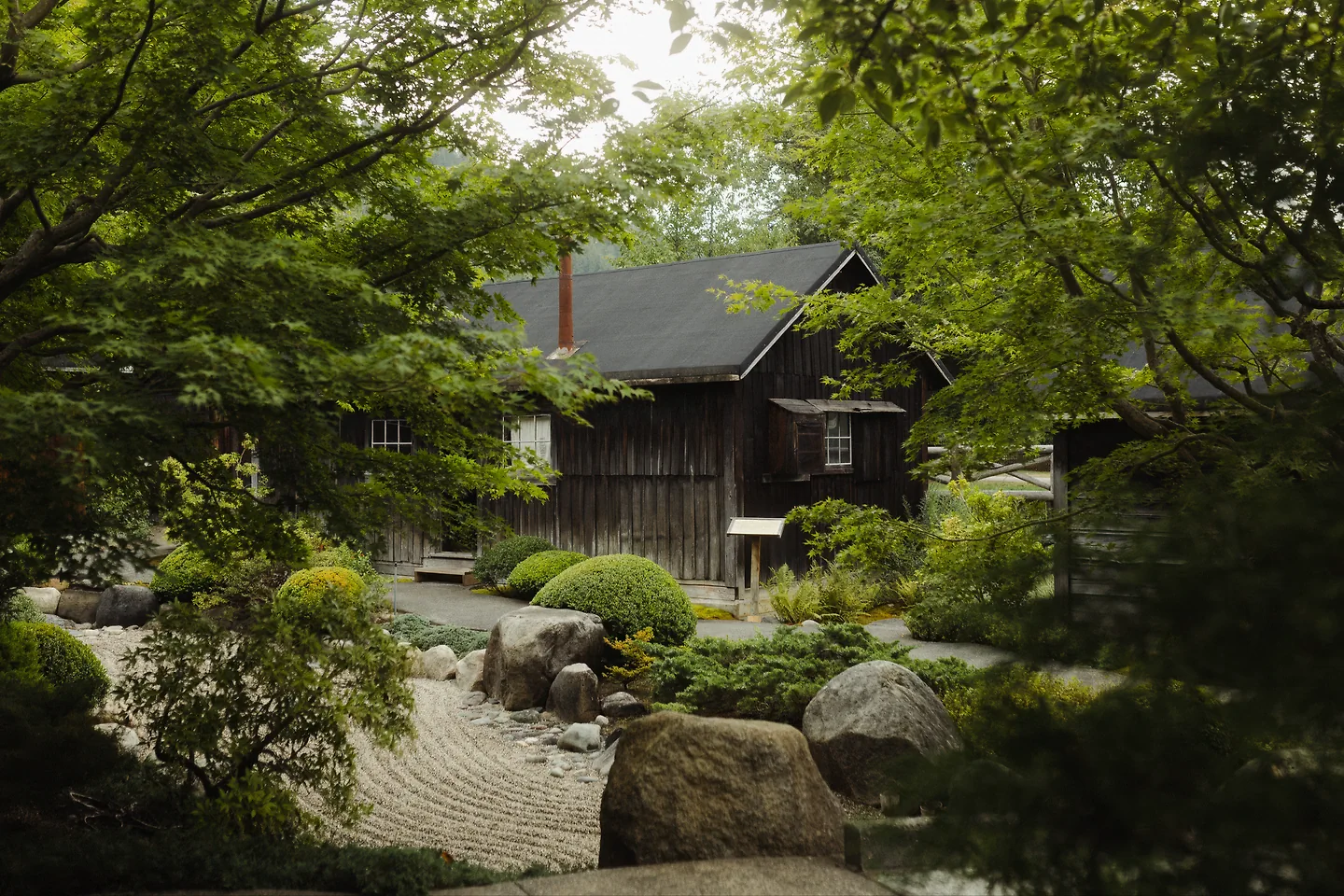
The Kohan Reflection Garden’s paths wind through traditional Japanese landscape elements—maples, cherries, grasses—alongside native plants. “We’re commemorating Japanese Canadians. They lived here,” Nikkel explains, “so we wanted Canadian plants too.”
Designed as a gentle introduction to internment history, the garden also functions as a threshold. From here, the Japanese Canadian Legacy Trail leads visitors through the Orchard—a quiet residential neighbourhood that once lay within the boundaries of the internment camp—and onward to the Nikkei Internment Memorial Centre.
In the Orchard, history hides in plain sight. Phil Whitfield, president of Friends of the Orchard Society, points to modest homes with low rooflines, six-pane windows, and unusual door placement. “The original huts were built quickly. They were rough and uninsulated,” he says. “But they were solid.”
By the late 1960s, many of the original Japanese Canadian residents were gone, but the simplicity of the structures appealed to newcomers—back-to-the-land hippies and draft dodgers on tight budgets—who modified them rather than tearing them down. About 50 still stand.
For decades, much of the remembering tied to places like Lemon Creek and the Orchard has taken the form of annual pilgrimages—bus tours first organized so survivors could return to landscapes they’d once been desperate to leave behind. Increasingly the trips are taken by descendants, new generations who engage with these landscapes in ways that honour both memory and legacy. The journeys remain deeply powerful, shaped by shared experience, grief, and memory. But they are also, by necessity, inward-facing.
I try to imagine how frightening it must have felt to be abandoned and reviled by your country and left in a place so hemmed in by mountains that they blot out the sun.
“Remembering isn’t just to help people understand how painful the experience was,” Kimiko Yoshino, education coordinator at the Nikkei National Museum and Cultural Centre in Burnaby, tells me when I call her weeks later. She has helped coordinate those pilgrimages for the past two years. “We can also learn about moments of resilience and community and friendship. And maybe we might ask ourselves what we would do if it happened today.”
The Japanese Canadian Legacy Trail grew out of a conversation between Lynn Shortt, executive director of the Arrow Slocan Tourism Association, and New Denver mayor Leonard Casley. Both felt the region’s history was significant yet largely unknown. Rather than replacing existing commemorative efforts, the goal was to link the stories and build on them—translating memory into a form that requires no invitation, no schedule, and no shared ancestry. Only presence.
The trail allows anyone moving through the Slocan Valley to encounter this history at their own pace. It asks visitors to move slowly, to notice what is marked and what is missing, and to understand that absence itself is part of the story.
At the Nikkei Internment Memorial Centre, I walk back and forth between two original internment shacks. Both are built of rough wood and tarpaper, cold and drafty. The first is staged as it would have appeared on arrival—more cell than home, furnished with little more than a bed, a blanket, and a bucket.
The second tells a quieter, more defiant story. Handmade lace curtains soften the window and frame the mountain view. Flour sacks have been repurposed into curtains and table cloths. I start to recognize the Japanese cultural concepts I’ve been reading about—mono no aware (a tender awareness of life’s impermanence) and satoyama (reciprocal care of landscapes)—and see how they shaped daily adaptation. Gardening, seasonal rituals, and artistic expression became acts of resistance. Children formed sports teams, music clubs, and drama groups. Schools, churches, temples, and gathering places emerged. Even here, people found ways to live with dignity.
Our final stop is Sandon, an old mining town improbably wedged into a narrow mountain cleft, a river running straight through its centre. If Lemon Creek represents a refusal to be erased, and New Denver resistance, Sandon reveals an unexpected compassion.
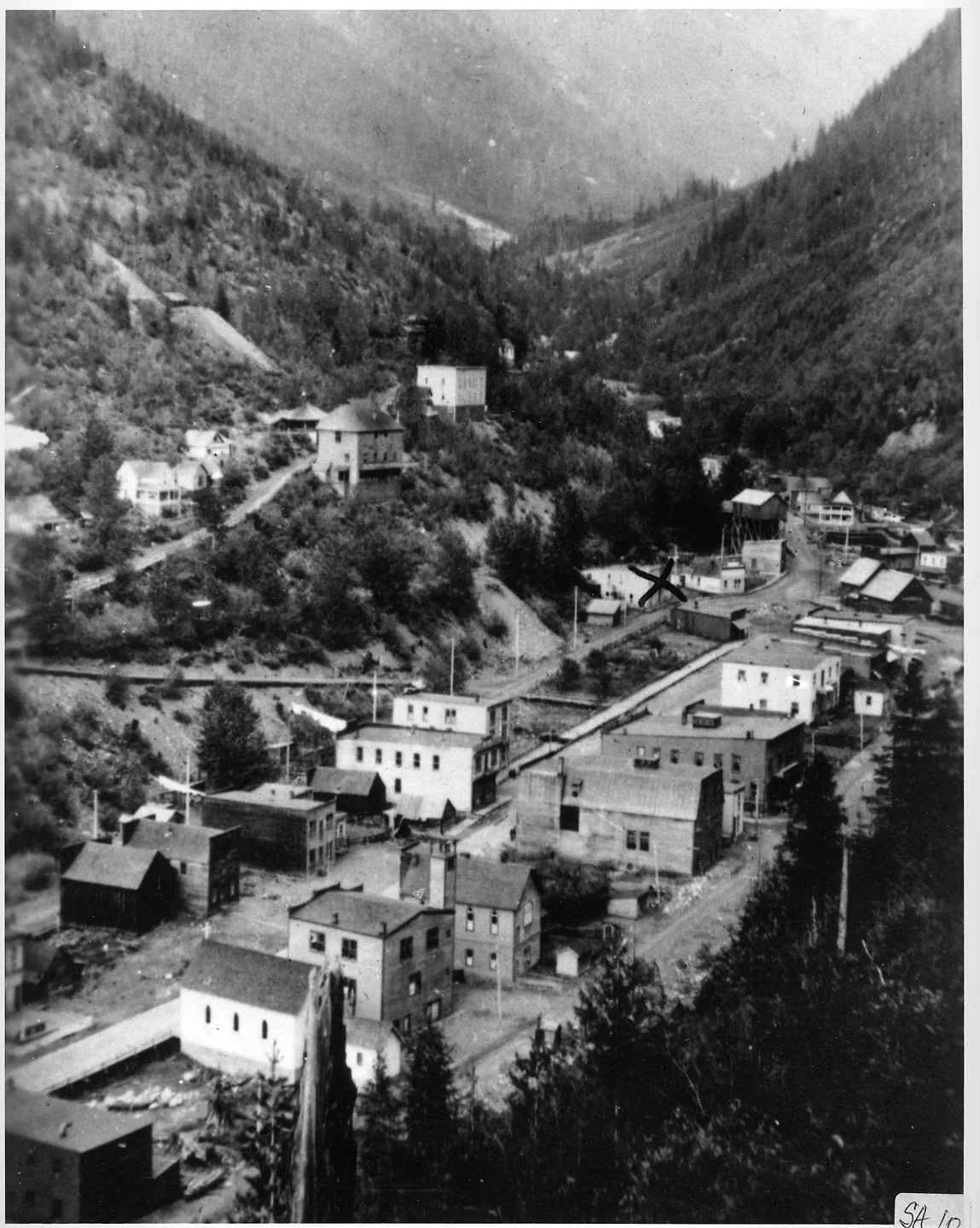
Almost 1,000 men, women, and children were sent to the ghost town of Sandon. Courtesy of the Japanese Canadian Cultural Centre.
When Japanese Canadian families were sent here, Sandon was already a ghost town, its buildings sagging, its population reduced to a handful of holdouts. I try to imagine how frightening it must have felt to be abandoned and reviled by your country and left in a place so hemmed in by mountains that they blot out the sun and so rugged that even your jailers eventually decide it’s too harsh.
Because of its remoteness, authorities decided no security guards were necessary. One provincial policeman was deemed sufficient to “keep the peace” for nearly 1,000 men, women, and children.
As I walk toward the old Silversmith Power & Light Generating Station, I’m struck again by the contradiction threaded through every stop on this trail: the beauty of these places, and the injustice embedded within them. I’m also in awe of how these families—people who today could be my neighbours—adapted and, in some ways, even thrived under inhumane conditions.
“Some of the Japanese men learned how to run the generator,” our guide says of the 1897 Nikola Tesla power plant that still electrifies the town. “When Sandon closed, and most of the internees were moved to New Denver, there are stories that a few volunteered to stay on until new engineers could replace them.”
Canada’s internment of Japanese Canadians is often framed as a closed chapter—a historical wrong acknowledged and apologized for. But walking these landscapes, it feels unfinished. It’s as though Yoshino’s question lingers in the air: What would we do if it happened today? How quickly can fear harden into policy? How easily can rights be stripped away when suspicion takes hold?
The gardens, communal baths, schools, and streets are gone. Yet the land remembers, whether we mark it or not. The mountains, forests, and rivers that confined people also sustained them—offering moments of peace, purpose, and healing amid profound loss.
Today, those same landscapes invite visitors to look more closely, to walk with intention, and to carry the story forward. The question is not whether the land remembers. It’s whether we are willing to listen.
Read more from our Spring 2026 issue.