

When Enzo hitched a ride in a Ferrari from Osoyoos to Vancouver in June 2022, he managed without the wave of a solicitous thumb. To be fair, not only would that have been physically impossible, but anyone spying him on the side of a road would have resolutely sped past.
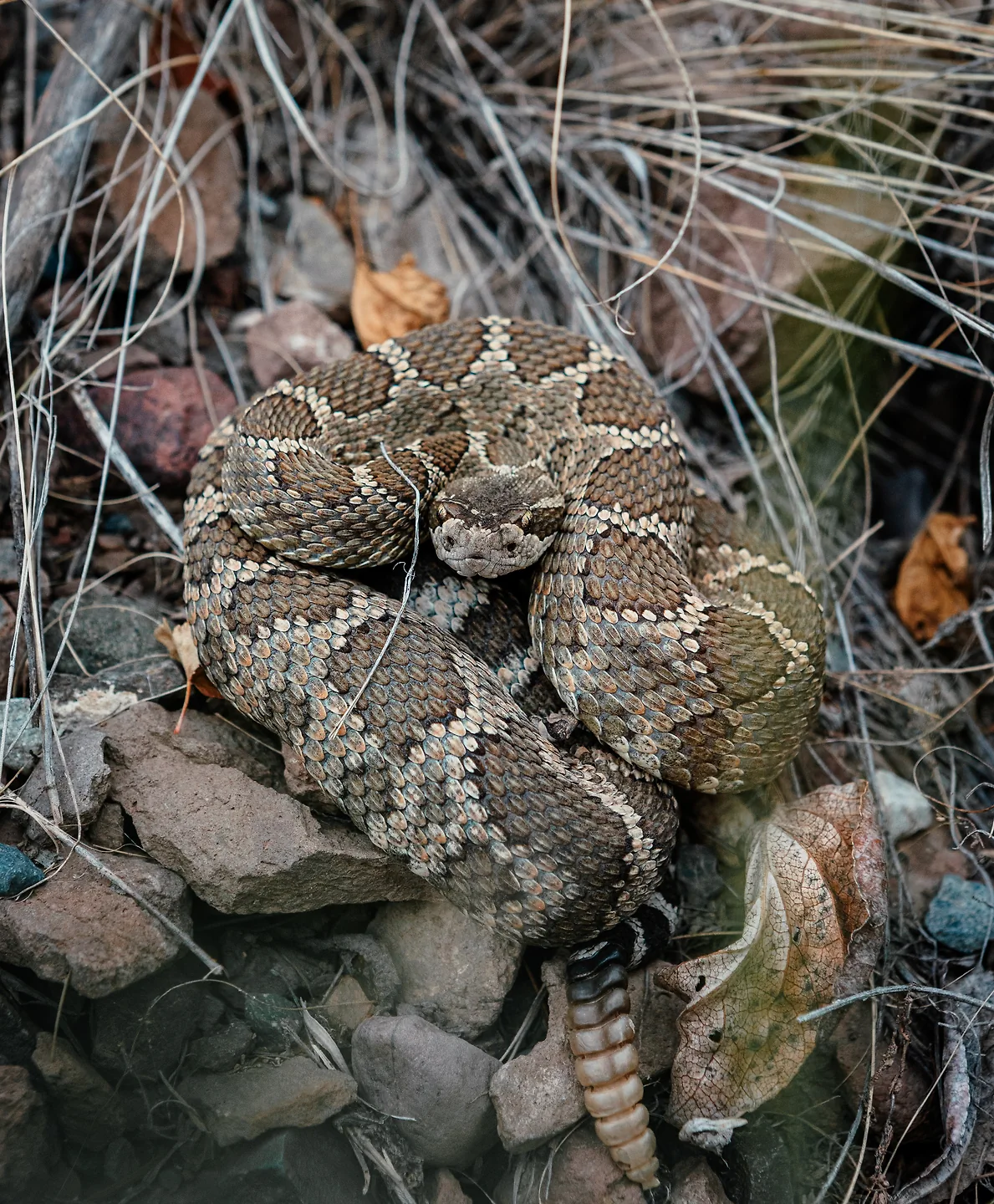
Enzo, you see, is a Northern Pacific rattlesnake.
Stowing away for 400 kilometres in a vehicle chosen not for prestige but as a warm, dark place to curl up (a surprisingly common snake-transport trope), Enzo debarked in the third-storey showroom of a Ferrari dealership to incalculable surprise. Despite the shock of a venomous reptile loose in their midst, employees just returned from a group trip to the South Okanagan were savvy enough to call in animal rescue. Through a microchip Enzo carried and the bright green band on his rattle, Dewdney Animal Hospital quickly identified him as a recent addition to the Snake Research Program at the Nk’Mip Desert Cultural Centre in Osoyoos. The unwitting serpent had crossed paths with the Ferrari group when the latter stopped at the adjacent Nk’Mip Cellars winery.
To much fanfare, Enzo was eventually driven (by truck) back to the desert and delivered into the hands of snake-program coordinator Lindsay Whitehead. Twelve days after his ticket to ride, Enzo was released where he’d originally been caught, marked, and added to the program’s roll during a May den survey.
As a tool to understand population size, demographics, reproduction, growth, and seasonal movement, tagging and tracking snakes informs the conservation of a long-persecuted and now endangered animal key to the Okanagan’s vanishing antelope-brush desert ecosystem.
In early April 2026, I join Whitehead for her annual den surveys near the Desert Cultural Centre. We’re nine rattlesnakes deep when she shares Enzo’s story—with a coda.
Though researchers fretted over impacts of a two-week alien abduction of an animal whose world revolves around local scent trails, Whitehead happily encountered Enzo again in May 2023. “He was coming out of his den, so he’d overwintered fine and even had a new rattle segment,” she says. Segments are added only when a snake grows enough to shed its skin, meaning that after his ordeal, Enzo fared well. “He looked great—good body condition.”
Very much the eyeballing of an experienced professional (Whitehead has been at this since 2022, when she arrived to study the effect on snakes of recent wildfires), there were also data to support the assessment: length, weight, and rattle counts recorded each time a snake is captured.
In 2026, the Nk’Mip rattlesnake program entered its 24th season, the longest-running snake study in the country, according to Whitehead. As a conservation initiative, it may also be the most successful—suspected to be the only monitored population of a Canadian reptile species at risk that’s actually growing. In the main, credit is due to the Osoyoos Indian Band’s protection of 1,600 acres of desert supporting some 42 species at risk. But the program’s contributions are also significant: understanding snake movements led to two kilometres of snakeproof fencing installed that lowered human interactions in an adjacent golf course, campground, and RV park. Twenty years of education and outreach also served to combat traditional fear and animus directed at rattlesnakes, with walkers and drivers (Enzo’s notwithstanding) on the lookout for snakes crossing roads, paths, and parking lots (roads are the number one cause of mortality). Increasingly seen as unaggressive desert denizens merely going about their snaky business of rodent control par excellence, the Nk’Mip metapopulation that inhabits both valley sage flat and hillside ponderosa pine forest is now estimated at about 2,000.
“It has been an amazing research opportunity to have this conservation partnership with the Osoyoos Indian Band supported out of the DCC,” Whitehead says.
Opportunity, and hard work—which begins with hiking to den sites. This day, one crew has headed to a distant rock slope, while Whitehead and I check a series of smaller, closer dens that share the commonality of surface rockpiles into which snakes disperse from underground haunts to soak up heat. Wary of predators, they often remain partly hidden, bodies lodged in a crack or vacuity into which they can retreat at any sign of danger—such as us. This makes speed essential to censusing. Indeed, at our first stop, within seconds Whitehead had used metre-long snake tongs to hoist a large, somnolent female into a mesh handling basket which, despite appearing specialized to the task, was, in the time-honoured way of skint scientists, actually a collapsible IKEA laundry hamper.
Rattlesnakes are the most reasonable of dangerous wildlife: their first line of defence is to remain undetected. Get too close, and they offer audio warning.
Not every snake we caught was as agreeable. With a buzz familiar to anyone who works with them, many rattled their annoyance at being shifted from warm lounge to cool mesh. Yet none were so peeved as to strike. Coiled, the snakes’ organic beauty seemed like plastic models from some gift shop, each with a slightly different colour and pattern of highlight-edged blotches and black-and-white-ringed tail. Whitehead and I both professed fondness for the pink- and green-tinged ground colours that most readily blended with constellations of lichen.
We eventually hefted four adults and a yearling into the basket together, while others made their presence known. As we stood on the rocks, invisible snakes half-heartedly rattled just out of sight. This would send a normal person or animal into rapid retreat—the point of the behaviour—but when you know the difference between the danger frequency and flashing yellow light of “Dude, I’m right here—just so you know,” you become sanguine.
Indeed, rattlesnakes are the most reasonable of dangerous wildlife: their first line of defence is to remain undetected. Get too close, and they offer audio warning. Closer still, and it becomes more emphatic. And they’ll still try to leave unless you’ve cut off their retreat. Because venom is energetically costly and intended for prey, snakes aren’t looking to bite defensively. Though varying by species, some percentage of all venomous snakebites are dry: i.e., no venom is injected.
DCC visitors pass on a nearby trail, and we hunker down below the sagebrush, hoping not to draw attention. Though steeped in safety protocols that make it no more dangerous than driving a forklift, the work requires full focus.
To “process” a snake, it’s encouraged to enter a plexiglass tube head first. Once a prescribed length of body is firmly within, the snake can be safely checked for general health and body condition: length, rattle segments, and, with females, whether it’s gravid with this year’s young or postpartum from last year’s effort. There’s a microchip scan with a small, handheld transponder. If present, as with Enzo, the chip’s code identifies the snake in a database along with its sex, previous size, and point of last capture. The rattle is then marked with paint near its base, every year a different colour (this year’s was blue). Finally, the snake is decanted into a pillowcase, weighed, and released. Snakes with no previous ID also undergo sex determination and have a microchip implanted just under their skin, welcoming them to a study that has marked some 2,500 individuals since 2002.
I hold the snake-in-tube while Whitehead—all business—works away. Her dedication offers stark counterpoint to the sad history of colonial attitudes toward the rattlesnake, bogeyman of the Old West that took its place in movie iconography beside saguaro cacti and swinging saloon doors.
In the Okanagan, local enmity toward rattlers also ran deep, no more so than with Vernon’s rabid Reverend Mackie, who, beginning in 1930, conducted a personal three-decade vendetta against the animal responsible for the death of a student under his care that included clubbing snakes and dynamiting dens.
While development and agricultural schemes of the time also vanquished snakes, albeit less aggressively, modern orchardists and vintners take a more enlightened approach. One winery I visited had constructed a fencing system around vineyards so that vines could be tended worry-free from rattlers migrating to and from hillside dens in spring and fall. That was in October 2004, when I’d also joined Jeff Brown, the first graduate student studying rattlers at Nk’Mip, for a day of tracking snakes by radio telemetry.
Telemetry involves following the signal of a surgically implanted microtransmitter. After chasing 20 rattlesnakes all summer, Brown was then recording their autumn return to dens. Sweeping an antenna ahead, he zigzagged up a steep incline at a slow run, skirting rocks and raising puffs of dust as his transceiver clicked noisily. “It’s like following a squirrel,” Roger Hall, an Osoyoos band member assisting with the study grunted. As sweat stung my eyes, Brown abruptly pulled up at a large sagebrush wrapped around shattered rock. Beneath, barely discernable in the netherworld of shadow and grass, was a mute coil. “Funny,” Hall said with a smile and an arch of a knowing eyebrow, “but several snakes stopped in this exact spot on their way up to the den.”
Searching for any clue to why this would be a popular roadside attraction for snakes, I saw nothing obvious. That alone offered a compelling reason to gather the basic biological data telemetry returns, and why it remains key to the program.
To reach our final den of the day, Whitehead and I similarly follow an animal trail up a steep hillside. A few hundred vertical metres later, we have a million-dollar view over Osoyoos Lake, as well as Highway 3 heading west toward Vancouver. Unfortunately, the large rattlesnake wedged in a crack above us can’t share in our outlook (relying on heat-sensing facial pits to find prey, rattlesnake sight is limited). “That snake has been tormenting me for days,” Whitehead says. “I can’t reach it up there.”
It’s brilliant positioning that guarantees the snake not only maximum security but also warmth to the last light of day. This feels symbolic for an exquisitely evolved species that could, were it not for such redoubts and those who study them, slip permanently from Canada’s biodiversity ledger, spirited away not by a Ferrari, but by hubris and indifference.
Read more from our Summer 2026 issue.