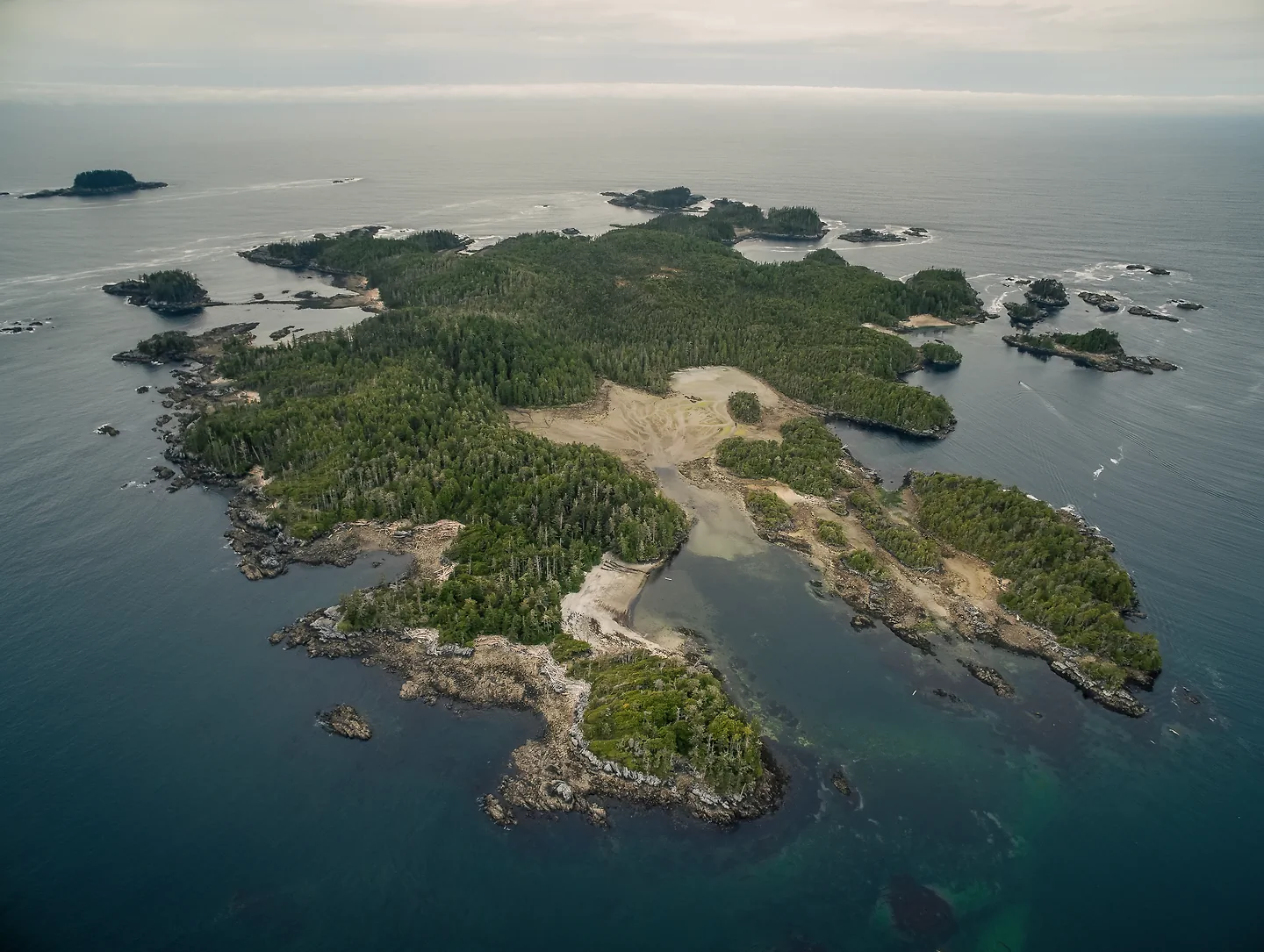


In 2014, anthropologists Daryl Fedje and Duncan McLaren found a footprint embedded just below the surface of a beach along the shore of Calvert Island on British Columbia’s Central Coast. It had been pressed into a layer of brown clay and filled with black sand and gravel. They were seeking signs of ancient human presence, so the indentation caught their attention. Tiny fragments of wood were detected in the heel of the footprint, and these were sent off to be radiocarbon dated. When the results came back, McLaren said they caused the hair on the back of his neck to stand up. The fragments were 13,200 years old, making this the oldest human footprint ever discovered in North America at the time, and one of the earliest known traces of human habitation in B.C.
The team returned in 2015 and 2016 to perform further excavations and eventually uncovered a total of 29 footprints made by two adults, one larger than the other, and a child—a Paleolithic family, perhaps. Most of the prints faced inland. A dozen were found near the remains of an ancient hearth, full of charcoal and ash and ringed by rocks, including a stone tool that could have been used for cutting or chopping, suggesting the family may have been cooking a meal.
The discovery drew widespread attention, connecting with the public in a profound manner. As Quentin Mackie, a recently retired anthropologist from the University of Victoria, who has worked on the Calvert site, notes, “Everybody has seen their own footprints in the sand. They’ve also seen them get washed away by the next wave. I think it’s that little snapshot of transience of the human condition from such deep time that grabs people’s attention. It resonates more strongly than something like a stone tool.” These footprints, along with several other recent finds, are helping rewrite the story of how people first migrated into North America.
Thanks to advances in genome sequencing and data analysis, we know that the first humans to set foot in North America were direct descendants of ancient people in Siberia. But how did they get here? Up until about 20 years ago, the prevailing theory was that nomadic hunter-gatherers first entered by crossing from Siberia over Beringia, a land mass that stretched 5,000 kilometres through Alaska and Yukon into the Northwest Territories, before spreading southward through an open corridor in the vast ice field that had previously covered the entirety of what is now Canada. The entry point was fixed at about 13,000 years ago. These Paleolithic people came to be known as the Clovis culture, after Clovis, New Mexico, where stone tools and fluted spear points were found alongside a cache of mammoth bones in 1932.
Since then, sites featuring these distinctive stone points have been found across the continent. But in 2007, Jon Erlandson, an anthropology professor at the University of Oregon, proposed a different story, a means of entry by boat that could have carried humans into North America long before frozen inland routes were passable. He dubbed this the Kelp Highway. The name struck a chord, and so did the theory’s plausibility. Kelp forests, which extend along the west coast from Alaska to California, support a wide array of life, including fish, shellfish, marine mammals, and seaweed. These vast swaths of kelp would have made for easier and safer travel, as they not only foster an abundance of edible sea life, but they also dampen waves—important for primitive boats. It’s a theory that has been embraced by a cadre of B.C. scientists, who are intent on locating “sweet spots” on the B.C. coast that might have provided shelter and sustenance to southbound nomads before any inland entry would have been possible.
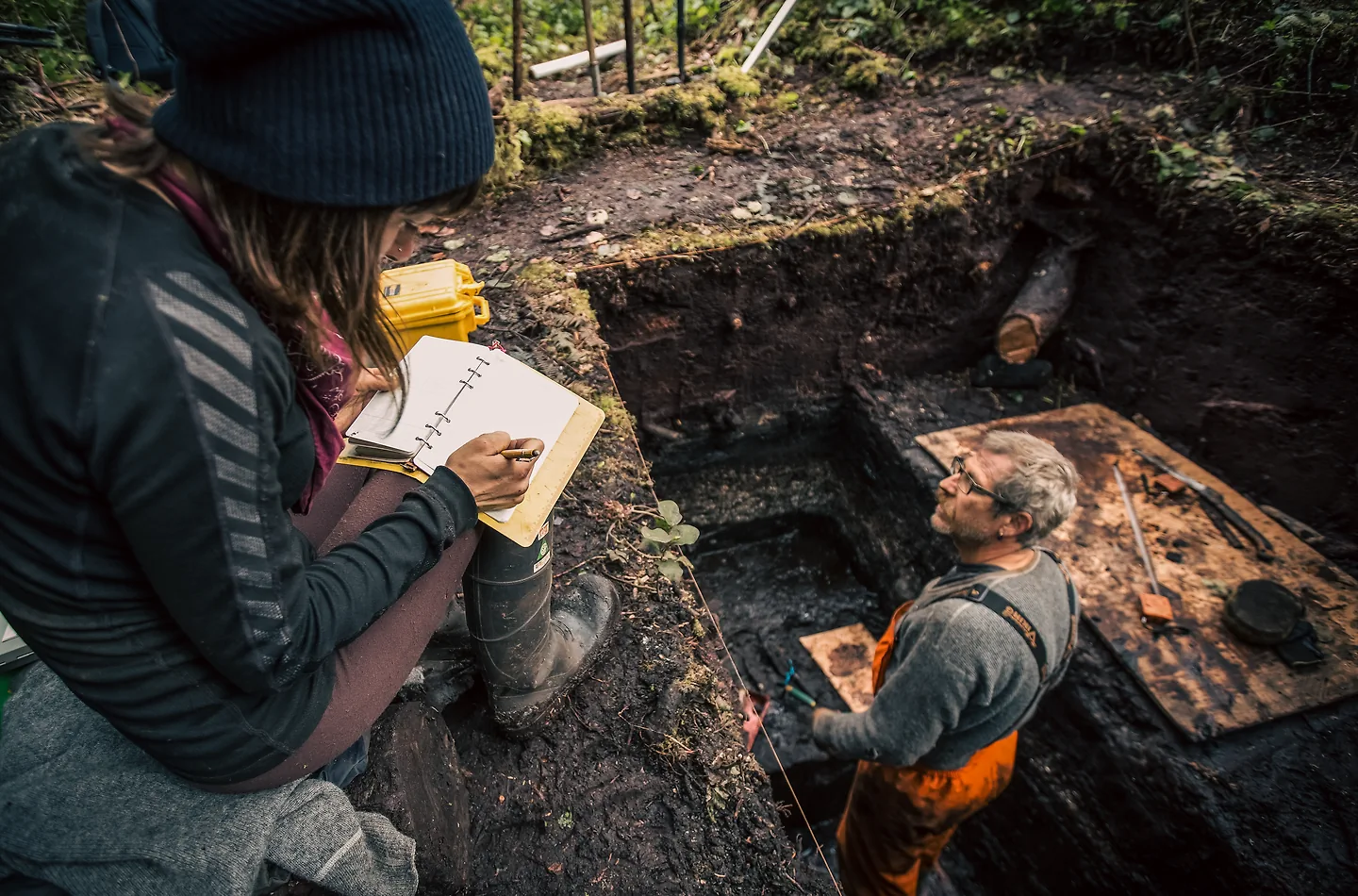
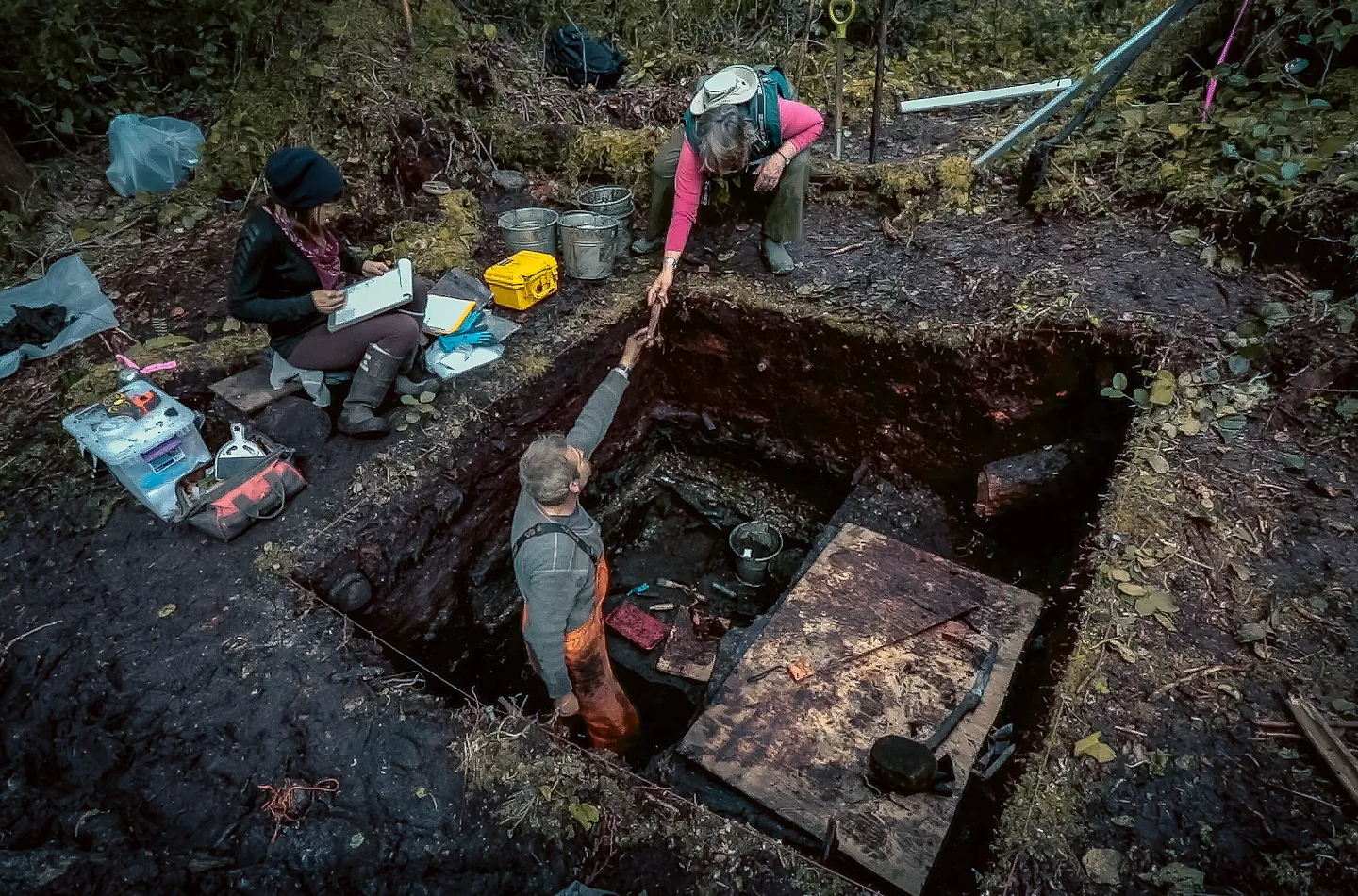
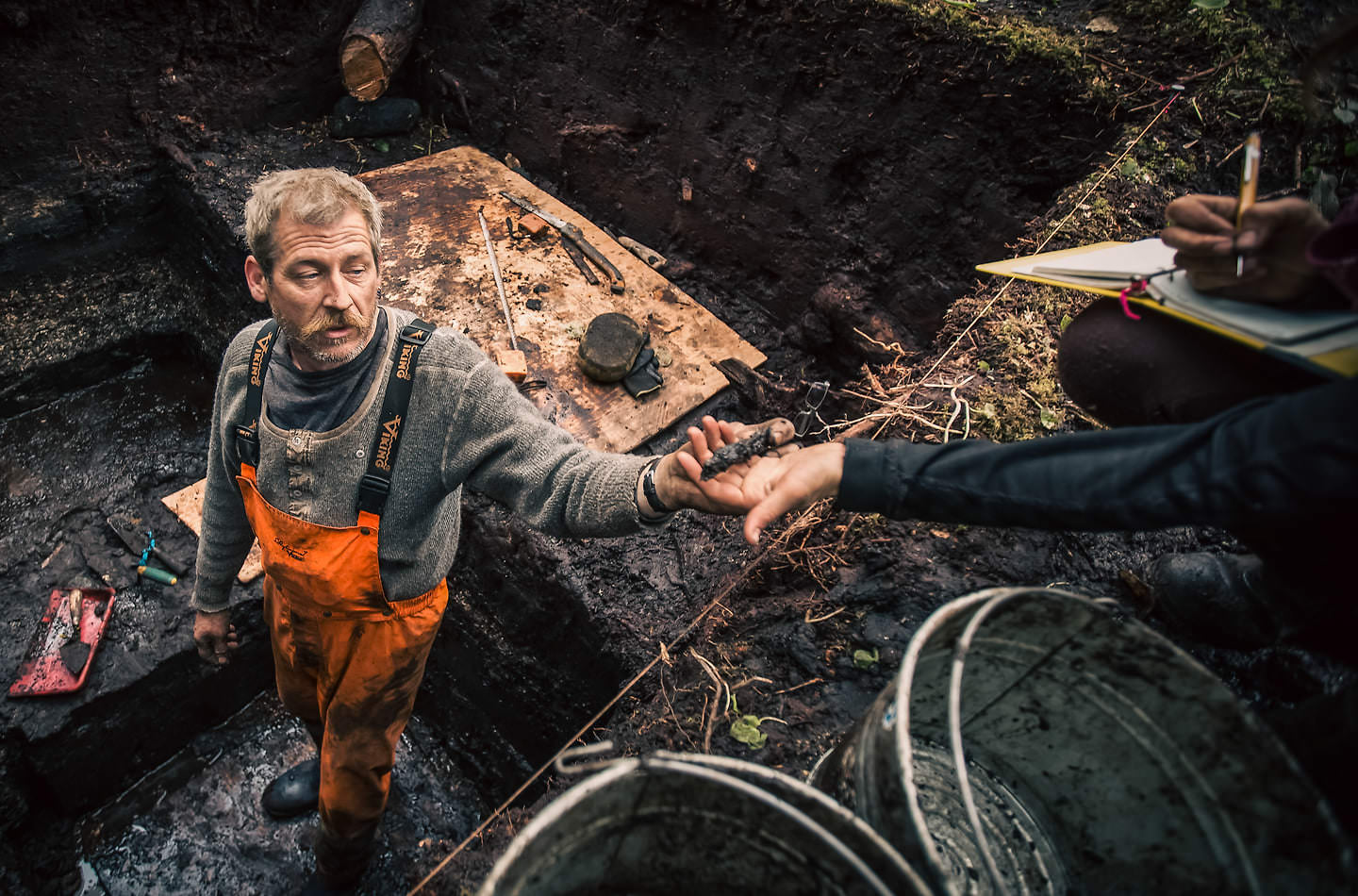
A second B.C. discovery made in 2017 on Triquet Island, just north of Calvert, pushed the geologic clock back a little farther. Here, a research team supported by the Hakai Institute and headed by McLaren and then PhD student Alisha Gauvreau, along with Fedje and other archeologists, dug down six metres below the surface where they found a charred hearth, a hand drill for igniting fires, a wooden device for launching projectiles, and a cache of stone tools that they dated at 14,000 years old. The tools included harpoons, bone needles, and other specialized hunting implements that suggest an understanding of marine ecosystems and the ability to navigate and survive in a demanding coastal environment.
Gauvreau, who is now an associate principal with Two Worlds Consulting in Victoria, a company that works on environmental projects with First Nations, Métis, and Inuit, industry, and government, says the site appears to verify Heiltsuk Nation oral history that humans took refuge on Pacific Coast islands during the Ice Age. “What’s really cool about Triquet is that the archaeological record reveals about 14,000 years of continuous use and occupation of the site, all the way up until contact,” Gauvreau says.
Why archaeologists chose to search for evidence of human life at Calvert and Triquet is based upon a couple of factors. Both are located near modern-day First Nations settlements and large middens, and both are in areas where the sea level has remained relatively unchanged throughout history. However, this is not true of large segments of the B.C. coast where the water from melting glaciers at the end of the Ice Age rushed into the ocean, raising sea levels by 100 to 200 metres. The rising of the seas has made archaeological work on the west coast impossible in many areas.
The geology of the west coast during the Ice Age was very dynamic, with areas rising and falling in response to the weight of receding glaciers, an effect that Mackie compares to the rippling motion of a waterbed. But this particular area near Calvert and Triquet functioned like a hinge connecting the undulating land masses to the north and south.
Determining where the landscape resisted dramatic change or finding places that may have escaped the Ice Age is a complicated business that involves testing sediment cores taken from ponds and lagoons, analyzing microfossils and deposits of single-celled algae called diatoms, and collecting traces of DNA that contain clues about what the environment was like and whether the water was fresh or salt in that area through time.
Hakai Institute archaeologist Chris Hebda has been exploring two lakes on the northern part of Vancouver Island that he felt would be good candidates to yield ancient environmental records. To obtain samples of lake sediment, Hebda and his team erect a platform atop a pair of canoes and then send down a coring machine that penetrates one metre at a time, collecting bits of soil that have been deposited over thousands of years that can be extracted and radiocarbon dated.
Data collected at Little Woss Lake, in Vancouver Island’s northern mountain ranges, revealed that the area was deglaciated some 14,000 years ago. This land would have hosted alder and pine trees, ferns, bears, and chinook salmon, suggesting an ecosystem suited to human occupation.
At Topknot Lake, which lies close to the ocean, the data indicates that this spot was ice-free back to 18,500 years ago and may possibly have never been glaciated. “Usually with lakebeds, you will eventually hit a layer of glacial till, but in this case, we never hit the bottom. We drilled down more than 12 metres before running out of cable,” Hebda says, noting that the area would have featured a treeless steppe tundra—similar to Beringia—with grasses, shrubby willows, small bushes, and wildflowers.
Farther north, Bryn Letham, an assistant professor with Simon Fraser University’s Department of Archaeology, has been exploring near Hartley Bay. “The ice retreated from west to east, so the first places where people could have lived are the small outer-coast islands,” he explains. “I’ve been working on the Moore Islands, where we’ve got the paleo-environmental story going back 16,000 years, so we know it’s the right place to look. We just haven’t found a 16,000-year-old archaeological site.”
Letham says that evidence of early human habitation could also be found in caves on Haida Gwaii and Vancouver Island, which “would have been natural attractors for both animals and people. The preservation potential in caves is excellent because of the chemistry of the bedrock. Bone, for example, preserves forever in caves.”
In fact, Hebda notes that “in caves on Vancouver Island, we’ve found thousands of animal bones that date to about 15,000 years ago.” In one cave, the evidence suggests there were people hunting animals, including even bears. There are quite a few areas with the potential to yield similar or even earlier dates on the coast, but logistically, as well as with costs and support, the work is a lot to undertake. As Mackie observes, “Much of archaeology is simply the art of the possible.”
Previously explored spots like Calvert Island may also retain hidden secrets. There are probably hundreds more footprints in that stretch of beach. The area that was excavated was six square metres, and there are thousands of square metres along that mud flat embankment that could be investigated, Mackie says.
Many archaeologists now feel that the inland corridor theory of the first entry into North America has been discredited by the recent discovery of spots south of the ice fields in Oregon, Idaho, Texas, and Florida featuring tools and campsites that date back 14,000 to 16,000 years ago. The people who left artifacts in these sites could have originally entered via the coastal route. More discoveries are sure to come.
While Mackie backs the theory of the Kelp Highway, he has always disliked the name. It worked to gain public attention, but he feels it conveys a misleading idea, suggesting that places like Calvert and Triquet were simply rest stops in a race down the coast to the southern tip of South America. “It implies some sort of kind of intentional, traversal, goal-oriented process. But these places were the homeland of ancestral First Nations. They settled here. Maybe some moved a little further afield, maybe they find something better, maybe they have a population expansion, or maybe they see that the geese are migrating, so they know something’s going on down south.”
Whatever caused the first North Americans to push southward is open to speculation. Perhaps most importantly, this story reminds us that movement is a constant in human history. We are a species of wanderers, driven by curiosity, necessity, and ambition. These journeys are a reminder that we are all travellers in time, heirs to journeys that began long before us, and part of a story that is still unfolding.
Read more from our Summer 2026 issue.