

After six days of travel in the sweaty embrace of Mexico’s Yucatán, I have gained a better appreciation of how the ancient Maya came to view the entire world as animate, granting even trees and mountains a degree of supernatural life, and why they believed the environment was controlled by spirits travelling in the guise of wild animals. Here, the presence of the unseen world is never far away. Sometimes, it boldly announces itself: huge, scaly-skinned iguanas strut past as I relax beside a hotel swimming pool, brightly coloured birds screech from above as I dine on a bougainvillea-draped patio, and geckos chirrup softly from bedroom alcoves. Tonight, as I sit in the dark outside my cottage, a cloud of blue fireflies begins to conduct a twinkling aerial ballet while an orchestra of frogs and crickets fills the humid air with mad, throbbing music.
My booking at the rustic 28-room Hacienda Chichen is a strategic move. It sits adjacent to the fabled Mayan city of Chichén Itzá, which ruled the Yucatán from 600 AD until its mysterious abandonment in the 1200s. Today, its skilfully restored ruins have made it a major tourist attraction, drawing more than two million visitors a year. By staying here, I can enter the site when it opens and prowl about for several hours before the first tourist-loaded buses arrive from Cancún and other cities. But the amber-walled hotel is interesting in its own right. During the 1920s, the main building and adjoining cottages served as the headquarters for archaeologists from the Carnegie Institute, who were excavating the ruins. Today, each of the rooms is named after one of the archaeologists who stayed there.
At a time when Europe was mired in the Dark Ages, the Maya built grand structures, including royal residences, galactic observatories, pyramids, roads, and canals, all without the aid of metal or the wheel.
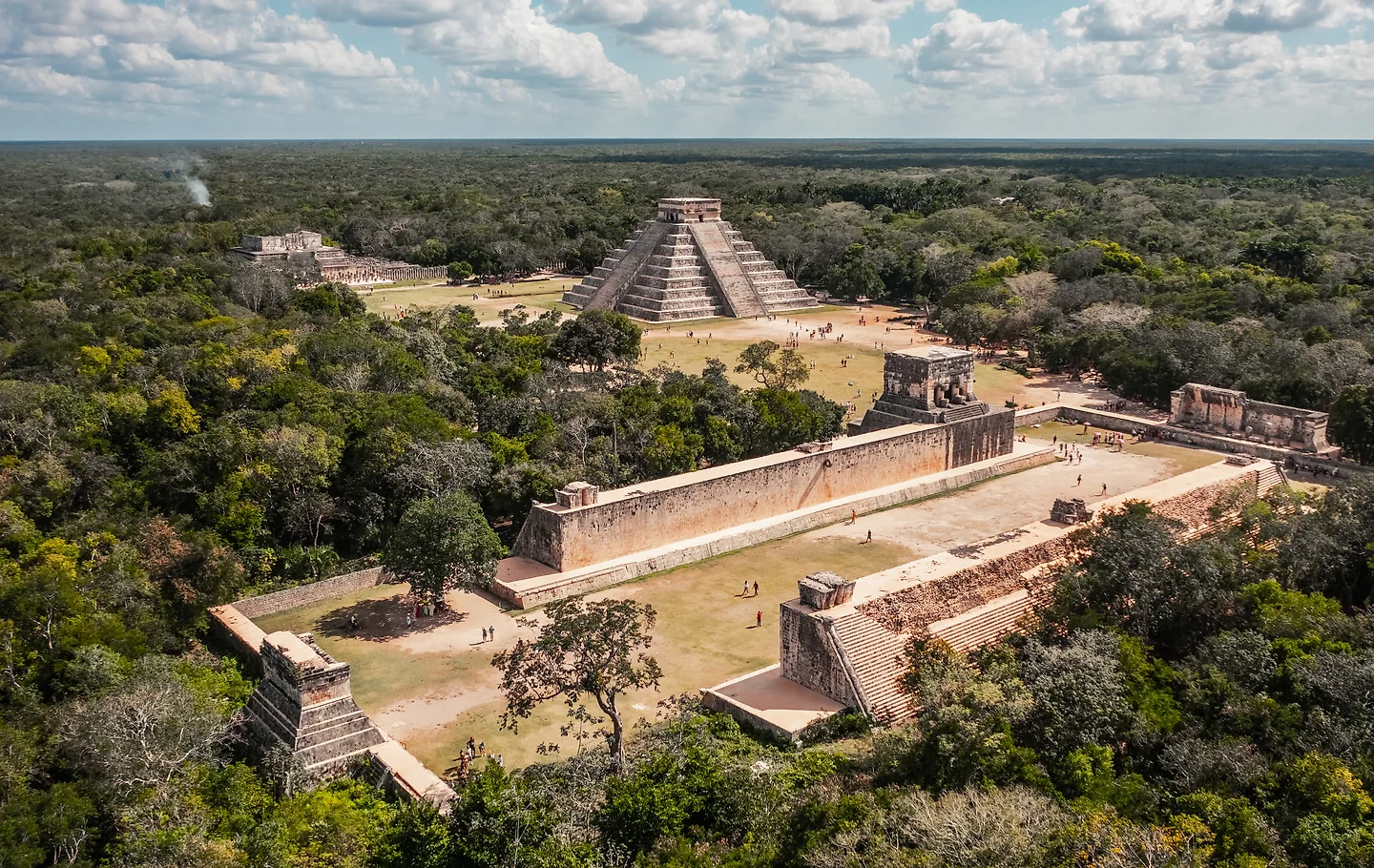
I enter Chichén Itzá shortly after dawn. Tendrils of mist swirl around my ankles as I make my way toward the towering temple of Kukulcán, a 30-metre-high pyramid with sculptures of plumed serpents running down its sides. I head to a spot about 10 metres in front of one side of the pyramid and clap my hands sharply. The echo that rebounds off the limestone steps sounds like the a chirp of a bird. There is no mistaking it.
Acoustic studies done in 1998 concluded that the echo resembled the cry of the quetzal, sacred to the Maya. One can only marvel at the engineering expertise required to produce this effect and the layered meanings behind its delivery. The temple is named after Kukulcán, a feathered snake god, and the quetzal, because its spectacular, long, iridescent-green tail was regarded by the Maya as a combination of a bird and snake. The sense of magic here is as inescapable as the low-lying mist.
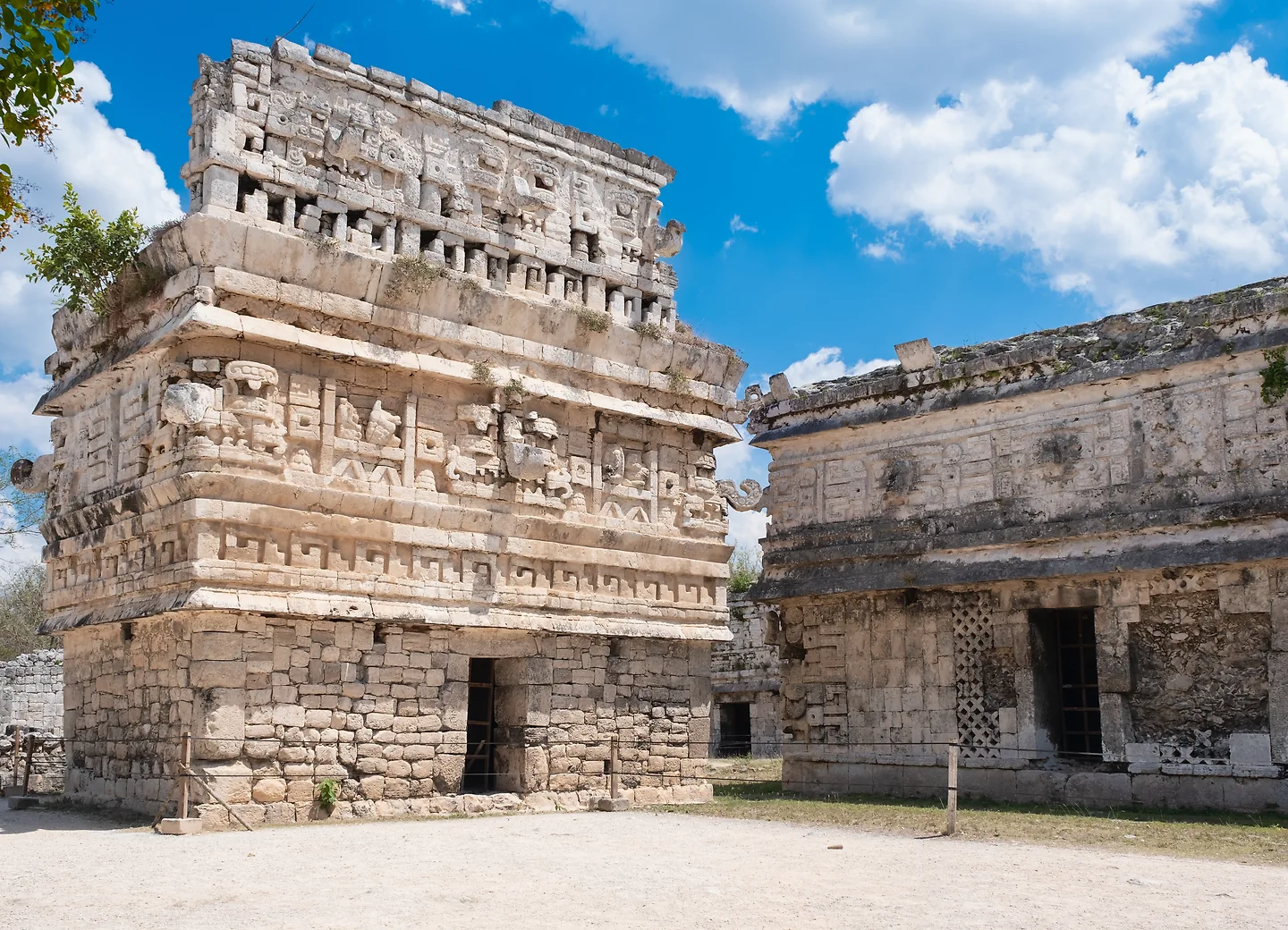
Called the Nunnery by the Spanish, this complex was likely used by government or royalty. Photo by kmiragaya – stock.adobe.com.
Each Mayan city has its own distinctive look and atmosphere. Chichén Itzá stirs competing emotions. One feels awe at the scale and the majesty of the architecture. At a time when Europe was mired in the Dark Ages, the Maya built grand structures, including royal residences, galactic observatories, pyramids, roads, and canals, all without the aid of metal or the wheel. They also developed a written language based on glyphs, created a calendar more accurate than the one we use today, and recorded the positions of the planets and predicted eclipses.
But this feeling of admiration is offset by a sense of revulsion when one realizes that several of the site’s celebrated landmarks are linked to the practice of human sacrifice. The Maya believed that the gods required sustenance, which could be provided through offerings, including food, animals, and, notably, human blood. Such offerings were seen as vital for retaining cosmic balance and ensuring the fertility of the land and the prosperity of their societies.
The Temple of Kukulcán captures this duality. Built to astronomical precision, it features four sides, each with 91 steps and facing a cardinal direction. Including the step on the top platform, these equal 365 steps—the number of days in the solar year. At the base of the northern staircase, the balustrades terminate in gaping snake heads. At sunset on the spring and fall equinoxes, the shadow cast by the edge of the pyramid creates a pattern that resembles a snake slithering down the side of the stairways and into the sculpted skulls.
But this temple was also used for sacrifice. War captives would be painted blue before being led to the summit and laid over a stone altar where the priest cut open their chests and tore out their hearts.
Off to the right of the pyramid stands the Temple of the Warriors, a spectacular 12-metre-high and 40-metre-wide structure consisting of four platforms, flanked on the south and west by 200 round and square columns. The central temple shows bas-reliefs of warriors, eagles, and jaguars devouring human hearts. As I climb to the top of the steps, I’m met with the unsettling sight of a Chac Mool, a sculpture of a reclining figure holding a tray on his belly. His head is turned 90 degrees to the side, and the gaze of his stone eyes seems to look through you into the hereafter.
Regarded as messengers of the gods, Chac Mools were used to hold religious offerings on their upturned abdomens. Chac Mools are closely linked with the Toltecs, a Mesoamerican culture based in Tula, Mexico, that predated the Aztecs. In fact, the architecture featured in the Temple of the Warriors, as well as the Temple of Kukulcán, displays strong elements of Toltec architecture, an anomaly that has caused some historians to conclude that the Toltecs invaded Chichén Itzá at one point and seized power from the Itzá people who founded the city. This view is disputed by other historians, and so the debate rages on.
Drenched in perspiration, I make my way to the Great Ball Court. More than 1,500 ball courts have been found scattered throughout Mesoamerica, and all feature the same capital I shape, with two sloping walls for the ball to bounce against, a long narrow playing field, and two end zones. The court at Chichén Itzá is the largest in Mesoamerica, measuring an imposing 67 metres by 170 metres. Sculpted reliefs line the walls, one depicting the victors of the game holding the severed head of a member of the losing team. At each end, there is a raised temple area, perhaps a place where nobles and priests could view the action.
In a landscape that features no lakes, rivers, or streams, the cenotes were a life-sustaining gift.
No one knows the game’s exact rules. Spaniards who saw the Aztecs playing it in the 1500s reported that two teams of two to five players had to keep the ball in the air without using their hands or feet. The balls—made of liquid latex extracted from rubber trees—ranged from the size of a softball to a soccer ball. They were heavy—weighing up to four kilograms—and could cause serious injury or even death. It is believed that points were scored by driving the ball into the opponents’ end zone, but the court at Chichén Itzá also sports two circular rings mounted high on the walls. Some contend that if a team directed the ball through the ring, they instantly won the game.
The site also houses sonic marvels. A whispering gallery permits a person standing on the raised platform at one end of the court to speak with someone at the opposite end, a distant 152 metres away. It also permits chatter between people at either temple and those on the playing field. The placement of the walls also produces a flutter echo, which researchers believe would have created an eerie ambience. Echoes of voices, body impacts, and the smash of the rubber ball would have shuddered throughout the arena.
From the ball court, it’s a 300-metre walk to Chichén Itzá’s Sacred Cenote. It’s thought that the city was built here because the area includes several cenotes, large sinkholes filled with water. In a landscape that features no lakes, rivers, or streams, the cenotes were a life-sustaining gift. Cenotes were also revered because the Maya believed they were portals into the dreaded underworld, a realm of nine descending levels of fright, ruled by the death gods.
This cenote was primarily reserved for rituals and sacrifices. The sinkhole exudes a palpable sense of menace. Staring down into its murky lime-green depths, 60 metres in diameter and 40 metres deep, I can appreciate the words of explorer John Lloyd Stephens, who wrote when he visited the site in 1840 that “a mysterious influence seemed to pervade it.”
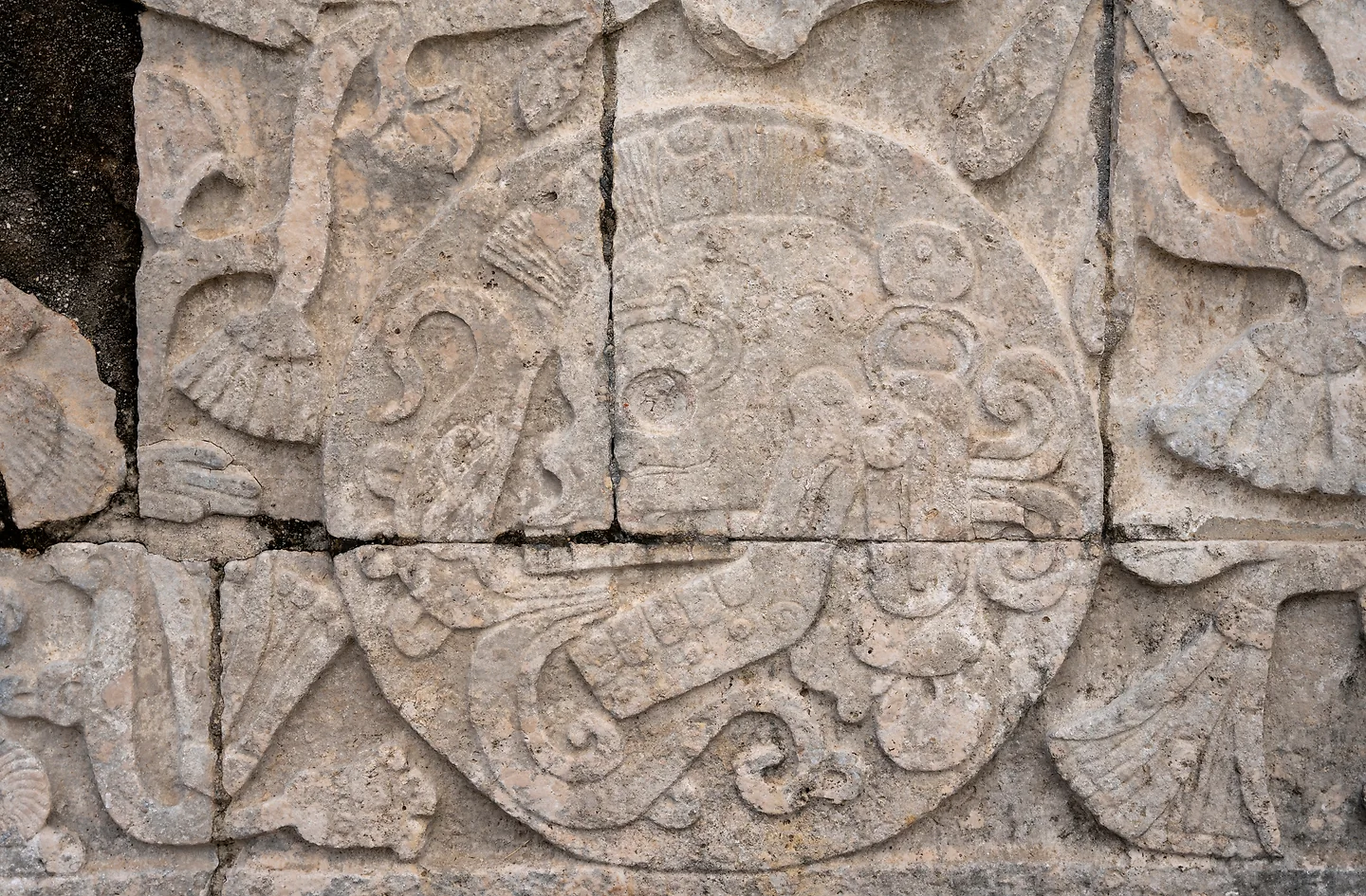
Basrelief detail from the Great Ball Court. Photo by Guillaume – stock.adobe.com.
When the cenote was dredged in the early 1900s, a hoard of gold, jade, copper, jewellery, pottery, and obsidian knives was recovered, as well as the skeletal remains of more than 40 humans. Most were children, aged 10 to 12. Children, being viewed as pure and innocent, would have been a valuable offering to the Mayan deities.
Historians do not know all the reasons why certain people were selected for sacrifice by the Maya, but a 2024 study shed new light on the practice. DNA analysis done on 64 individuals who archaeologists believe were ritually sacrificed and then placed in an underground chamber near the Sacred Cenote revealed them all to be young boys, ages three to six. Most were interred between 800 to 1000 AD. Further analysis revealed that the boys were drawn from local populations, and at least a quarter of them were closely related, with a similar diet, implying that they lived in the same household. As well, there were two pairs of identical twins. Because some of these boys represent multiple generations of related individuals, the study’s authors claim that their sacrifice would have been viewed as a badge of honour by their families for helping keep the cosmos in balance.
Later that day, back in my room, I struggle to fathom the mindset of families who would willingly send their young children to death. My visit to Chichén Itzá has introduced me to several perplexing mysteries. This one, I suspect, will remain unanswered.
As evening falls, I head for an old stone church on the top of a nearby hill, a relic from the site’s original role as a hacienda. Like the hacienda, it was constructed using stone from the Mayan temples and buildings. I tread silently up the path in the lemony light, carefully stepping over a wriggling column of red ants. Everything is soaked with moisture, and the air has a sharp metallic taste.
Just outside the church’s walls, I glance up. Two huge black vultures sit atop the white wooden crosses above the church’s façade. As thunder rumbles in the distance, I move closer. One of the vultures shifts on its perch, stares directly down at me, raises its massive wings, and utters a guttural hiss. Then, as if having made their point, the two birds gather themselves and flap off into the purplish horizon. Skin tingling, I watch them disappear into the Yucatán night.
Read more from our Winter 2025 issue.