

Last year, using information gleaned from the astoundingly comprehensive website Operabase, the Chicago public-radio station WFMT put together a list of the 20 operas most frequently performed in the 21st century.
Taking the top spot was La Traviata, Giuseppe Verdi’s 1853 tear-jerker based on the play La Dame aux camélias by Alexandre Dumas fils. According to WFMT, there were 18,732 performances of La Traviata between 2000 and 2025.
Coming in hot in the number two slot was The Magic Flute by Wolfgang Amadeus Mozart, with 18,332 stagings during the time frame in question.
And so it goes, with Carmen, La Bohème, The Marriage of Figaro—opera’s greatest hits, essentially. Opera companies worldwide are savvy enough to program crowd pleasers: mostly Italian masterpieces composed in the 19th century.
Vancouver Opera’s general director, Tom Wright, understands this reality better than most, thanks to hard-earned experience. For VO’s 2024-25 season, the company programmed Johann Strauss II’s Die Fledermaus and Giacomo Puccini’s Madama Butterfly. Sandwiched in between was a more modern piece: Flight, composer Jonathan Dove and librettist April De Angelis’s 1998 opera inspired by the true story of an Iranian refugee who spent 18 years living at Paris’s Charles de Gaulle Airport.
According to Wright, VO’s adventurous version of Flight, directed by Vancouver theatre icon Morris Panych, “was an extraordinary production, and it’s a wonderful opera, but nobody came to it. It doesn’t have the name recognition.
“When we didn’t reach our earned-revenue goals on Flight,” Wright continues, “I deliberately took a look at last season and this season as opportunities to get back to just doing traditional opera. Still with what we’re known for—high production values, high artistic and musical integrity—and, boy, the community’s responded, saying, ‘This is what we want.’”
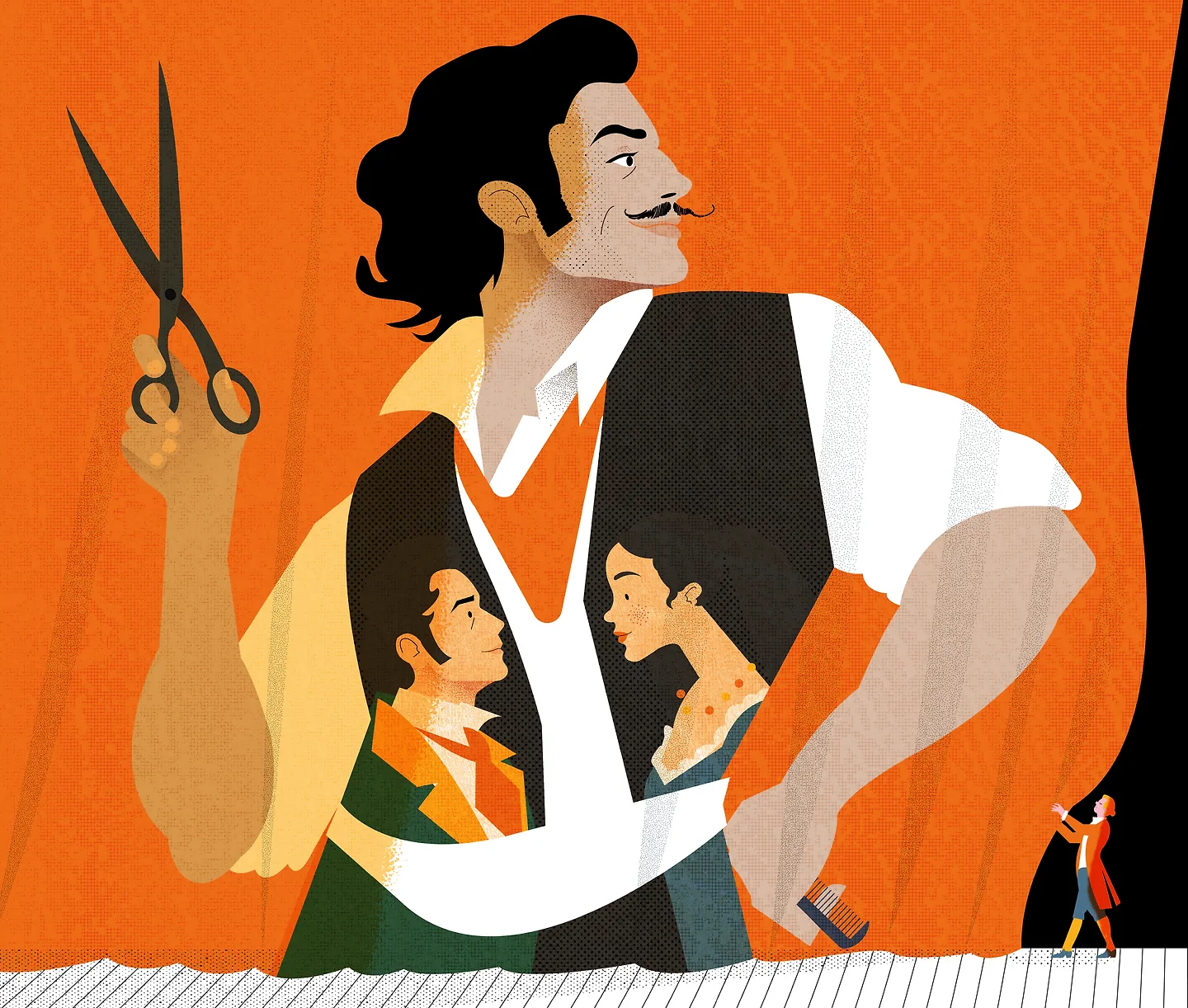
What they want, it turns out, is the world’s most popular opera. VO will close its 2026-27 season next April with La Traviata in a new co-production with Pacific Opera Victoria directed by Idan Cohen. The season begins, however, with Puccini’s Tosca in the fall, with the middle slot belonging to Gioachino Rossini’s The Barber of Seville, in a production created by Panych and designer Ken MacDonald.
This trio of mighty Italians has, perhaps unsurprisingly, already proven to be a hit.
“We’ve had phenomenal subscription sales this year,” Wright reveals. “We’re four months ahead of where we were last year, and we’ve surpassed our budgeted subscription goal. We just started selling single tickets to all our shows. Tosca’s 20 per cent sold on single tickets already. It doesn’t open until the end of October.”
Those impressive advance ticket sales as of early July are a sign that Wright and his programming team—which includes music director Jacques Lacombe and head of music/associate conductor Leslie Dala—are making choices that are ultimately beneficial for Vancouver Opera’s bottom line.
“I’ve got to tell you, opera is the most expensive thing to put on,” Dala says, reached in New Mexico, where he’s a member of the music staff at Santa Fe Opera. “All of my colleagues here in Santa Fe work for companies all over North America, some in Europe, and everybody is feeling the pinch. There are many companies in the last two or three years, especially in the United States, that have ceased to exist.”
“I’ve worked all around the world,” says Lacombe, who will conduct both Tosca and La Traviata. “I have to say that, since COVID, a lot of opera companies are still recovering from that, because it was a big, big shock for that business. And some companies are still struggling bringing people back in theatres.”
Vancouver Opera has never quite been at death’s door, but a downward trend in subscription sales in the 2010s was sufficiently alarming to spur a radical change in how the organization presented its productions. Wright’s predecessor, James Wright (no relation), announced the launch of the Vancouver Opera Festival, which was designed to cut costs by condensing an entire season into just a few weeks.
It was a bold move. It was also a major misstep.
“In 2017, we announced our Vancouver Opera Festival, but we didn’t do our homework,” says Tom Wright, who held the post of director of artistic planning at the time. “We didn’t have enough conversations with our key stakeholders. And we lost a million dollars in subscription sales that season, from the season before to the first year of the festival. And really, we were told in the first year of that festival, our supporters don’t want to see opera all in two weekends. They want to see it throughout the season. So we did the festival model. It was a commitment to four years, and we almost completed four years, but the pandemic took care of that fourth year. We didn’t have to do the final festival year.”
“We crave things that are beautiful, and to me, of all the art forms, opera is the culmination.” —Leslie Dala
That pandemic year, 2020, was also when Wright stepped into his current role and earnestly began the process of turning VO’s fortunes around.
“He has a very strong vision for building the core of the company back,” says Dala, who will be conducting this season’s production of The Barber of Seville, starring baritone Clarence Frazer as Figaro, the titular haircutter. “In other words, we need to make sure that there are always people coming to the shows, and we lost a lot of subscribers because of the decision to move to the festival—which had its own reasons.”
One strategy for ensuring that there are always people coming to the shows is to plant the seed of opera appreciation early and cultivate a younger audience.
“What we’re doing with our community engagement and our education is to really inform the youth of today that opera is an exciting art form, that you shouldn’t be scared of it just because it may be sung in a different language—because we have, of course, surtitles—and that it is an all-encompassing art form in that we are all performing arts under one roof, often, with dance and design and of course music and the voice,” Wright says.
In addition to the Vancouver Opera in Schools program, which VO has been running for more than 40 years, Wright says the organization is involved in a new project that will serve two important functions, bringing opera to new audiences and facilitating the creation of new works by emerging artists.
“We actually are partnering with our friends across the water in Victoria, at Pacific Opera Victoria, on a program called Opera Sprouts,” he says. “It’s really a little competition for composers and librettists to write 45-minute operas for young audiences, for grade-school kids.”
Who knows, Opera Sprouts just might discover this century’s Puccini, Rossini, or Verdi. At the very least, it will likely spark an interest in an art form that, to hear Dala tell it, has an almost supernatural appeal. And that can only be a good thing for Vancouver Opera’s subscriber base.
“To me, opera is magic,” the conductor says. “The community that it brings together, all the people on stage, behind the scenes, in the pit, some of whom have been part of the process for years, sometimes more, planning it, designing it. It’s such a beautiful thing. It’s a thing that has no reason to exist. There’s no practical reason for it to exist. There never has been, except that we as human beings crave storytelling. We crave things that are beautiful, and to me, of all the art forms, opera is the culmination, because you have music, you have movement, you have storytelling, you have orchestral playing, you have singing.
“The human voice is the most magical thing,” Dala concludes. “If everything on Earth ceased to exist, we could continue to tell stories and to sing.”