

Where am I, exactly? On my first visit to Vancouver’s Oakridge Park on a Sunday afternoon in early July, it feels like I’ve landed in a brand-new airport with no departure gates. Wide white corridors are dotted with curved red sofas. Glass leaf sculptures dangle below a skylight like paper cranes.
This vast west-side mall and residential complex—its first phase launched in May—is home to about 60 shops, with more to come. At a glance, it’s busy but not buzzing, a vibe that suits its marquee tenants.
Louis Vuitton, Miu Miu, Rolex, Loro Piana—many of the world’s most recognizable luxury labels are here. Dior’s window displays ceramic-and-glass cakes along with literary tote bags. Outside Chanel—the maison’s only Canadian store to house all its product categories—a handful of people stand behind a black rope as if they’re queueing for a nightclub.
Those exclusive boutiques sit alongside outposts of local giants Aritzia and Lululemon, plus a soon-to-reopen Safeway from the mall’s previous incarnation.
Oakridge Park isn’t the only vote of confidence in Vancouver’s retail future. Downtown will see Aritzia and Quebec-based department store chain Simons open high-end flagships next year, in the wake of Nordstrom’s departure. That’s a ton of investment for an industry that’s been struggling everywhere else. Right?
Globally, luxury retail is coming off a bumpy stretch. Between 2022 and 2025, its customer base plunged from 400 million to 330 million, according to management consulting firm Bain & Company. The outlook is mixed. Bain projects three per cent to five per cent growth in personal luxury goods for 2026. Morgan Stanley is less bullish, having recently cut its own forecast to about 2.5 per cent.
So where does Vancouver fit in this cloudy picture?
When Nordstrom announced in early 2023 that it was shutting down all 13 of its Canadian stores, the retreat looked like a bad omen for the city’s luxury market. But David Ian Gray, founder of Vancouver retail consultancy DIG360, traces the closure to Nordstrom’s overexpansion and debt load nationally.
Before it closed, he notes, the Vancouver Nordstrom was consistently one of the top three to five performers chainwide. “I would say also that Nordstrom wasn’t true luxury,” he adds. “I think it would compete with an Aritzia.”
Gray says Nordstrom’s departure was a boon for nearby Holt Renfrew, the only downtown department store left standing after The Bay folded last year.
Like Nordstrom before it closed, Holt Renfrew’s Vancouver location is one of the highest-volume stores in the chain. Business was “pretty steady” for the first half of the year, says Ryan Roguski, Holts divisional VP and general manager. The World Cup helped draw international visitors. Strolling through the three-level, 180,000-square-foot store on another Sunday in July, I see soccer-themed banners floating among many of the same tony names found at Oakridge.
Certain luxury brands are having a tough time, Roguski admits. But Holts, whose Vancouver store turned 50 last year, has built long-term relationships with its customers. The previous week, three generations of a family—a grandmother, mother, and daughter—stopped by together, he says. “If those relationships continue to remain strong, our business will continue to be steady, regardless of what’s happening with the specific brands.”
The Nordstrom closure gave Holts a chance to reconnect with some customers, Roguski says. He also credits Nordstrom with helping bring excitement to downtown. For the same reason, Holts looks forward to having Aritzia and Simons as neighbours, he says.
Roguski views Oakridge Park in a similar light, framing citywide growth as a rising tide rather than a competition. “It just gives more presence to how important a city Vancouver is in the luxury marketplace.”
Brands are certainly doubling down. Between Holts, the nearby Alberni Street shopping strip, and Oakridge Park, Vancouver has become something of a luxury hall of mirrors, with labels popping up repeatedly. It’s never been easier to nip out to Prada or Moncler.
That kind of retail density needs a steady influx of buyers. Roguski points out that city hall has approved four new downtown hotels—a welcome development for Holts, which, like Alberni Street, benefits from well-heeled visitors staying nearby. “They continually send guests to us, and we recommend, obviously, their hotels,” he says.
Gray’s verdict: “I’m not worried about Holt Renfrew being around in five to 10 years.”
So who exactly is buying luxury goods downtown—and at Oakridge Park’s new stores?
Besides folks from around the Lower Mainland, Holts’ customer base includes visitors from Seattle, cruise ship passengers, and Asian clients who might spend six months in Vancouver, Roguski says. South Asia “has been a bigger market for us over the last number of years, and it continues to grow.”
That mix reflects something structural. Vancouver is a “nexus point” between North American and Asian standards of what counts as luxury, says Andy Yan, director of the city program at SFU. Arc’teryx, the locally founded outerwear brand, bears that out: it carries higher luxury status in China than in Canada. Straddling those two worlds gives the Vancouver market “a certain level of sustainability,” Yan suggests.
There’s a second layer to that resilience. Vancouver luxury retail doesn’t run on local income, Yan observes. “Metro Vancouver in general is really more about wealth as opposed to income.”
Luxury shopping in Vancouver is largely supported by tourists, foreigners with seasonal residences, and locals with inherited wealth. That top tier is where the market is concentrating, locally and globally. The “aspirational buyer has … been somewhat priced out by inflation,” says Chrystal Burns, executive VP of Canadian retail at Oakridge Park-owner QuadReal Property Group. That leaves luxury spend “more concentrated in the top sort of affluent segment.”
Yan sees the same divide. Malls built for a disappearing middle class are hollowing out, part of what he calls “K-shaped society.” So Oakridge’s timing could be good: a mall for the top of the K, opening just as the middle shrinks.
Ah, here’s where the action is.
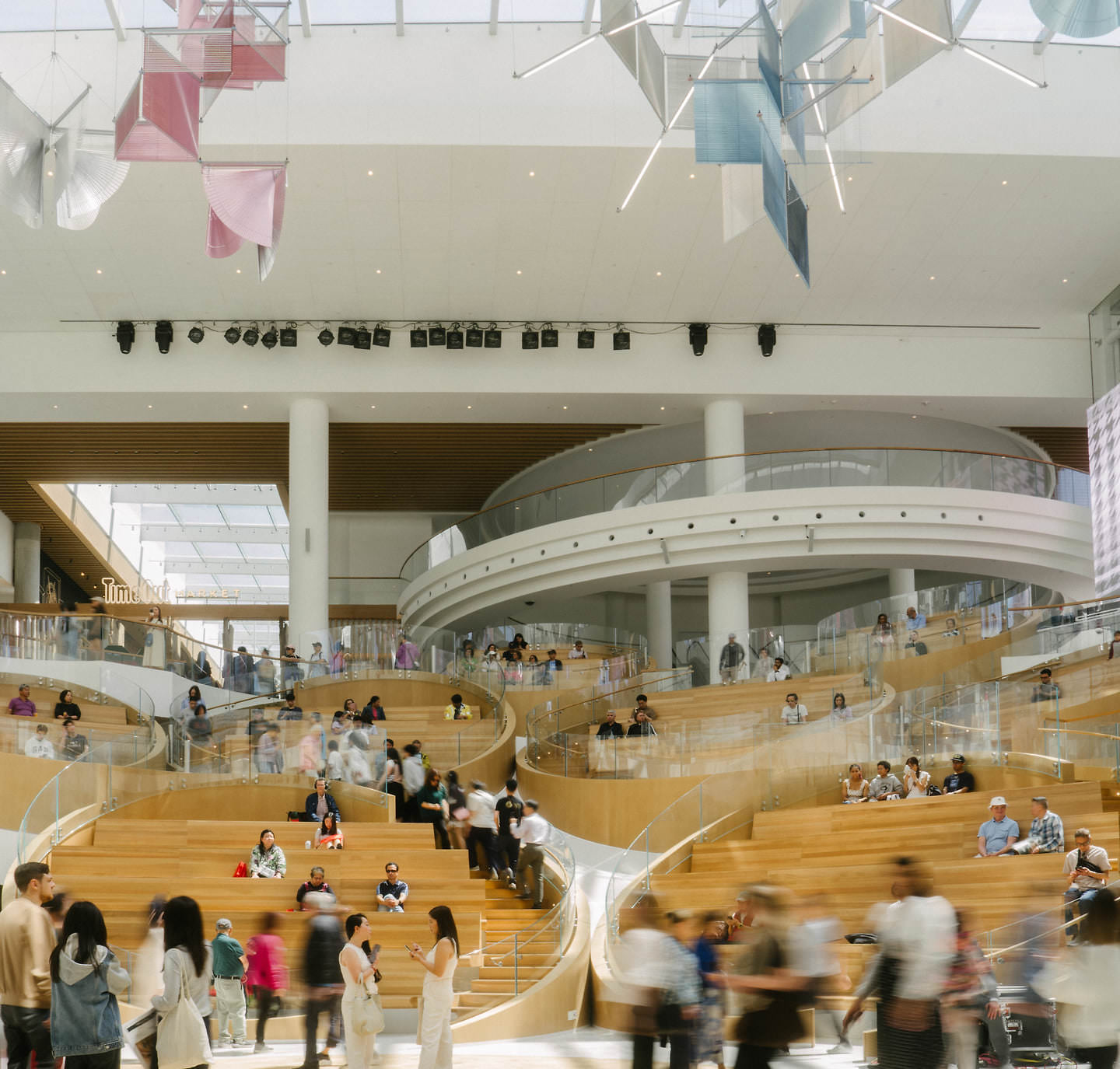
Heading deeper into Oakridge Park, I find out why it bills itself as “Vancouver’s Cultural Hub.” A string quartet performs to a few dozen spectators scattered across an ovoid wooden seating area that could have rolled in from the Chan Centre. I climb its stairs to Time Out Market Vancouver.
Past the old-growth timber panels that divide the broad entrance to this crowded food hall, a smartly dressed crowd gasps at the World Cup match between Brazil and Norway. Its 20-plus eateries and bars—no logos on signs, please—tilt heavily toward Blnd Tger, DownLow Chicken, Lunch Lady, and other restaurants originally found on the city’s east side.
Oakridge Park isn’t done growing. Now 650,000 square feet, its retail footprint will expand by another 200,000 when the second phase opens.
Outside in the rooftop park, Brian Jungen’s Bush Capsules bursts skyward like a cluster of giant dandelions—one of several public art installations throughout the complex. Families and couples eat lunch on a patio flanked by Oakridge Park’s futuristic towers. Those residences, which contain rental units and a mix of luxury, market, affordable, and seniors housing, will add daily foot traffic when move-ins start at year’s end.
Burns pitches Oakridge Park—whose final version will include 3,000-plus residential units and 720,000 square feet of office space—as a community. And by her own account, it’s a patient play: “This is a long-term, generational investment for QuadReal.”
So far, retail sales have exceeded expectations, she says. The mall had 155,000 visitors on day one, building to almost 1.5 million in its opening month.
Burns sees strength in the macro numbers, too. “We’re looking at analysts looking at four per cent growth for the luxury spend across Canada, and Vancouver is seeing no distress in luxury real estate.”
But monogram bags and four-figure coats are only part of the picture at Oakridge Park, where the retail mix creates a “critical mass” for customers, she says. Whether it’s luxury, casual wear, or stretchy exercise pants, people want the “best in class,” she adds. “That is what Oakridge Park brings together.”
Retail has been called an “apocalypse,” Burns acknowledges. “We call it … an evolution, the survival of the fittest.” Oakridge Park isn’t done growing, either. Now 650,000 square feet, its retail footprint will expand by another 200,000 when the second phase opens.
A key driver of that evolution is accessible luxury. Even as top-tier brands struggle, Bain found that entry-level names like Aritzia and Lululemon were 2025’s most dynamic segment.
At Oakridge Park, Gray argues, accessible brands are borrowing prestige from their high-end neighbours. “When I went to check it out a couple days after open, people did looky-loos down the luxury wing, but Aritzia was packed,” he says. “Alo was doing really well.”
Yan wonders how the new Oakridge will engage with its local environment. “Is it this kind of orchid that comes into the western Canadian rainforest landscape?”
To Yan, the space borrows less from Europe’s classic shopping arcades and more from upscale international transit hubs. “The aesthetic is airport chic,” he says, noting that YVR has its own collection of luxury outlets.
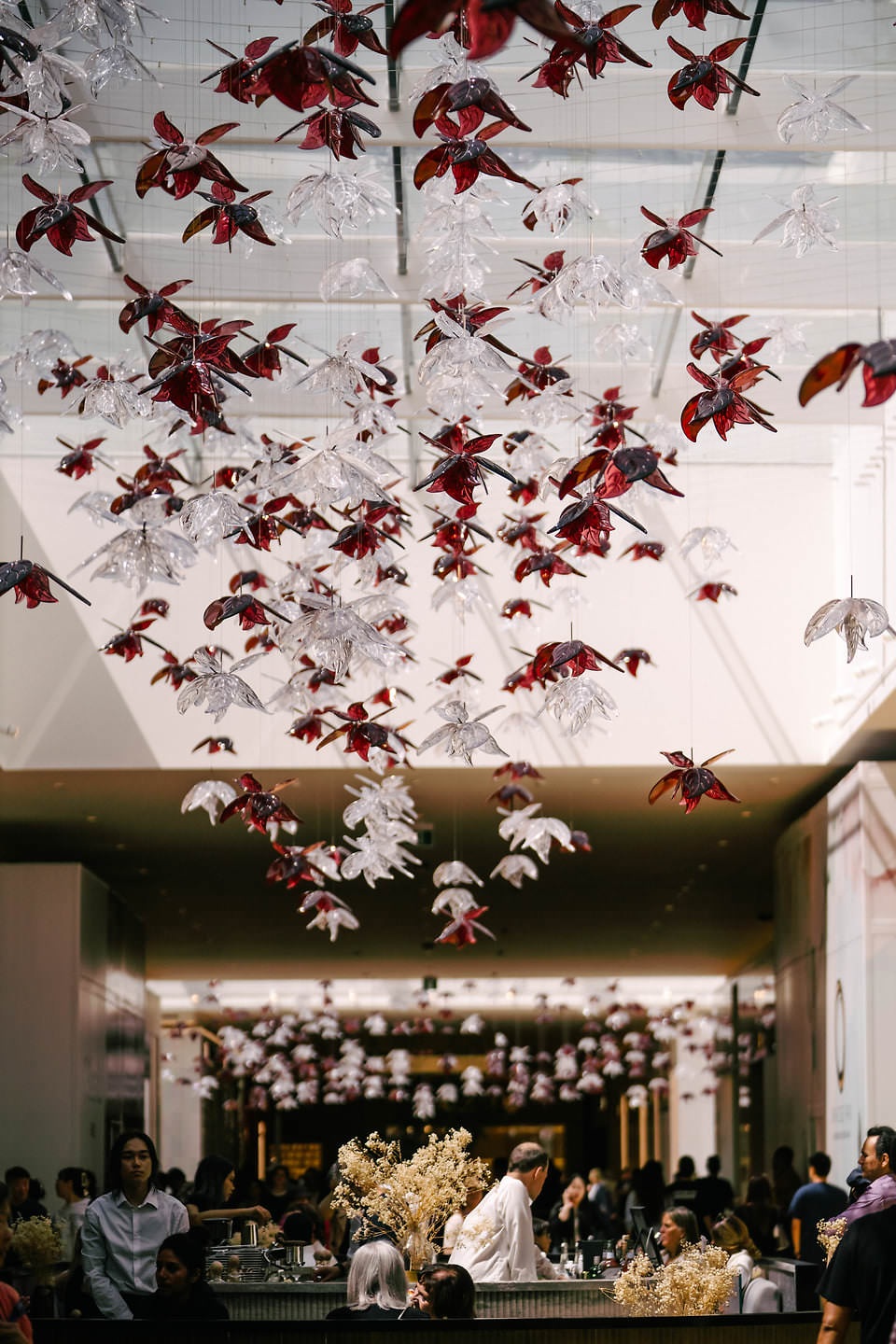
Glass leaves by Lasvit.
Yan also stresses how much Oakridge Park differs from the original Oakridge of 1959, a decidedly middle-class mall anchored by Woodward’s department store. “It’s like you’re exchanging mall rats for luxury leopards.”
But is the timing right? Gray traces Oakridge Park’s ambitions to the same boom-era Vancouver that drew big brands to Alberni Street a decade ago, flush with wealth migration and pricing arbitrage that have since cooled. “A lot of those early decisions were made with a view from a different era,” he says.
The real test, Gray reckons, won’t come until around 2033 or 2034, when leases are up for renewal. Flagship leases are as much about visibility as immediate returns—“If it’s a hot market, not being there might be as noted as being there”—so brands’ 10-year commitments can turn into 20. When renewal time comes, retailers will decide, based on revenue more than traffic, what they’re willing to pay to stay.
Gray expects the mall to adapt accordingly, raising rents if tenants are doing well and offering discounts if the economy is soft. What he doesn’t expect: that Oakridge Park “will suddenly become populated with Dollarama.”
In the near term, he anticipates a redistribution. “I think they’ll be treading water, and I think they’ll take a little bit of a bite out of Alberni.”
That bite includes staff as well as shoppers. Gray has heard that experienced sales associates and even managers want to move from downtown to Oakridge Park.
Do Vancouver luxury retail’s best days lie ahead of it? Yan notes that back in 1913, landscape architect Thomas Mawson called Vancouver a “City of Optimists.” More than a century later, it’s putting that confidence to the test one pricey purchase at a time.