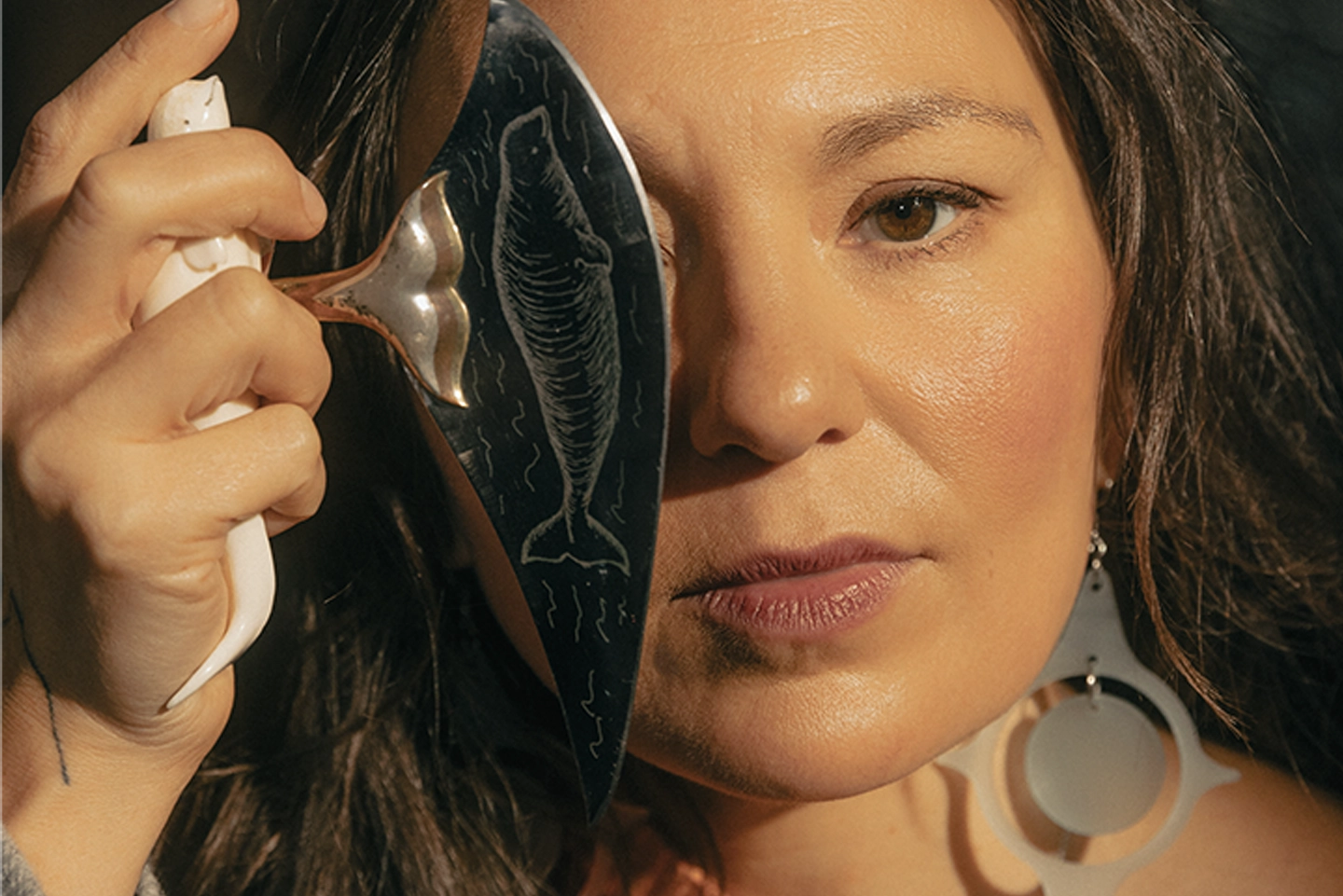


There’s a sound rising over the music coming from the restaurant’s speakers. It’s tuneful but not really a tune. The disconnect is confusing: it’s filling the space, but where is it coming from? There’s something unsettling about it, but I am drawn to find its source, like a sailor bewitched by the sirens’ song.
I have to smile. Oblivious to her surroundings, Tanya Tagaq is waiting for me, headphones on, looking at pictures on the restaurant’s wall, releasing this haunting sound wave that bathes and unsettles in equal measure. I am, not for the first time, in awe of the power this woman holds within her small frame.
At 50, Tagaq has amassed an impressive body of work as an avant-garde musician and composer, throat singer, and author. Her 2014 album Animism won the Polaris Music Prize and took home a Juno, and was followed by Retribution (2016) and Tongues (2022). In 2016, the Canadian Inuk artist was awarded Member of the Order of Canada. Two years later, she flexed her writing muscles, publishing her first book, Split Tooth, to wide acclaim (it made the Giller long list). Somehow, she has found the time and energy to add acting to her skill set, appearing in HBO’s True Detective with Jodie Foster and as a recurring character in the Canadian comedy series North of North.
Her new album, Saputjiji, like its predecessor, Tongues, draws on the words and themes of Split Tooth, this time taking the connection one step further in a live show, Split Tooth: Saputjiji, which premiered to a PuSh Festival audience that sold out the Chan Centre for the Performing Arts in February.
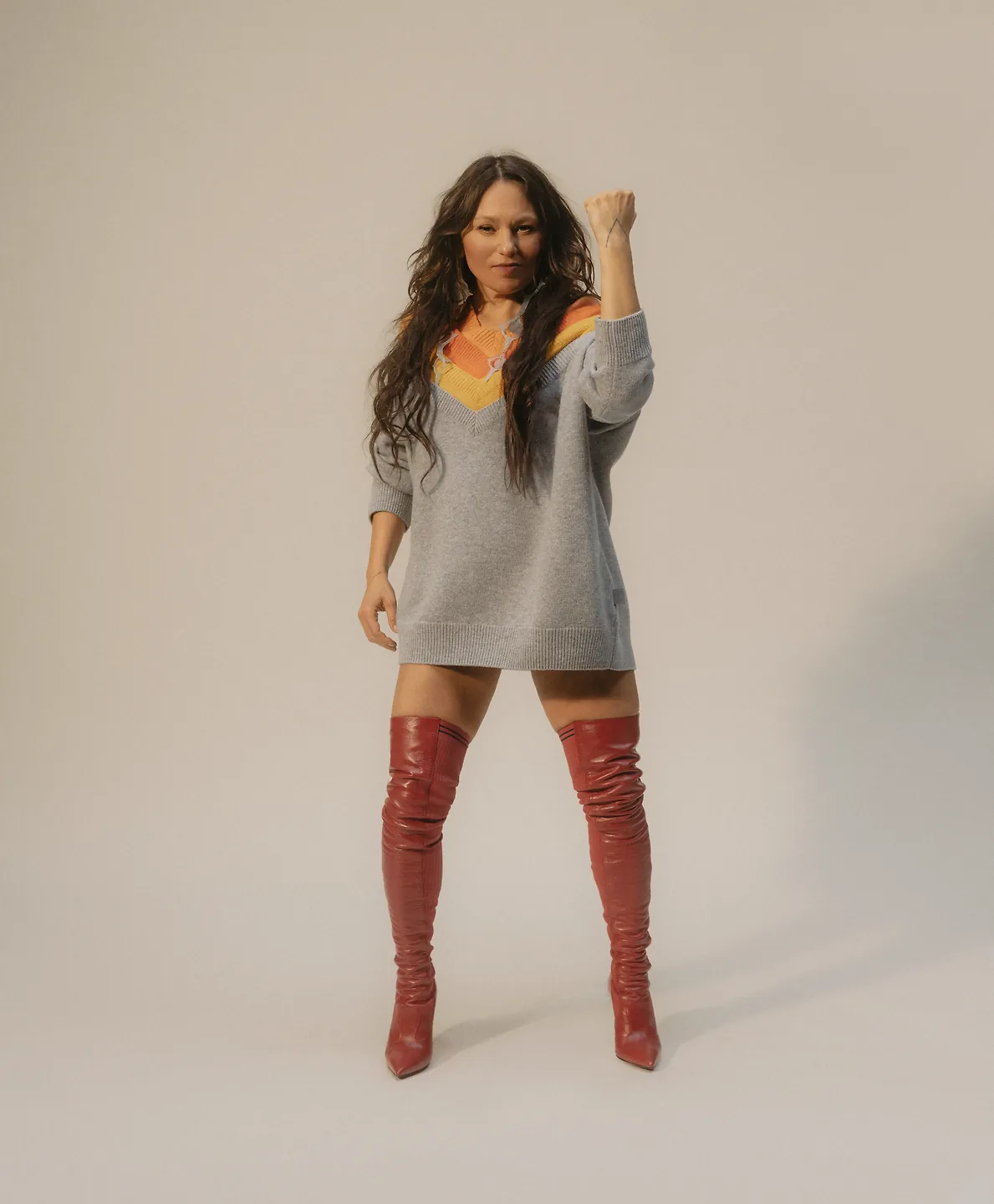
Loewe sweater from Holt Renfrew; Fendi boots from Mine & Yours; Ay Lelum earrings.
We meet in Vancouver just before rehearsals begin, Tagaq clear that this is the beginning of an art piece, not its culmination. In December, the Banff Centre for Arts and Creativity held a work-in-progress open rehearsal.
“I fly off the seat of my pants,” she says, when I ask how the PuSh performance will build on that. “And I don’t have many preconceived notions of what’s going to happen, but the most I can say about this show is I know it’s going to change every time, as we are changing all the time—our old selves are being breathed out, and we are creating new ones. I think this show is going to keep doubling on itself in a way that allows for a lot of growth.
“We are kind of conceiving this thing every time we perform it,” she continues. “And we’re really excited. I’m nervous about it, and there are things missing still that I want to bring in, but it’s just the first round. You put the key in the new car, and the engine, and it’s sexy, and it smells good—and that’s where we are at.” She lets out a peal of infectious laughter. “There’s no mileage on this baby.”
“I went to where my mother was born for the first time last summer, and I never felt more connected to any place. I can still feel this is where my minerals come from.”
The idea for the album was hatched back in 2018 but was derailed, like so much, by the pandemic. And that strange, liminal time, brought its own voice to the work, Tagaq says.
“Steps were made that couldn’t have been made without that isolation. Steps that couldn’t have been made without that time between 2018 and now,” she says. The album’s call to action to reject the military machine and the colonialism that underpins it has become even more urgent, she adds.
When she finally got into a studio, she told her frequent collaborator, drummer Jean Martin, to start with just a click track because she needed to scream out her anger.
“Saputjiji means designated protector in Inuktitut,” she explains. “And I feel in order to stand up against what we know is right and wrong, we need to be brave and stand up and be the antidote for this illness that is taking over the world, and the illness in humanity itself.”
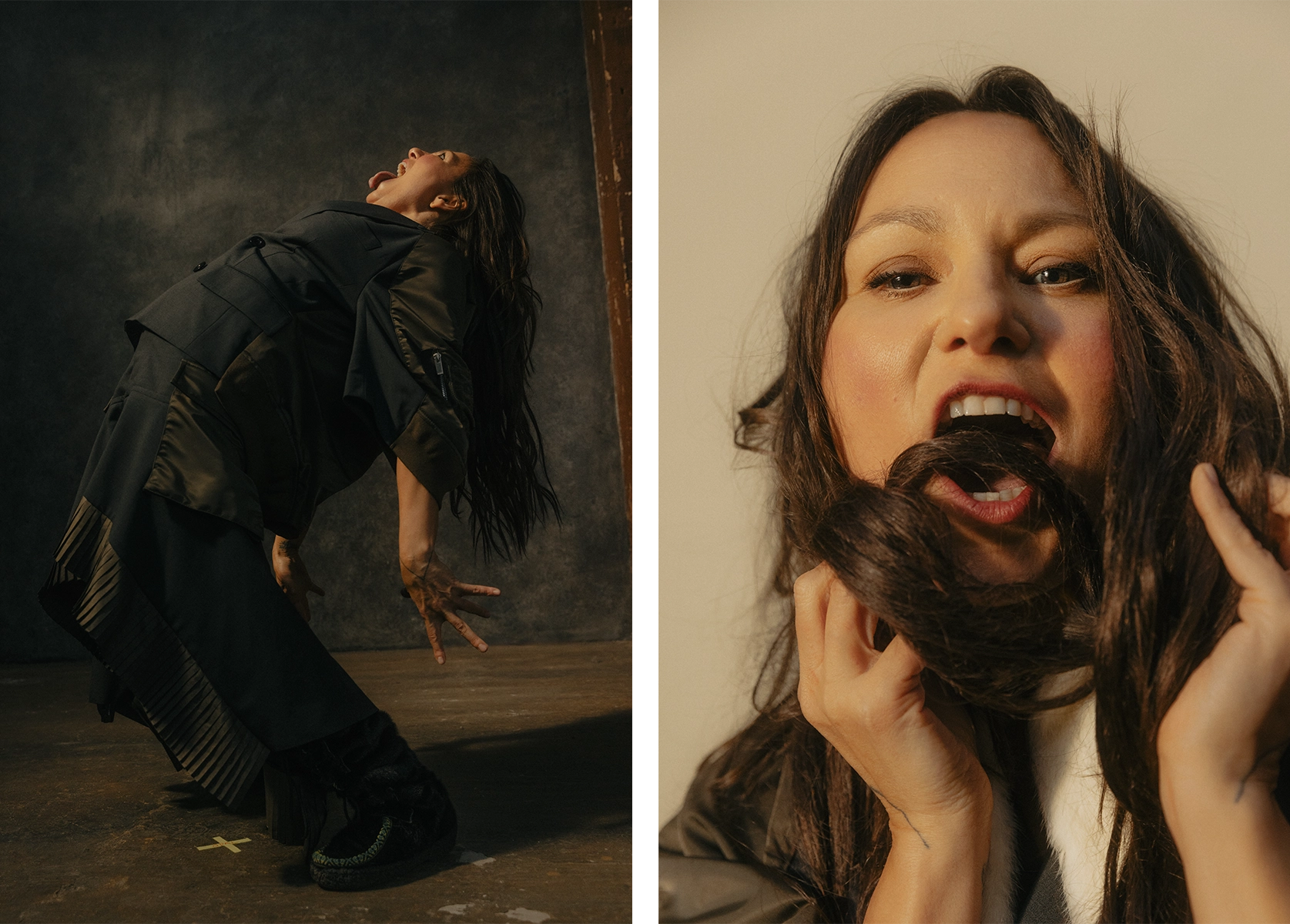
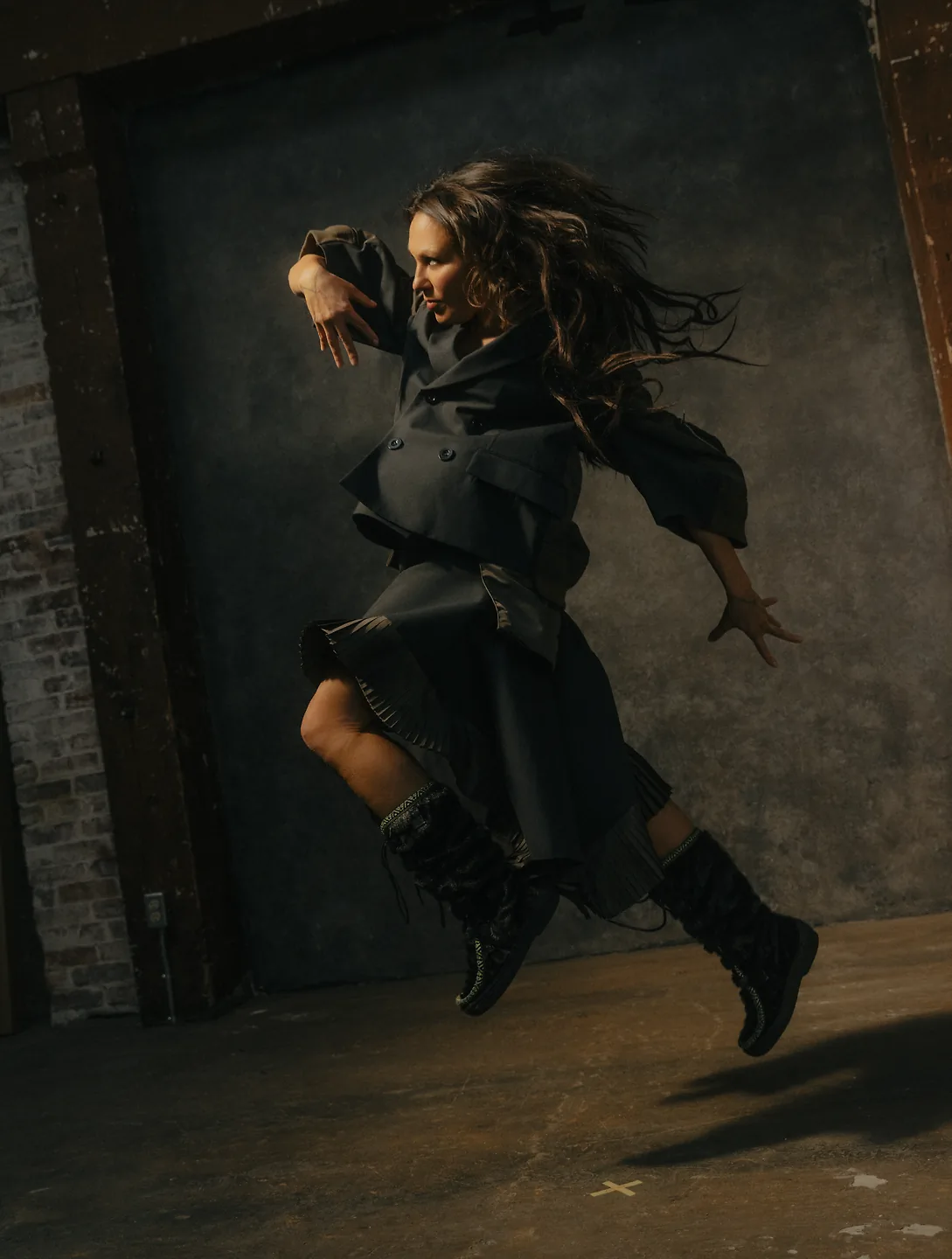
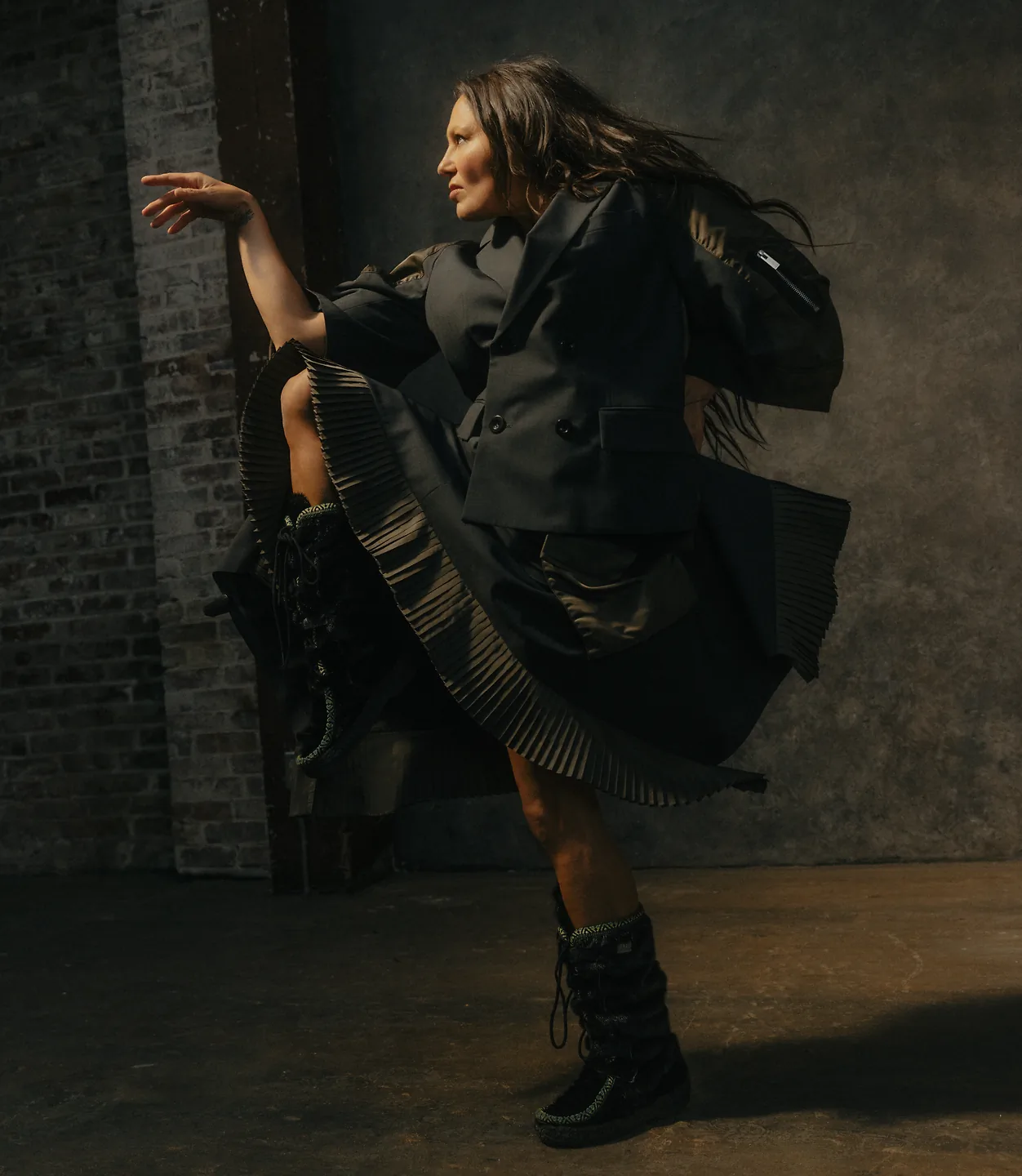
Sacai jacket and skirt from Holt Renfrew; Tagaq’s own boots and earrings.
Tagaq grew up in in Iqaluktuuttiaq (Cambridge Bay), Nunavut, before being sent to residential school in Yellowknife and then attending university in Halifax. She has travelled the world performing and now splits her time between Victoria, Toronto, and Nunavut, but the North is where she feels most at home. The NFB 2022 documentary about Tagaq, Ever Deadly, captured her connection to the Arctic beautifully.
Ever Deadly has inspired Tagaq to work on another documentary, this time centred on her mother, whose family was forcibly moved to Resolute Bay from Pond Inlet on Baffin Island as part of Canada’s High Arctic relocation in the 1950s. “I went to where my mother was born for the first time last summer,” Tagaq tells me. “And I never felt more connected to any place. I can still feel this is where my minerals come from.
“I really love what sound is, what it does, the shapes it makes.”
“We want to uncover the story of what actually happened when they arrived there,” she explains. “I think a lot of people are reluctant to share atrocities—within our culture there is a stoicism and a reluctance to dwell on the past, lest it infest you in the present. So a lot of people haven’t spoken out about what really happened there.” She pauses, a darkness crossing her face.
“It’s a lot worse than you think,” she notes, adding, “there was an army base there.”
Saputjiji is a howl of anger against war and disrespect for the Earth, patriarchy and power, greed and oppression. This anger, she says, is an act of love. “It’s this desperation for justice that I have, because there is only peace through justice.”
She looks at me scandalized when I ask if she ever wishes she didn’t feel the need to be the one to stand up and push back.
“Absolutely not,” she counters. “I find that people use avoidance as a shroud for cowardice. It’s wonderful if people have the privilege to be able to not look. Good for you. But I find you dreadfully boring and very asleep.
“When people are awake, then we are connected, and it feels like we are connected to something real.”
Connection in a more physical sense—between sound and body, heartbeat and breath—is a key component of Tagaq’s live performance. I’ve seen her a few times, once in a small anteroom at the Chan, where the rhythmic intensity of her throat singing became so powerfully transcendent, I felt what I can only describe as an out-of-body experience.
“There’s so much power in groups, large groups, when we all feel the same thing,” she says, nodding. “It’s almost predatory—not predatory exactly, I’m taking in everything you are thinking and feeling. The audience is so important. I sing a lot on the land, and that’s perfect too,” she adds. “But I really love what sound is, what it does, the shapes it makes. You can make a concrete composition out of the clinking of those forks”—she looks over at a table being cleared.
“But the concerts themselves,” she continues, “if it’s a good one, I’m not there either. There’s been times where I’ve gone to a few places where—I never really talked about this before—where there’s no bodies and no light and no thought, and you’re just there, and it’s very dark, but not in a bad way. And I’ll hear something very faint, very far away, and slowly realize that the sound is coming out of my mouth, and the sounds get louder and louder, and I realize I’m in a concert in front of the people.”
People recount all manner of responses to her concerts. A woman with terminal cancer told her after one concert she was no longer afraid to die. “That was heavy and perfect, and it made me feel that whatever I’m doing, if no one ever saw my show again, it would have been worth that.”
Some reactions are less than positive, and that’s fine too. “I’m not there to entertain,” she says with a shrug. “I’m there so that we can be together. My favourite is when someone gets pissed off and leaves and hates it.
“You have permission to not like it.”
Tagaq has always been a straight talker, and menopause is only sharpening her tongue. “I’ve seen people saying it’s because we’ve become embittered. Whereas I think the procreational hormones that made us caretake have left the building,” she says. “And now I don’t want a man-child. I don’t want to take care of a man-child. You can take care of yourself.”
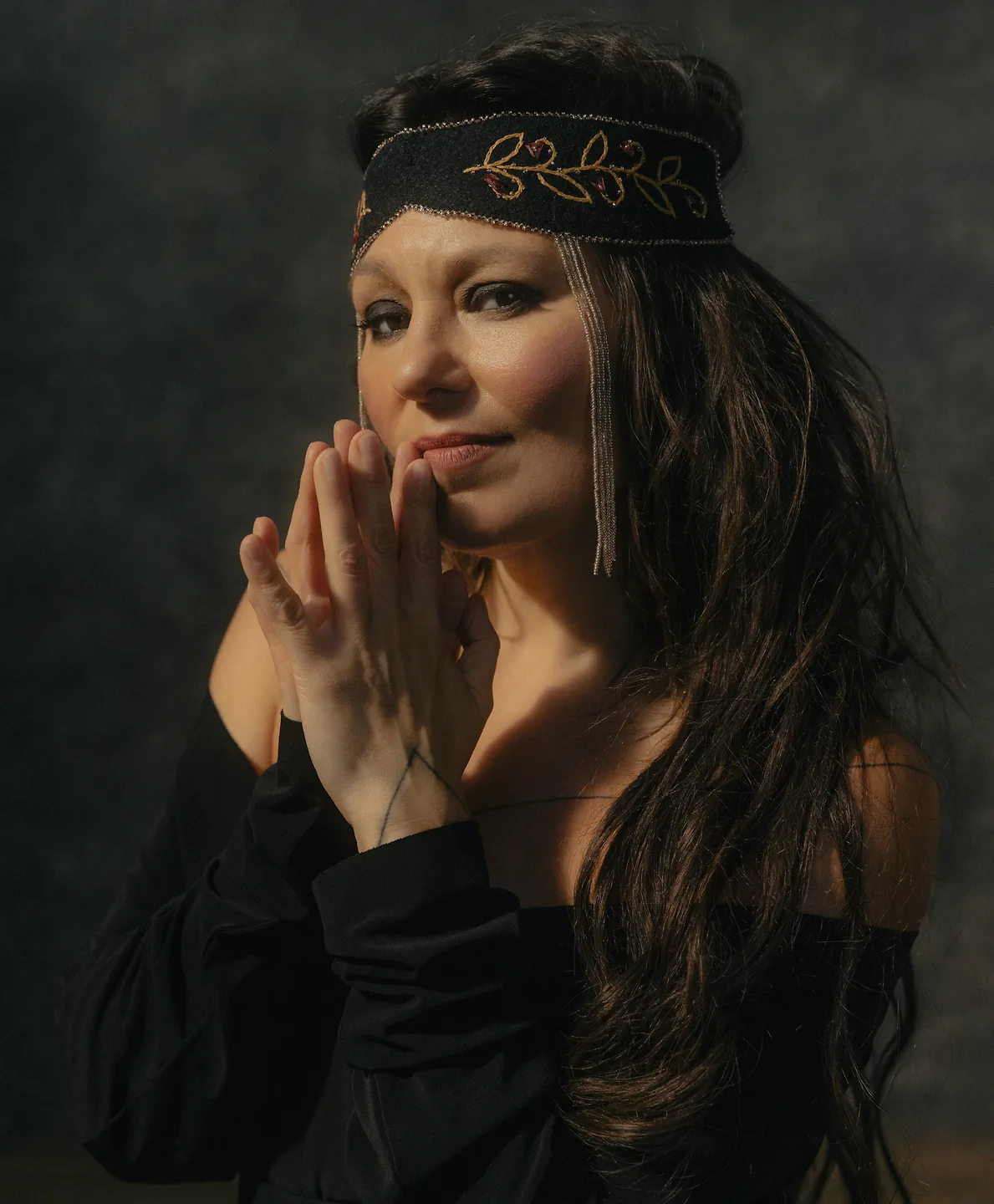
Tagaq wears her own top and headband.
She points out that older women in her culture have higher status. “When you come from a matriarchal culture, it matters what you say as an older woman. It’s understood that’s where wisdom lies. Historically you would have to listen to what the older women say because they know better, because they’ve seen it. They’ve seen everything.
“The accumulated knowledge of women, it’s very valuable. And it’s a sin that it’s been cast aside by so many cultures.”
Menopause also brought her a breakdown, and with that, an assessment and a diagnosis of autism and ADD that, she says, once she knew, made so much sense.
“I had been struggling a lot—my whole life—and couldn’t understand people,” she explains. “I would be, ‘Humans are really weird. I don’t know why they behave this way.’ And I put it down to cultural differences of trauma. I just didn’t understand why I said and felt things I couldn’t explain, and I really, really hated myself for all of the things that I now know are very typical symptoms of autism, like the emotional dysregulation.
“What was so sad,” she says after taking a beat, “is that I thought I hadn’t healed from trauma fast enough, or that I wasn’t making enough progress. It’s a big deal, because when you grow up hard, you don’t want to be a pussy. You’re afraid of that. A lot of my self-worth is based in that grit. And all these things I was ashamed of I thought were softness. But really it’s just because I am autistic.”
She feels empowered by the diagnosis especially, she says, in the North “where people accept each other for who they are.” Certainly, it has not dampened her passion or her purpose, which, right now, is getting people to hear Saputjiji and be spurred to action.
“If you avoid things that make you anxious, avoid things that scare you, I understand that you might think that makes you safe, but it doesn’t actually make you safe. A lemming in a hole that’s scared of the owls will starve. You have to be brave to get what you need.
“I’m really firm in this idea of anger and bravery being rooted in love, because when you love something so much, you want to protect it,” she says, referring to the English translation of saputjiji.
“But we have to start standing up. Indigenous peoples have been standing up forever, but everybody needs to stand up now—and that’s the base of the album. It’s the base of the production. I’m tired of people pretending not to know the difference between right and wrong, because we all feel in our hearts—we know what’s equitable; we know what’s fair. I really believe that harnessing sound, like a dog team, is a good way forward. And you need a whip.”
Her voice changes tone, made serious by the urgency she feels.
“It’s time to wake up. It’s time to be the antidote. It’s now. It’s right now. It’s not in 15 minutes. It’s not tomorrow. It’s right now.”
Read more from our spring 2026 issue. Hair and makeup: Marlayna Pincott @hype relations using Oribe. Hair and Makeup Assistant: Lindsay Tanner. Digitech: Christoph Prevost. Photographer’s assistant: Kyle Gibson.