

With three great rivers, two seas, an ocean, and many of the world’s best-known wine regions, France presents a problem of plenty: wherever you visit, there’s a village or vineyard you’re missing out on somewhere else. Some places are famously attractive. Others try to shout about their restaurants or their sights to lure in more visitors. Those places have only rarely been wine regions. Until recently, if you wanted a wine tasting and a great meal in Champagne or Burgundy, it helped to know a local. Point out that worldwide admiration and interest are usually considered assets, and the inhabitants would give a Gallic shrug and go back to making wine.
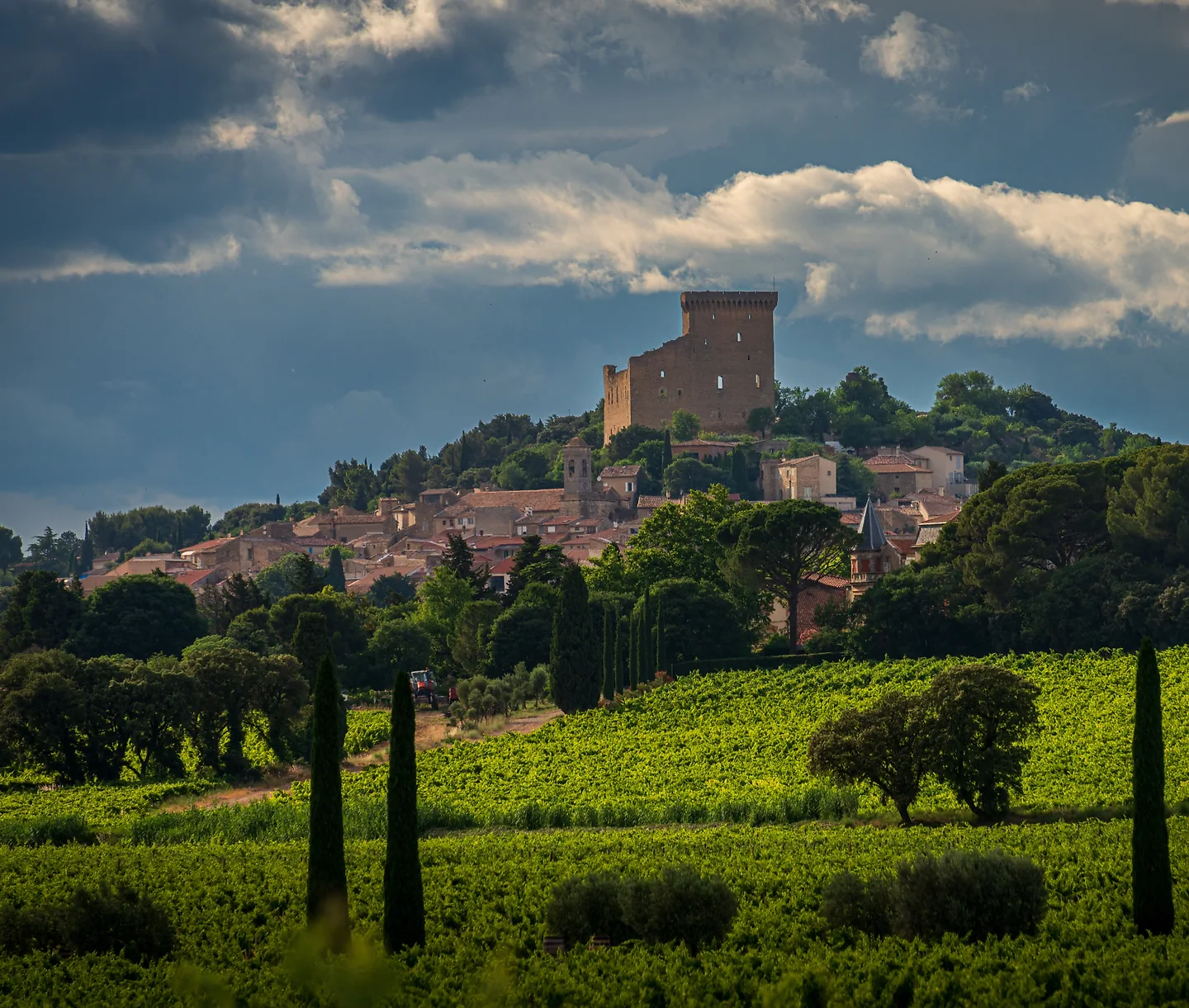
This was also true of Châteauneuf-du-Pape, the pretty village beside the Rhône River that is famous for rich red blends. Which was especially strange, since this was the hot spot par excellence for a very early form of tourism. In the 14th century, when the popes had fled Rome for Avignon, less than 20 kilometres south along the Rhône from Châteauneuf-du-Pape, Pope John XXII built his summer residence here, atop the hill, with panoramic views of a landscape that hasn’t changed a huge amount since.
“There’s a new pedestrianized square, Place Jean Moulin, buzzing with restaurants: waiters bustle beneath the terrace parasols, and diners call happily to friends at nearby tables.”
In the 20th century, when the route to the Riviera ran past the village, tourists once again flowed into Châteauneuf-du-Pape. It didn’t hurt that Germaine Vion, who in 1922 opened her restaurant La Mère Germaine in the centre of the village, had cooked for the president of France. In 1950, the restaurant won a Michelin star, and hungry A-list actors jostled for tables: Mistinguett, the prima donna; Fernandel, the comic; Jean Gabin, the romantic hero.
Those were the high points. But the popes went back to Rome, and in the 1970s, the motorways stole the traffic. Châteauneuf-du-Pape shrugged and went back to making wine. When I visited a decade ago, there were a few single-producer wine shops and the odd lacklustre café. I bought a couple of bottles and hotfooted back to Avignon.
I returned last April to find a place that has taken leave of the 14th century at last. It is still possible to walk up to the ruined castle—destroyed during the Second World War—and look out on a gorgeous expanse of vines, fields, and trees toward the wide silvery-blue band of the river. Closer by, though, there’s a new pedestrianized square, Place Jean Moulin, buzzing with restaurants: waiters bustle beneath the terrace parasols, and diners call happily to friends at nearby tables. Across the way is the Maison des Vins, where it is possible to buy bottles from around the region at a variety of price points, although none are cheap: this is a fine wine region, after all, so much of the work must be done by hand. “The terroir is a bit hostile,” says Nicolas Brunier, and as the sixth generation to make wine at Domaine du Vieux Télégraphe, in the next village, Bédarrides, he should know. Châteauneuf-du-Pape vineyards are famous for stones known as galets roulés: smooth rocks that hold the sun’s heat. The vines love them, but no tractor ever has. “This land is difficult to work: it breaks machines and men,” Brunier says. But his wines are wonderful: the reds spiced, with black fruit and a sprinkling of chocolate; the white, a blend of grenache blanc, clairette, and roussanne from a single plot called Clos Roquète, is perfumed with yellow peach.
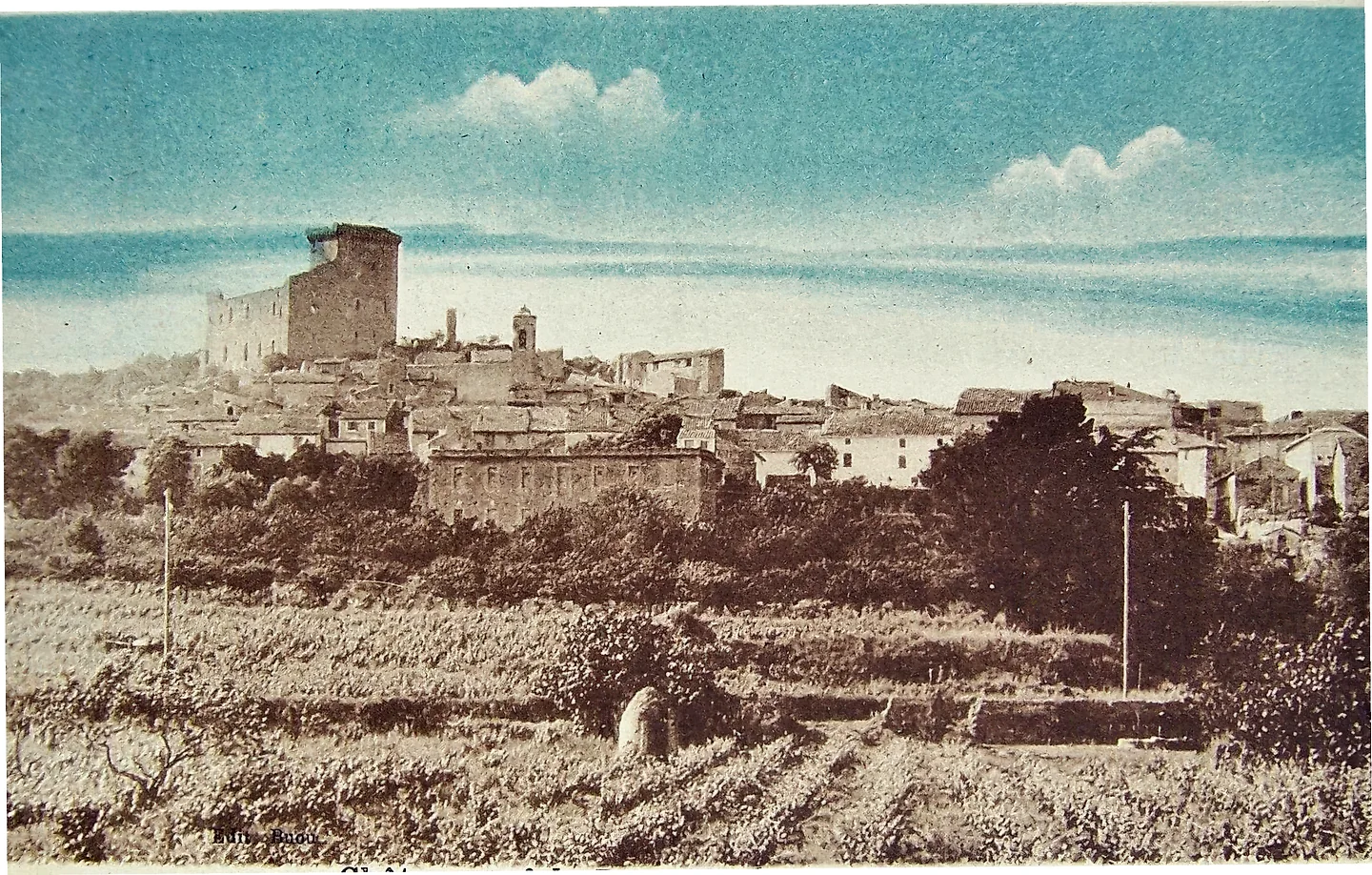
Photo courtesy of Châteauneuf-du-Pape.
If a modern, vibrant town square and younger winemakers such as Brunier taking over from the old guard are two reasons that the village feels different, the Strassers are another. In 2016, Arnaud and Isabelle Strasser—he on the board of the company that runs the Casino supermarket chain, she a French teacher—decided to buy a vineyard in the Vaucluse, just north of Aix-en-Provence. Despite their hard work and enthusiasm, they found this less prestigious wine region a challenge, so they branched out: to Beaumes-de-Venise, Tavel—once so famous for its rosé wines—and Domaine le Prieuré des Papes, in Châteauneuf-du-Pape. Then the opportunity arose to buy La Mère Germaine, which had long since closed. One thing led to another, and the restaurant, with beautiful floor tiles and a magnificent terrace, has regained its Michelin star, and they have somehow also opened an adjoining 12-room luxury hotel, a wine shop, and Le Comptoir de la Mère Germaine, a bistro with rotisserie grill, one of the restaurants on the new place.
Twelve rooms isn’t many, and they were all full on my visit, because it coincided with Les Printemps de Châteauneuf-du-Pape, a weekend when, for a very reasonable sum (10 euros in 2025), you get a tasting glass and the chance to chat with and buy from a roomful of enthusiastic winemakers. Passes for the party on the Saturday night, with its food stalls and magnificent range of bottles, were as hard to come by as Willy Wonka’s golden tickets, only here, instead of chocolate, it was fine wine that flowed.
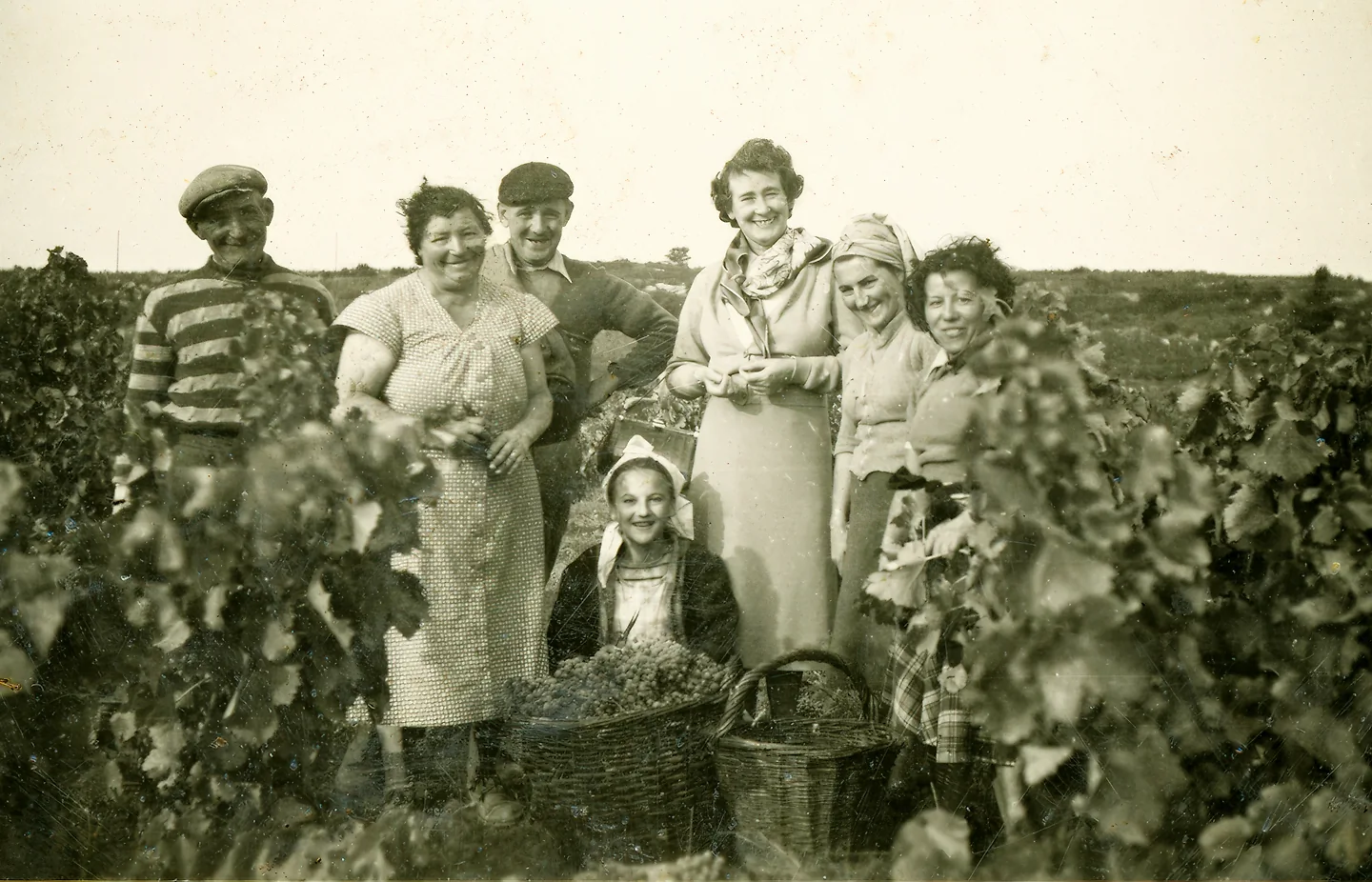
And that wine, too, has changed. “This generation is very dynamic. They are much more open to the world than their parents,” one local told me, and the wines—less oaky, more elegant—backed him up. The grand wines still need time. But everyone is also making fresher wines that can be drunk right now. Domaine de la Solitude’s black-plum Gigondas, from the appellation down the road, would have done me nicely while I waited for its premium wine to mellow. Mont-Thabor’s grenache, cinsault, and mourvèdre are all fermented with their stems (only the syrah is destemmed), which keeps the wine fresh even as climate change brings mounting alcohol levels. And while its top wine, the Philosophe, a blend of grenache and syrah from its oldest parcel of vines, was a six-year-old baby, it was one with a very promising future. “You know, we winemakers are often alone in the cellar or the winery,” said Mont-Thabor’s owner, Daniel Stehelin, gesturing toward the enthusiastic crowd, clutching their glasses and beaming through purple-stained lips. “We do it for this.”
Châteauneuf-du-Pape, named for the 14th-century castle built by Pope John XXII as a summer residence, is famous for its vineyards. Photo courtesy of Châteauneuf-du-Pape.
What is most surprising about the Châteauneuf-du-Pape renaissance is that it works on so many levels. Those with less money to spend can hang out in the place, eating roast pork and crushed potatoes or grilled pollock and spelt risotto and quaffing a glass of good Vaucluse wine. The better-heeled get to enjoy Adrien Soro’s beautifully presented tasting menu along with old-vine Châteauneuf-du-Pape at La Mère Germaine. And then there’s the option to go up a level, in every sense. Right at the top of the hill, the Strassers own a sumptuous four-bedroom private house, Le Prieuré, available for rent. Ten minutes away, beside the wetlands of Courthézon with their rich wildlife, Maison Ogier has a château the sand colour of the galets roulés: part winery, with vats and barrels dramatically lit in a cellar carved out of the rock, it is also part private venue, with options for tastings of its glorious L’Oratoire des Papes, tours and cookery classes, or meals in the superbly appointed kitchen.
Meanwhile, the best-known winemaking family in Châteauneuf-du-Pape has taken this sort of glamorous bespoke experience a step further still. The Perrins make some of the appellation’s top wines, Château de Beaucastel and Hommage à Jacques Perrin, but the family’s widespread fame has more to do with their association with actual celebrities: they co-own, and make, Miraval rosé for Brad Pitt (his ex-wife, Angelina Jolie, is no longer involved). They have just spent seven years (and 15 million euros) rebuilding their entire winery, except for the 16th-century farmhouse, with the assistance of two firms of architects and the gardener, Tom Stuart-Smith, who designed the beautiful new Hôtel du Couvent in Nice. So environmentally conscious is the family (their vineyards have been farmed biodynamically since 1974) that the walls have been refashioned from the displaced earth, with galets roulés adding location-appropriate decoration. The rebuild includes a high-spec kitchen for private dinners. Everyone else is welcome to stroll into their shop in town and buy bottles. Châteauneuf-du-Pape, once the reluctant abode of an uprooted pope, has become a place with something for everyone.
Read more from our Winter 2025 issue.