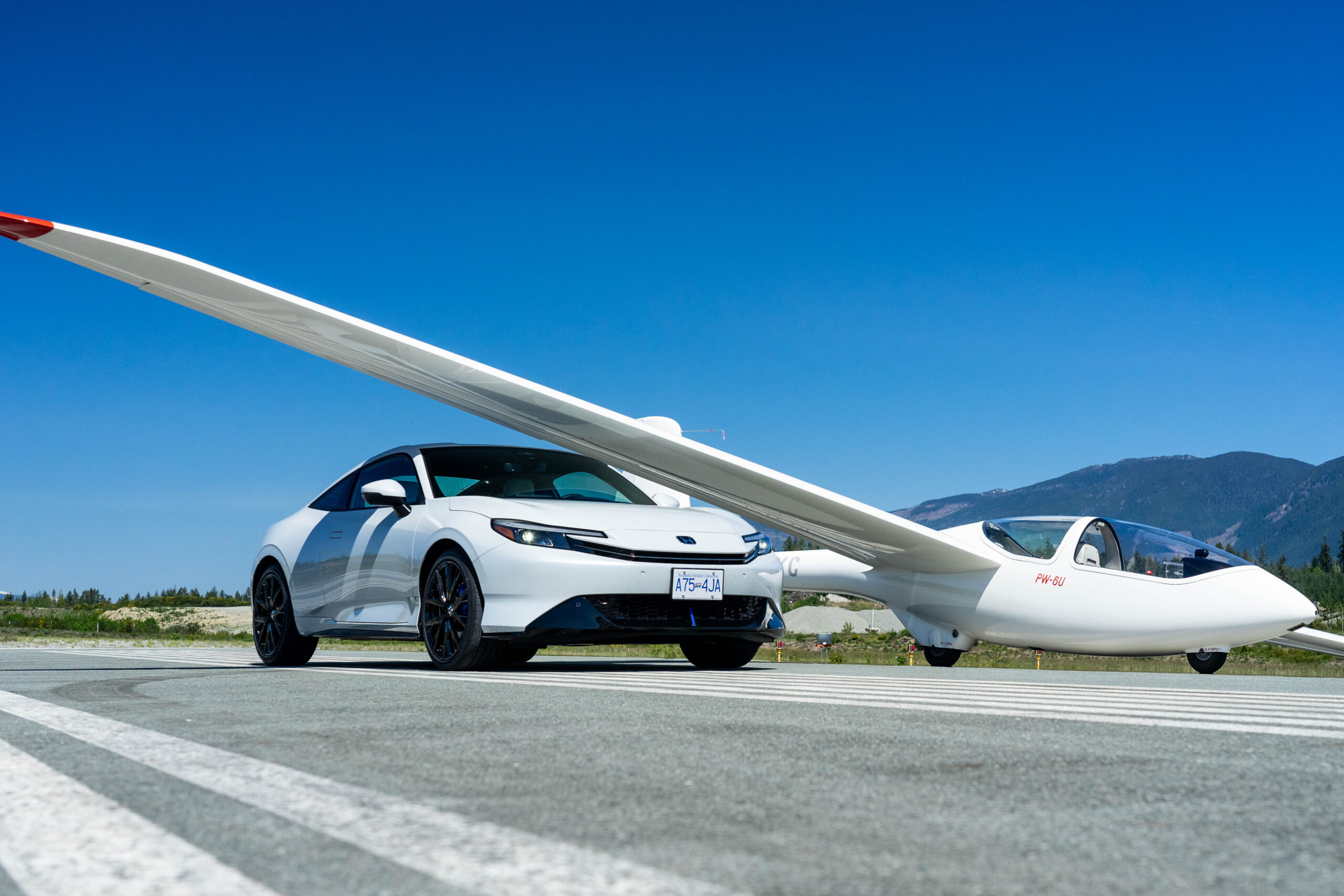


“While struggling with the conceptual design and direction of the new Prelude, I suddenly recalled in my childhood, my grandfather building a radio-controlled glider, and the blue sky and white clouds I saw when he took me to the riverbank. From the very beginning, we shared with the designers the vision of a sports car that was unlike a fighter jet, but rather a glider with long wings, flying gracefully and effortlessly.”
—Tomoyuki Yamagami, Honda Prelude Development Leader
Unpowered flight is an unusual place to find inspiration for earthbound travel, especially in a car that still operates on piston power. And so here I am on the road to Port Alberni at the controls of a new glider-white Honda Prelude, en route to assess just how well it delivers on Yamagami’s ambitious mission statement. The flight plan: plot a course to a small airport in the middle of Vancouver Island, drive some twisting roads on the way there, and seek out the opinion of a real glider pilot and instructor—about just how close the automotive glider comes to the real thing.
The Prelude nameplate is old enough to schedule regular cholesterol checks and be confused about celebrity news cycles. Over five generations, it has been a flagship of sorts for the company, a sporty and stylish coupe with nimble handling. A sixth generation is out now as a hybrid. The kids are saying the vibes are off.
First off, the price tag for this admittedly good-looking two-door compact is an Acme anvil-sized $53,000 or so. Even in an era when the average new car in Canada is more than $60,000, pricing a coupe not far off the bill for a V8 Mustang GT is going to set expectations high. With the Prelude’s hybrid powertrain summoning up 200 horsepower, even Honda fans might be let down.
You can hear the muttering: instead of a hybrid powertrain, the Prelude should have the potent 2.0-litre turbocharged four-cylinder of the Civic Type-R, good for a third more power. Thing is, we already have a vehicle that does the job of the Civic Type-R. It’s called the Civic Type-R. With all allocations of the 2026 model year of that car already spoken for by Canadian customers, you could say Honda can check off a win and go looking to do something a little different.
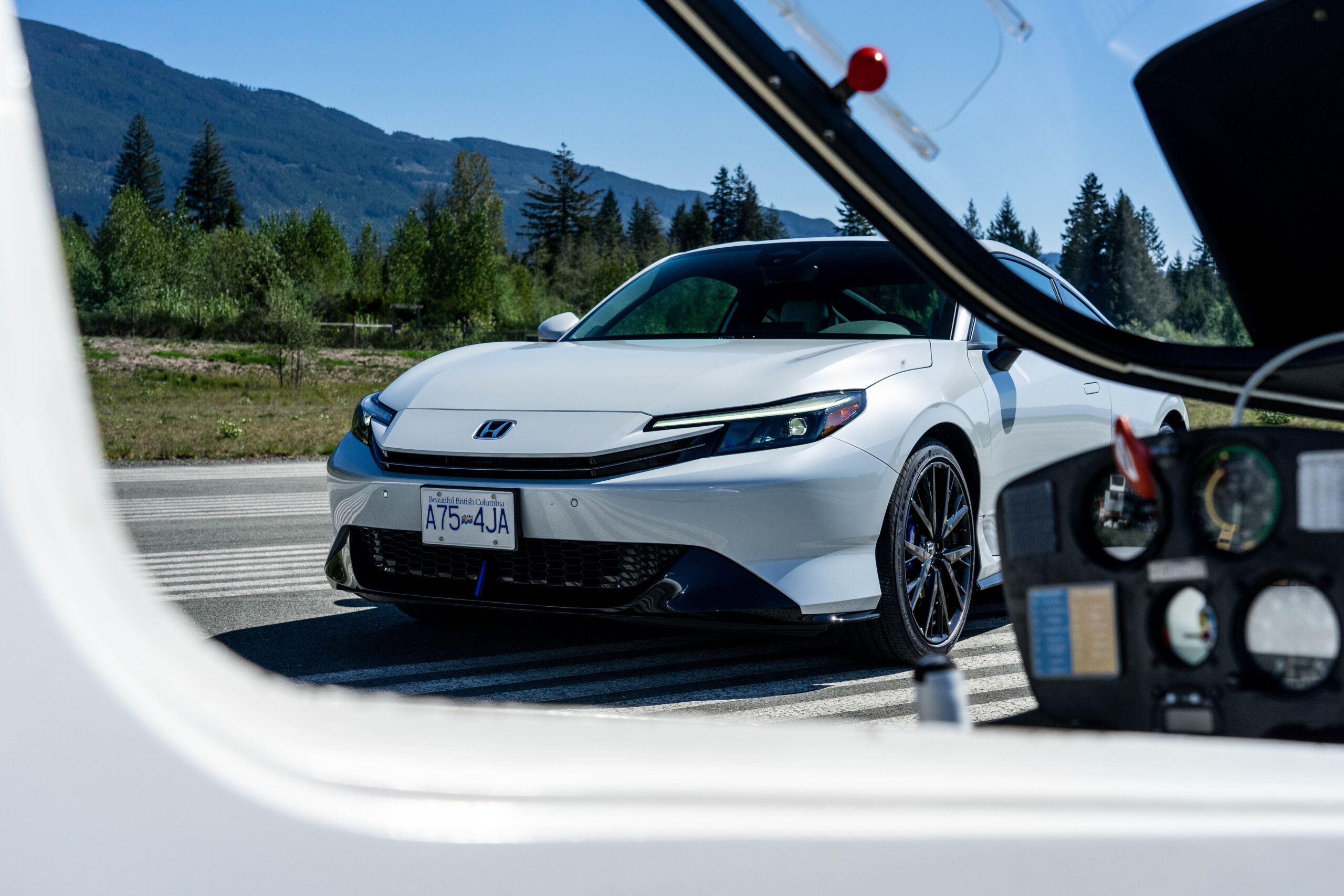
And so here I am on the way to Vancouver Island Soaring Centre in Port Alberni, about a third of the way along a trip to Tofino. The place has much of the feel Squamish did 20 years ago, bustling enough given its proximity to more densely populated areas but far enough off the beaten path to still feel like small-town B.C.
Pilot Warwick Patterson has lived here for several years, having moved to Port Alberni with the express intent of founding a flying school. Gliding being the purest form of flying, and the area such a sprawling playground of rolling sylvan landscape and thermal updrafts, it was a perfect match. Beyond training new glider pilots, the centre also offers soaring experiences as ride-alongs in a tandem two-seat glider.
Patterson, a longtime driving enthusiast, is also well suited to evaluate the Prelude’s glider parallels. Not only is he an award-winning motorsport cinematographer for his work on Subaru’s Launch Control documentary series, which covers the company’s rally racing exploits across the globe, but he is also a co-founder of a vintage car touring and event group, Classic Car Adventures. Until recently, he owned a rally-prepped Mk1 Ford Escort, an icon of compact performance.
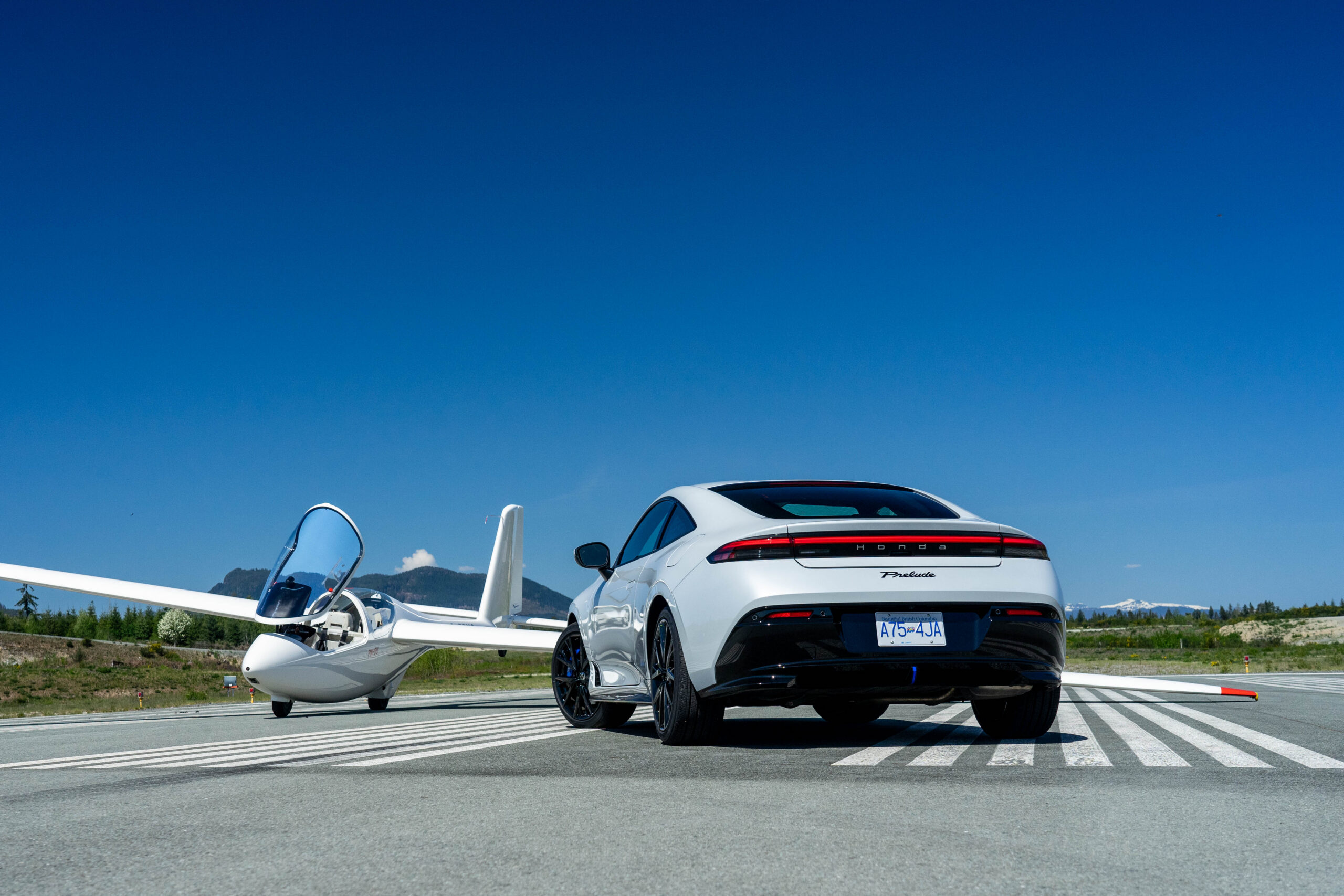
As any pilot knows, you don’t go flying without a flight check of your equipment, so let’s take a look under the skin of the Prelude. Built on the same platform as the current Civic, the coupe body style shortens the wheelbase by just under 13 centimetres, making for a theoretically nimbler car. Honda also raided its parts bin, using parts from the most sporting Civic variants, including suspension components and Brembo front brakes from the aforementioned Type-R.
As for the powertrain, that’s pure Civic too, a thrifty 2.0-litre four-cylinder paired with two electric drive motors and a small lithium-ion battery with just over a kilowatt of power. It’s not a plug-in, so all motive power comes from a fill-up at the fuel pump, but it is designed to run on regular-grade gasoline and is officially rated at 5.4 litres per 100 kilometres of fuel consumption.
“When flying gliders, you’re more in touch with the air, the surroundings, with what’s going on around the airplane, trying to feel what the air is doing,” Patterson says. “You don’t have the bailout of excess power. You’ve got to plan ahead, think ahead.”
Despite what those pining for a Prelude Type-R might think, a surfeit of horsepower is the opposite of what Honda’s road cars are all about. No sporty Honda ever made a driver feel they were driving around in Dwayne Johnson; the best of them were zippy little buzzboxers as frenetic as Timothée Chalamet’s Marty Supreme.
You don’t muscle out of a corner in a proper Honda—you preserve momentum through it. On that end, at least, the new Prelude’s trick suspension delivers.
“It’s a handling car” is Patterson’s evaluation after a stint behind the wheel. “It doesn’t have a tonne of power—good power, and it’s fun to drive—just enough power to be fun.”
Honda’s most powerful production car engine was a V6, but no Prelude has ever had more than four-cylinder power. The breed has always been more about poise than power, though the control of a manual transmission was always part of the mix.
While the car was in development, there was plenty of enthusiast speculation that a stick-shift Prelude might be on offer. Development leader Yamagami owns two cars with manual gearboxes, an Accord Type-R and a 991-generation Porsche 911, and there was hope that some of that old school flavour might sway the planning team.
Yet perhaps traditionalism isn’t what the Prelude badge is supposed to stand for. Notable Prelude owners include actor Patrick Stewart, who bought a silver third-generation with his paycheque from the early seasons of Star Trek: The Next Generation. Other cast members bought Porsches and Mercedes. Like Captain Jean-Luc Picard, Stewart made a more cerebral choice.
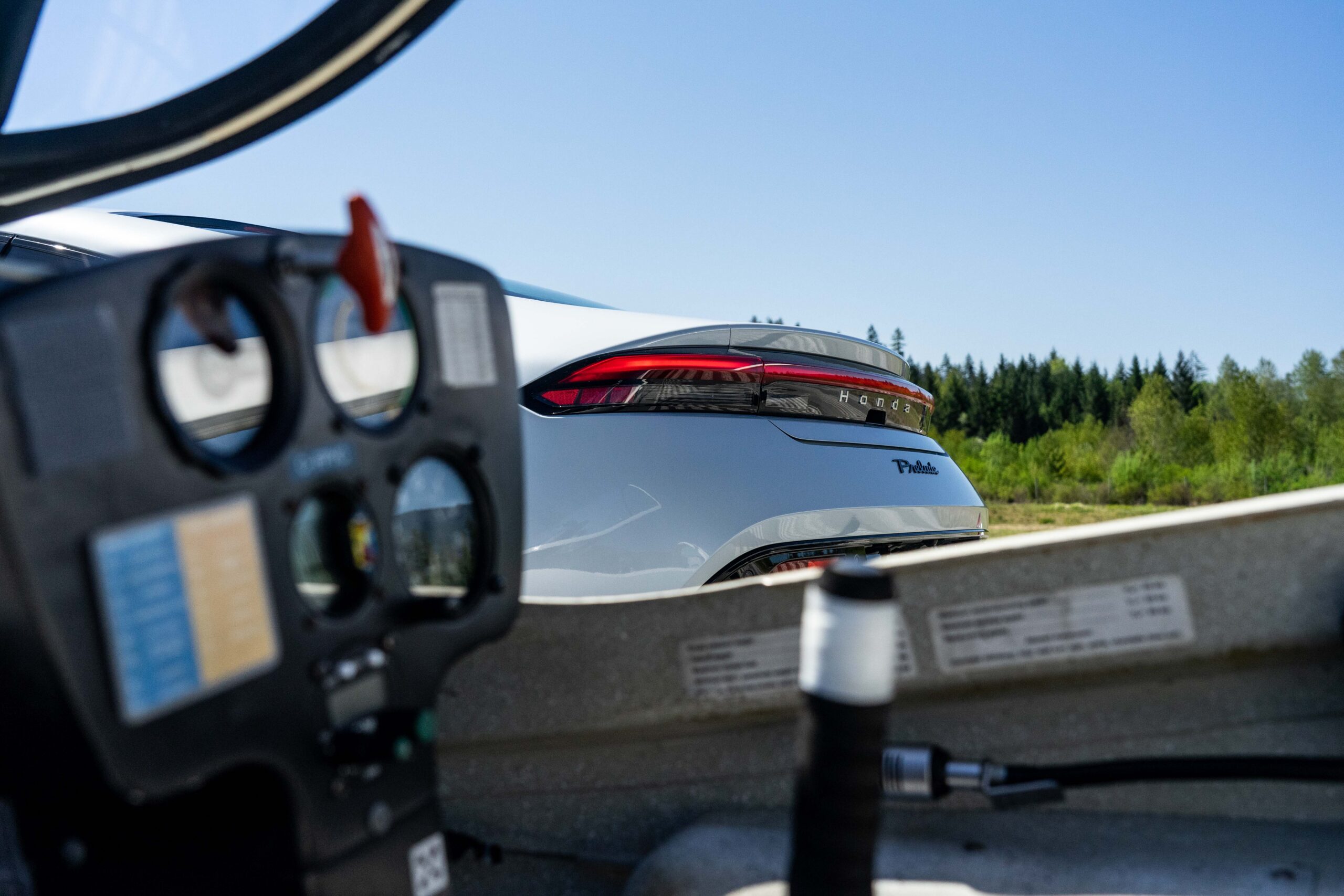
So fire up the Prelude, put the transmission in drive, and engage. The car does come with a trick gearbox mode called S+ that simulates stepped gearshifts and increased engine sounds, but the drive is better without it.
Instead, the hybrid powertrain delivers ultrasmooth, unbroken, linear power. Flooring the throttle is like hitching a ride from a tow plane, then you ease off the accelerator and slither through corners with effortless rapidity. Technically, a Civic Type-R can pull additional lateral-gs on a track day. In the real world, there’s a scalpel’s difference between them.
Besides which, unlike most racetracks, real-world roads come with speed limits. Building a car that’ll end up in an impound lot is easy. Crafting an experience that’s thrilling while not being a liability to road safety is trickier. The Prelude is plenty quick enough to get past a tractor-trailer struggling through a short uphill passing section, then a delight to cruise the clear roads ahead, banking through the turns.
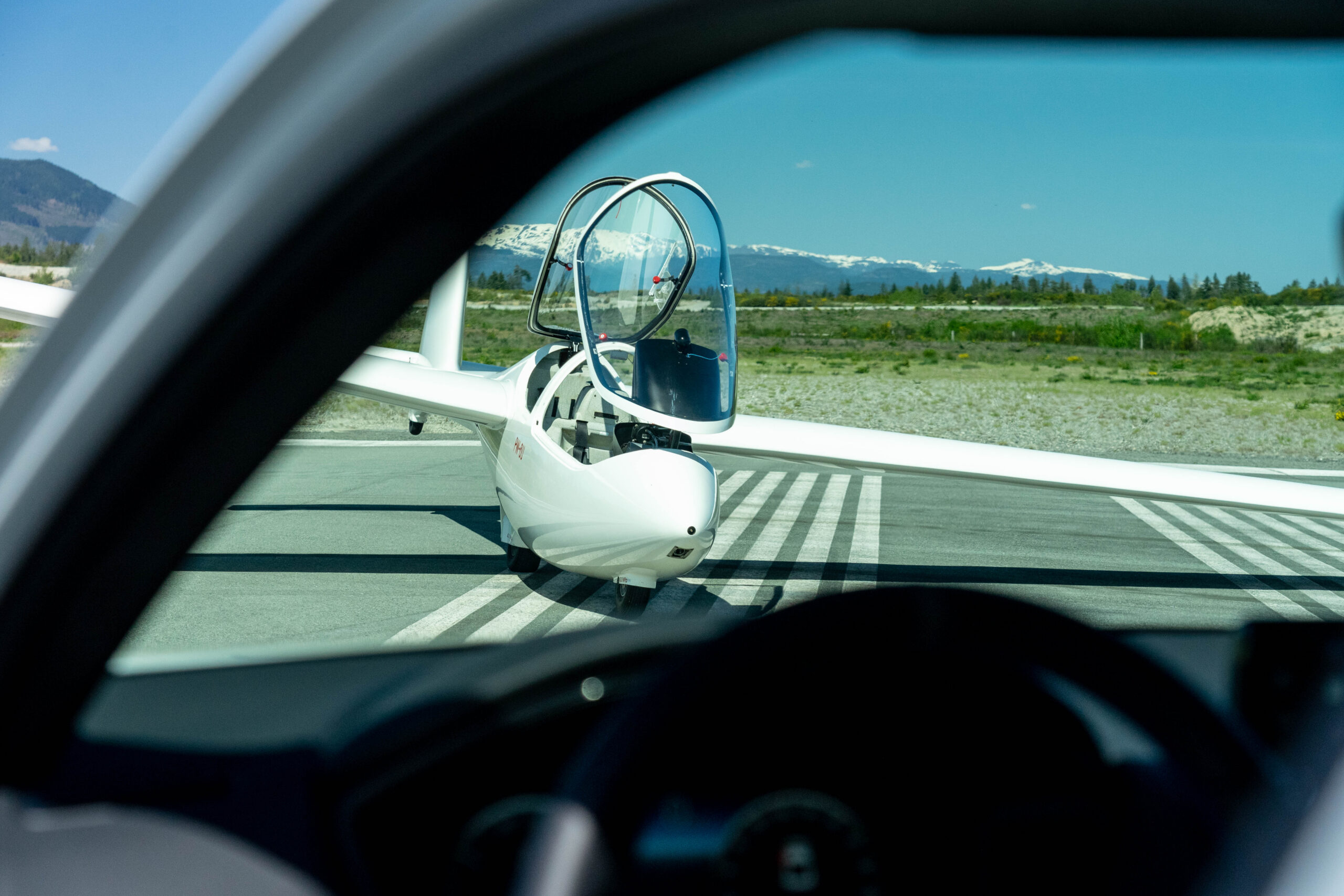
For a while, I find myself pacing a current Mazda MX-5 along the same roads, tandem and abreast, exchanging the lead. The MX-5 is a modernized version of the old Sopwith Camel feel of a vintage British sportscar, the Prelude’s hybrid drive looking more to the future than the past. But both pilots were enjoying their machines on the twisting tarmac.
Somewhere high above, a passenger jet left the white scratch of a contrail along the unblemished blue of the sky. The plane was travelling hundreds of kilometres per hour, moving with purpose, its occupants glued to screens, scarcely feeling the speed.
That’s not flying—that’s just waiting to get somewhere else. By contrast, just as a glider does, Honda’s new Prelude puts you in touch with where you are.
Read more transportation stories.