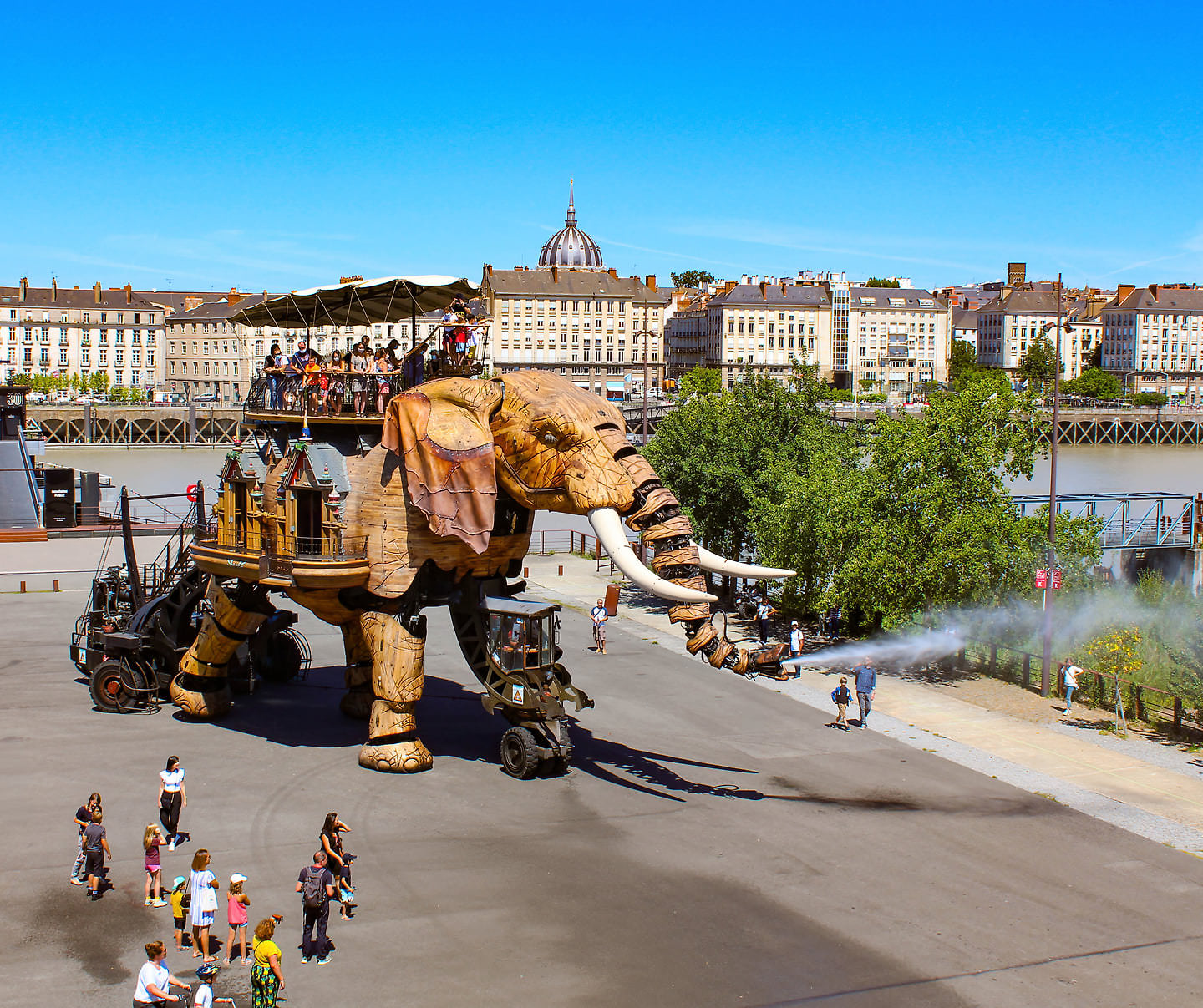


In Place du Bouffay in the centre of Nantes, a man steps sideways into midair. The bronze statue is Éloge du pas de côté (Ode to Sidestepping). It has become a symbol of the city. As I look up at the suit-clad gentleman, his half-suspended stance is disorienting—and that’s the point. The Nantais are bold and free-thinking, from a statue such as this to a 12-metre-tall mechanical pachyderm lumbering along the Loire.
Near the mouth of France’s longest river on the northwest coast, Nantes has always stood a bit apart from the rest of the country and fostered a touch of the absurd. This is the hometown of the father of science fiction, Jules Verne. It’s also the historic capital of Brittany and a university city (some 60,000 higher-education students live here) with a revolutionary spirit (workers and students revolted in massive strikes and uprisings in the 1950s and ’60s, and it’s still a hotbed of social protest). Nantes has always been independent minded and passionate about its distinct culture, and that creative energy continues to flow in its vibrant contemporary public art.
My first night in the city, just off Place Graslin, the central square near the opera house, I stop in front of some street art and read: “Vouloir le bonheur c’est déjà le bonheur,” which means “To want happiness is already happiness.” And as I explore the art of Nantes, this philosophy makes sense: the pursuit of joy is palpable.
I later discover that the phrase is from the 1961 French film Lola, starring Anouk Aimée, and that the director Jacques Demy is from Nantes. The movie is a love letter to his hometown, featuring the 1895 brasserie La Cigale and the 1843 shopping arcade Passage Pommeraye, both steps away from the street art by Théâtre Graslin. La Cigale has been called a joyful example of art nouveau, and the Passage Pommeraye’s spirited figures and creatures stirred Verne.
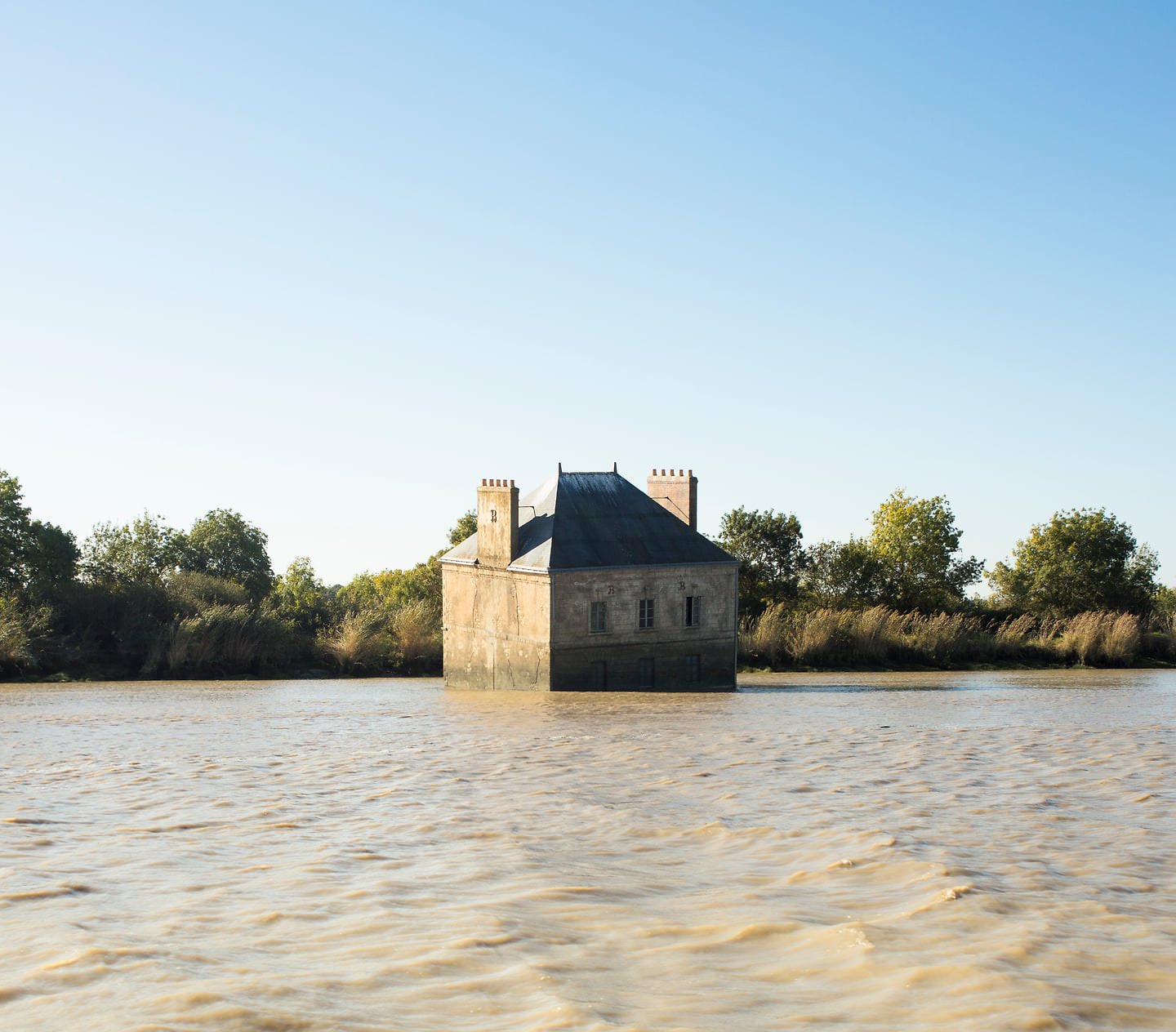
“La Maison dans la Loire.” Photo by Philippe Piron.
This happens with almost everything I observe in Nantes: one piece of art leads to another and another and another. It’s a wonderland of rabbit holes. Or one of the subterranean passages in Verne’s Journey to the Centre of the Earth. I also find out that Jean-Luc Courcoult, founder of the world-renowned street theatre company Royal de Luxe, which is based in Nantes, is the artist who created the surreal, half-sunken La Maison dans la Loire. And another revelation: the genre- and gender-bending musician Rahim Redcar (who formerly performed as Christine and the Queens, long on my playlist) is from Nantes and grew up in its alternative and performance art scene.
When I first glimpse Courcoult’s submerged house in the Loire, I don’t realize it’s one of 33 in situ artworks in an open-air art collection commissioned by the city and scattered along the estuary. I snap photo after photo as I sail from Nantes to the neighbouring port city, Saint-Nazaire, where another spectacular creation, Serpent d’océan, snakes along the opposite shoreline, appearing and disappearing with the tide. And at the edge of the Atlantic, I marvel at Le Bois des Trembles, where artist Gilles Clément planted 107 aspens in the concrete beams of a submarine base built and occupied by the German military during the Second World War. The explosion chambers that withstand bombs are reclaimed by art and nature as a “bastion of resistance.” It’s a beautiful transformation of postwar decline, and the green gleam amid the stark grey feels like another manifestation of bonheur.
These estuary artworks are part of the city’s ongoing curation of public art through Le Voyage à Nantes, a municipal organization that promotes arts, culture, and heritage. Each year, it puts on an annual event showcasing new large-scale exhibitions and contemporary art installations throughout the city’s public spaces. It has also painted a green line to follow: a literal 20-kilometre-plus strip on the ground to guide visitors to monuments and more than 130 permanent works of art. This includes the half-suspended and sophisticatedly suited sidestepping man, as well as the Château des ducs de Bretagne where the dukes of Brittany once ruled an independent state.
Barbara Schroeder has jubilantly sculpted columns out of cow dung in the Jardin Extraordinaire, a former granite quarry metamorphosed into a fantastical garden.
I follow the green line spontaneously, sidestepping here and there, like a Nantaise. In Place Royale, I come across a three-tier fountain from the late 19th century that’s unlike any other I’ve seen. Its original allegorical stone statues have been temporarily replaced with 14 hyper-realistic figures representing 21st-century occupations in the city: a nurse, a bus driver, a construction worker in a neon-orange safety vest, a student protester. This square has long been a gathering place for demonstrations and celebrations, but now the people in the Place Royale fountain—posing and reclining like the traditional god-like sculptures—are actual modern-day Nantais. Called Latest Version, it’s another quirky and transformative artwork that upends expectations.
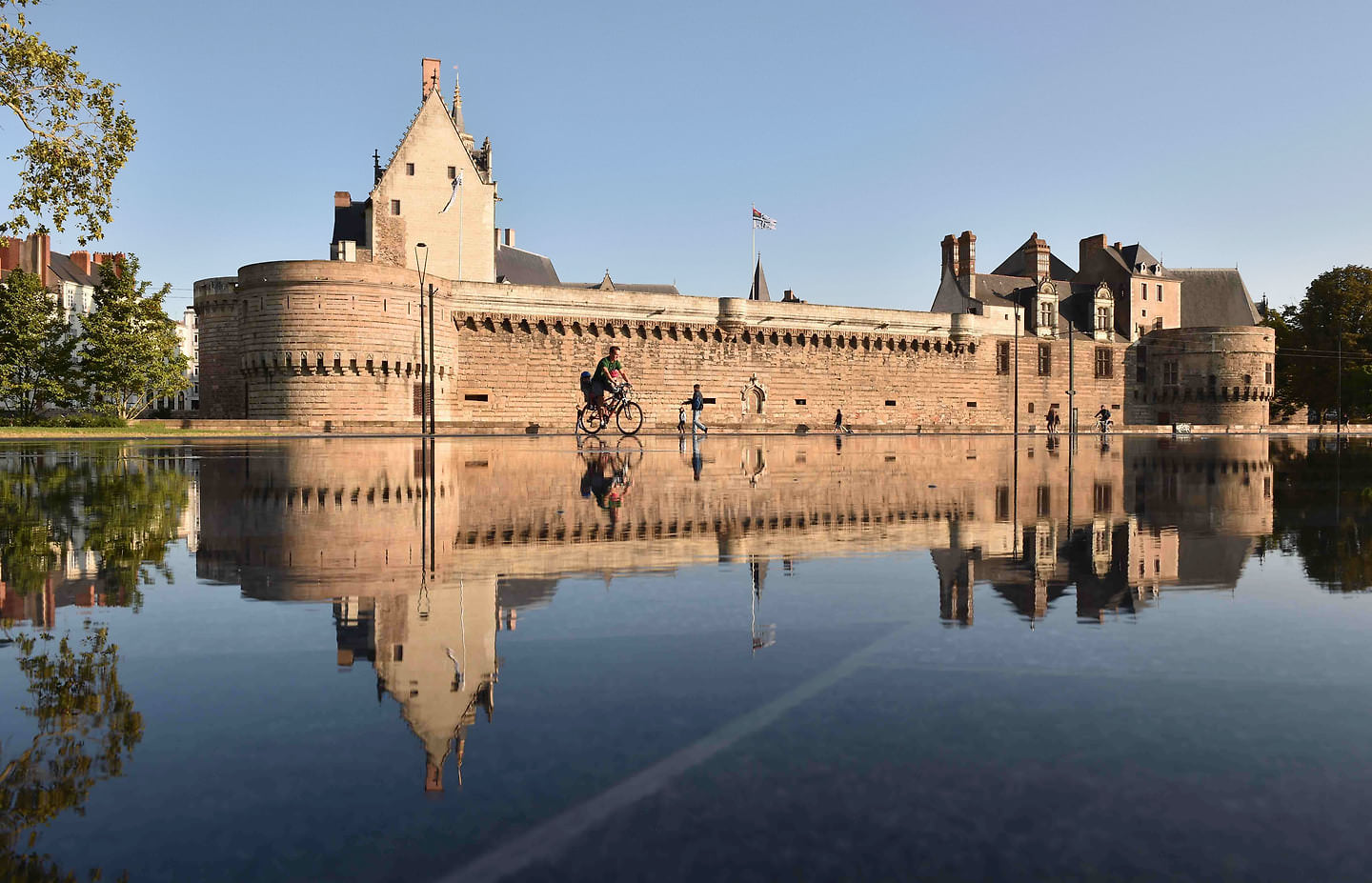
Miroir d’eau in front of the Château des ducs de Bretagne. Photo by Jean-Dominique Billaud.
It’s an art-filled adventure, Verne style. “The aim of Le Voyage à Nantes is less about travelling through town and ticking off must-see attractions as it is about offering a chance to wander freely in a city full of surprises,” says Sophie Lévy, the organization’s director, and “to see the city differently, through the eyes of artists … you come across works of art that take you on a journey you never imagined.”
This could be a monumental fountain honouring a welder from the local Airbus factory as in Latest Version or stumbling upon so-called fossils of the industrial age—automotive wreckage, construction debris, building detritus—in front of the neoclassical opera house. Fossil Opera is a huge art installation of “maximal gestures with minimal ecological impact,” in artist Théo Mercier’s vision, and part of Le Voyage à Nantes’ 2026 art event. Another shape-shifting artist, Barbara Schroeder, has jubilantly sculpted columns out of cow dung in the Jardin Extraordinaire, a former granite quarry metamorphosed into a fantastical garden out of Verne’s Voyages extraordinaires—including a spectacular waterfall from The Mysterious Island.
I spot one of the garden’s lookouts, the bird’s-nest-like Belvédère de l’Hermitage, from the Île de Nantes, where my journey through Nantes’ wonderland continues. Another spectacle: Le Grand Éléphant. This is the enormous mechanical elephant that has become synonymous with the city. Since it took its first steps in 2007, Le Grand Éléphant has been the centrepiece of Les Machines de l’Île, alongside similarly gargantuan creatures in the Galerie des Machines—where a chameleon, heron, sloth, hummingbird, spider, and other mechanical beings reside—and the whimsical Verne-inspired Carrousel des Mondes Marins.
This wild-and-wonderful world has reinvigorated what was previously a defunct shipbuilding and industrial district. Out-of-commission cranes, now relics and de facto art pieces, stand next to galleries, bars, and restaurants on the river’s edge. As I meander, on or off the green line, there’s more gleeful art with almost every step. Just past the domain of the gigantic elephant are also-gigantic gumboots. And rings that glow at night and frame centre-ville sites on the other side of the Loire. The 18 rings turn the architectural art—the dome of L’église Notre-Dame de Bon-Port, the art nouveau tower of the famous LU biscuit factory, the Cathédrale Saint-Pierre et Saint-Paul that’s taller than Notre-Dame in Paris—into colossal cameos.
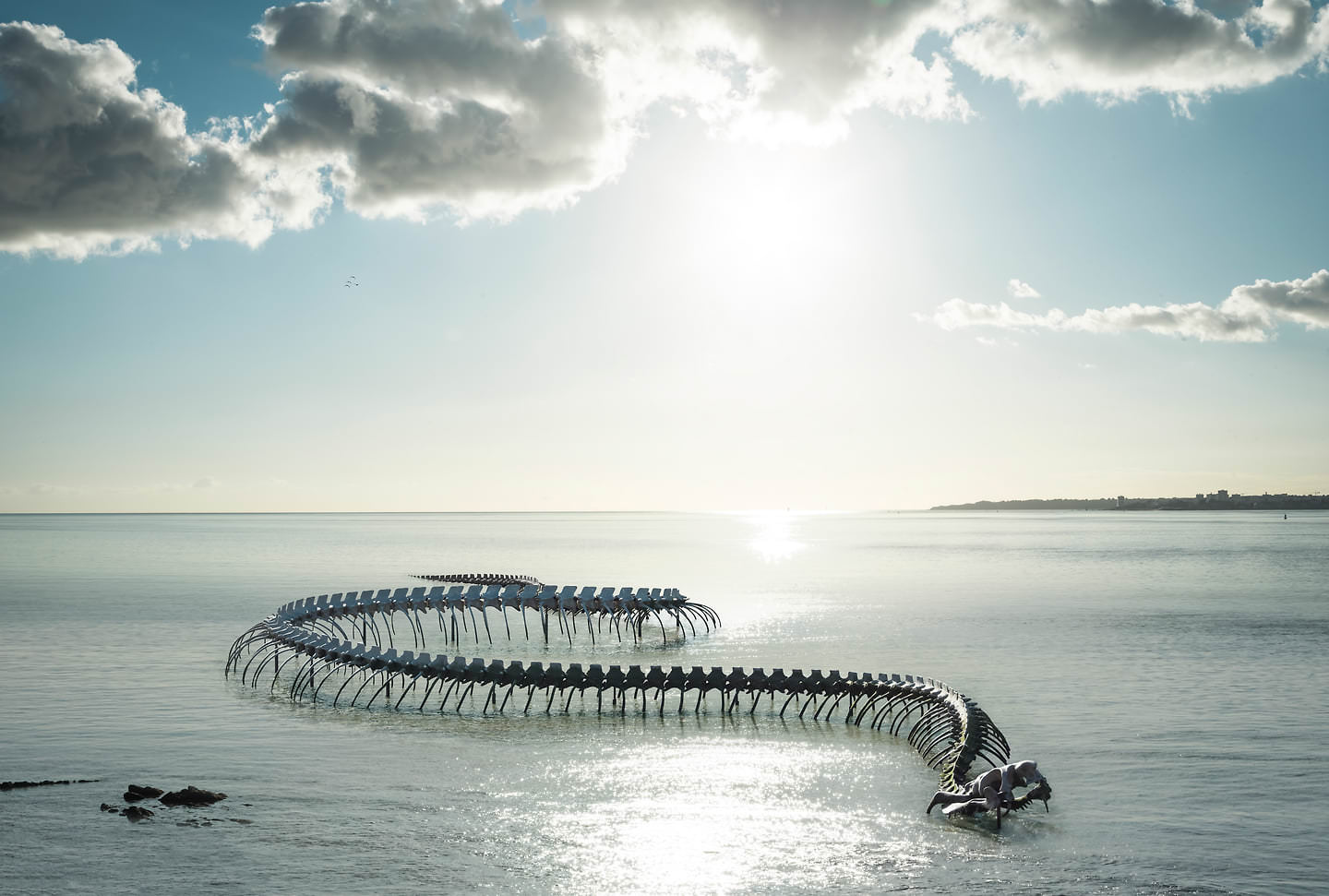
“Serpent d’océan.” Photo by Franck Tomps.
Most of the art is outsized, out of the ordinary, or off balance. Even the trees. One of the first pieces of art I encounter in the city is at the tram stop by the Château des ducs de Bretagne. Here, a leaning pine tree seems to swerve or sidestep like everything else in Nantes, challenging perceptions by growing horizontally. Artist Max Coulon, asked to create something in collaboration with this leaning tree, carved a huge wooden hand around its trunk. It’s unclear if the hand is trying to straighten the tree or bend it even more. Like much of the creativity on display in Nantes, it’s open to interpretation.
The artist of that sidestepping statue, Philippe Ramette, has another sculptural ode in the Cours Cambronne, a startlingly pretty park and promenade lined with linden trees in what was once a convent’s garden and is now surrounded by elegant neoclassical residential buildings. People walk dogs and sit on benches. And the schoolgirl in the artwork climbs down—or up—an empty pedestal. The piece is called Éloge de la transgression, and again, the title is fitting. The playful girl is not a typical bronze figure but a mischievous one—a joyful transgression—and the essence of Nantes.