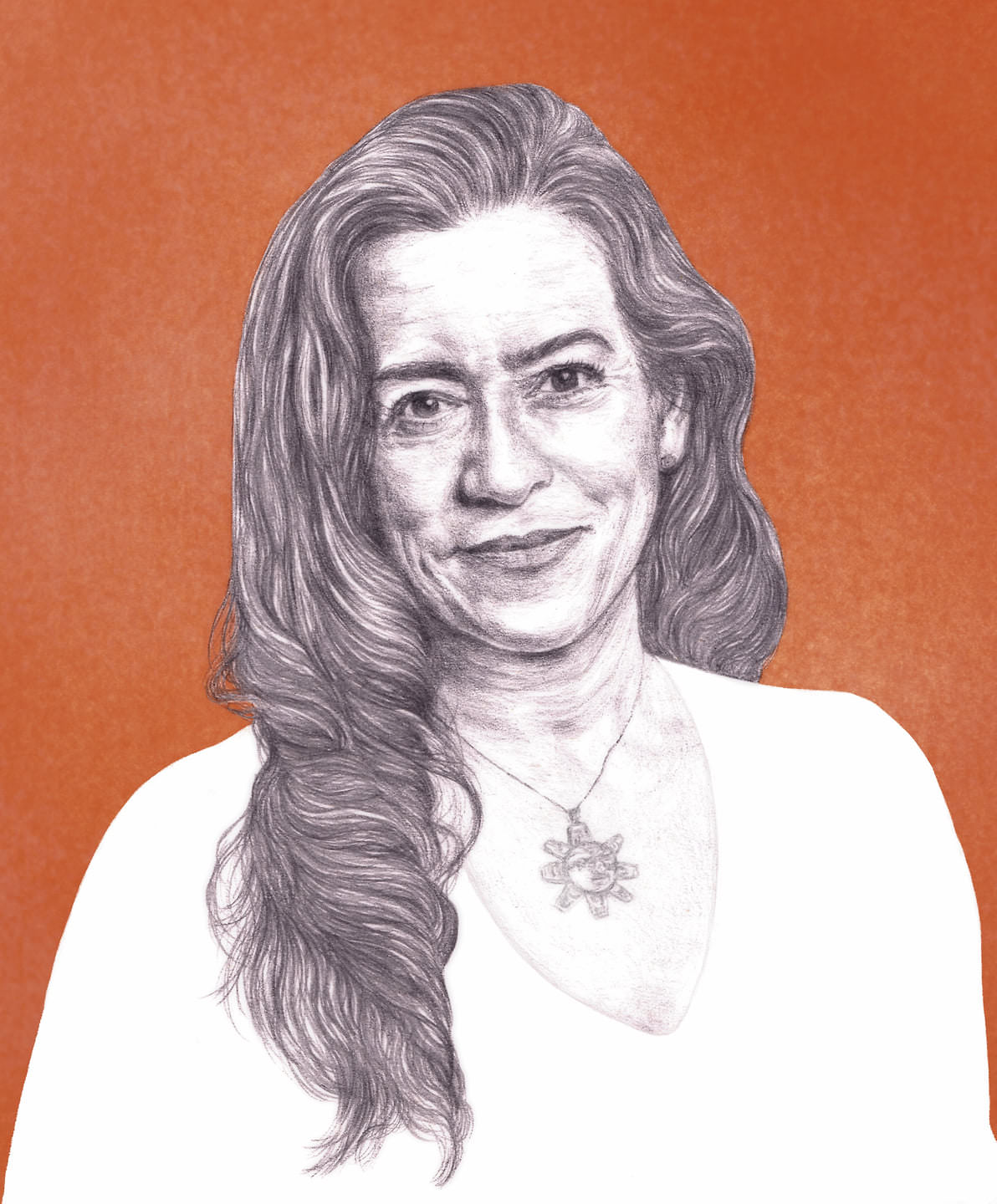


Adapted and excerpted from The Inbetween Leader: Cultivating Courage and Unity in a Complex World, by Jody Wilson-Raybould and Roshan Danesh. Published by Greystone Books, September 29, 2026.
From the earliest age, I can remember being schooled in how one should conduct oneself as a leader, including in formal roles that I would be expected to play. In our system, I am a Hiligaxste’—a role always held by a woman. One of my jobs is to lead the Hamatsa, the Chief, into the Big House. Hiligaxste’ can be translated as “one who corrects the Chief’s path.” We show them the way—a metaphor for life—and in our ceremonies, the power of the Hamatsa is tamed, as he readies to be Chief.
In our culture, the long historical tradition of the Hamatsa includes some forms of training that were more severe and strident than what we see today. Readying to be Chief would involve spending months, or even years, in nature and in seclusion. This rite of passage, and the transition back to the community when ready, is seen as taming one’s tendencies toward being wild and granting one perseverance, constancy, strength, and wisdom.
Beyond these formal roles of Hiligaxste’ and Hamatsa, I also was schooled in values, ideas, and practices about what it means to be a leader. These include how one builds consensus, maintains balance, and supports people to thrive by meeting their capacity. It also includes practices for maintaining coherence in how one leads by critically self-reflecting and honestly accounting for how one is leading.
We can see in this model of leadership, where there are distinct but interconnected roles, the importance of balance—including between men and women. We can also see how one’s role and responsibility as a leader is always defined in relationship to other people, and the roles and responsibilities they hold. For this reason, leaders in this tradition need to tread softly, to respect the roles that people must play, and to ensure they are acting in a respectful and appropriate manner.
Saltala is a central teaching in my culture, and some others, that essentially means “be still, tread softly.” This teaching reflects the importance of showing respect. In my ways, every living thing is owed respect, and by showing such respect, necessary balance is maintained. In my language, Kwak’wala, the word for respect is maya’xala, which can also be translated as “treat others and all things the way you want to be treated.” My grandmother once described respect in terms of where leaders stand in relation to each other: “I always said that the Big Houses were our churches. Once you went in there, the respect came. Everything had its origin in respect. Nobody ever said, ‘Why are you talking like that to me? You are nothing. I’m higher than you.’ Nobody ever said that.”
Implicit in these ideas is another reflection of the idea of “inbetween leadership.” In this tradition—where one treads softly and shows respect as part of an effort to maintain balance—a leader is not positioned above, trying to exert control over others. Nor are they below. While one is indeed serving others, the goal is to ensure strong, firm, and positive relations in which everyone’s roles and responsibilities are fulfilled. I believe that to do this, a leader must stand firmly inbetween.
If one divides, one is not a leader. If one promotes conflict, one is not a leader. If one tries to force people to bend to one’s own will, one is not a leader.
The tradition of inbetween leadership in my culture is also evident in the Potlatch, the central governing institution of my people. The Potlatch ceremony takes place in our Big House, the gathering place of our people. Potlatch means “to give.” As part of the patterns of giving, important decisions and events take place and are witnessed, including naming, leadership succession, and affirming rights and privileges.
In the Big House, and when we are doing the work of the Potlatch, there are no political parties or partisanship. There are also no decisions made by individual leaders. While there is rank, we govern through the principles of consensus, and the role of leaders is to seek that consensus; they are raised to do this. We meet and debate the issues at hand. Not everyone may agree on every aspect of the discussion, but we seek general agreement to help ensure that decisions are balanced and supported and will be enduring over time.
What does it mean to be a strong leader in the culture and tradition of the Potlatch and the Big House? Well, it certainly is not the domain of control or power, or failing to show care or empathy. It is also not the domain of the great-man-theory leader. Indeed, there is not really space to locate oneself as above others in this tradition; a leader’s role is to help the group, the whole, achieve a shared outcome. As a leader, one is part of that group, and one’s well-being is dependent on the well-being of the whole.
At the same time, in the tradition of the Potlatch, it does not make sense to position oneself as below—at least to the degree that this situates oneself as somehow outside the group as a whole. This element of separation, even if subtle, would be in tension with one’s role as a source of unity and binding. One is focused on pulling the group—which one is also a part of—together. While there is a focus on lifting up all individuals and creating space for them to play their roles as best as they can, this is because it improves the well-being of the group as a whole.
A strong leader in this tradition is one who can help guide people toward consensus, one who can serve as a bridge between different views and opinions. A strong leader is also one who can engender respect and be seen as an authority through their ability to be unifying. In this way, they can help maintain the cohesion of the whole group.
In this model, if one divides, one is not a leader. If one promotes conflict, one is not a leader. If one tries to force people to bend to one’s own will, one is not a leader.
This model of leadership reflects the particular worldview of my people, but it has some similarities to the worldviews of many Indigenous Peoples. In my people’s worldview, all things are in their greatest state of well-being when there is balance. This includes balance between humans and the natural world, between genders, between groups of peoples, within a family or community, and in how we live and organize our own lives. Balance is viewed as the proper state of things—where conditions of harmony and justice flourish—while imbalance gives rise to conflict, contention, and harm.
There are other traditions and practices that uphold inbetween leadership. Many are ancient or very old. We sometimes hear phrases or teachings such as “walking among the people” or “first among equals,” which situate leaders as being part of the group or navigating among and between people. There are also traditions in which the leader’s role is to mediate between individuals, families, and groups.
We can also see inbetween leadership at work in effective organizational teams. I think that a strong leader on a team will see themselves as being inbetween the other team members, not above or below. In this role, a leader will recognize their responsibility to help build toward the shared outcome and not seek to impose their will or separate themselves from the work of the group as a whole.
One thing these traditions share is an emphasis on how leaders must be positioned in a way that is accessible and not remote (like above or below can sometimes be). They also emphasize the relational nature a leader has with others; the core relationship is not as much about control or service as it is about stewardship. After all, if healthy and balanced relationships are the foundation of our reality and the source of well-being, the role of a leader should be to restore, repair, and heal frayed relations, something that can be done by being inbetween and helping to bind together.