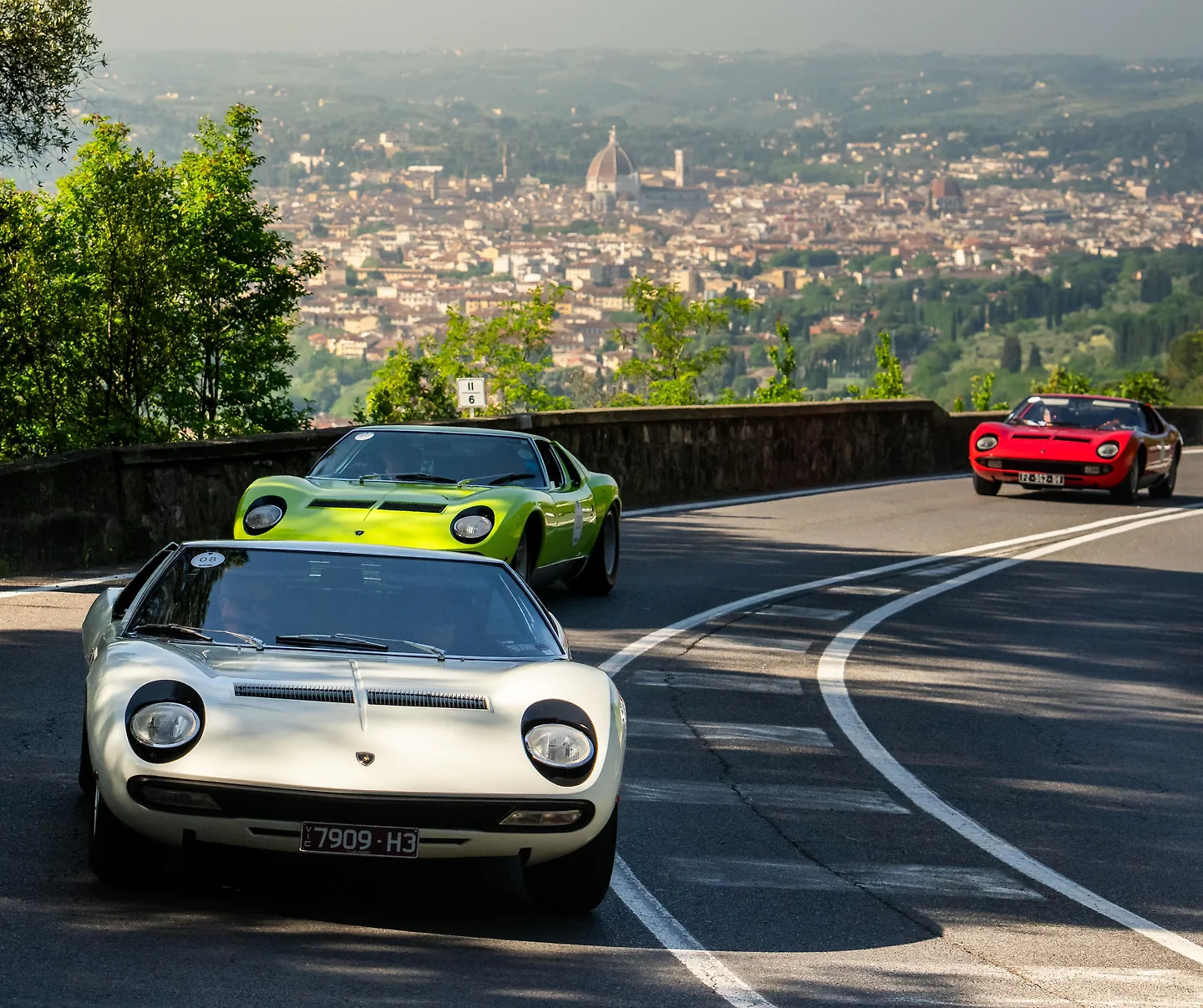


On many a sunny Sunday morning, you can find the long parking lots at Spanish Banks filled with exotic machinery. Vancouver is a supercar city, with more scissor-doors and carbon fibre than almost anywhere else in Canada, and many of them gather here while owners share a coffee and a chat. Occasionally, the queen of them all makes an appearance: a 1960s Lamborghini Miura.
There’s plenty of arm-wrestling over which road car has pushed the limits of performance the furthest, but the Miura is unarguably the benchmark. It is low-slung, lightweight, and jaw-droppingly gorgeous. Its engine, mounted amidships, is a prestigious and powerful V-12. Any modern Lamborghini, any McLaren or Zonda, owes its basic ethos to this car.
The Miura celebrates its 60th anniversary this year, feted by Lamborghini as the cornerstone of the company’s heritage. As part of the festivities, 19 Miura owners were invited to bring their cars to Italy, where they would drive as a group through the hills and along the coastline of northern Italy, passing numerous UNESCO world heritage sites and finishing in Imola. With 20 cars in attendance in total, including a 1972 Miura SV just restored by Lamborghini’s Polo Storico heritage division, it was a 240-piston parade lap for one of the most beautiful cars ever made.
Among that group, a single ambassador from the west coast of Canada: a yellow 1968 Miura P400. Now that it has returned from its Piedmontese holiday, you might be lucky to catch it passing on a morning coffee run or sunset cruise. It is, of course, an incredibly collectible piece of automotive art, but its owner wanted a driver rather than a static display. Queen of the road, not of the garage.
What’s perhaps the most interesting piece of the Miura’s story, as it receives its well-deserved laurels, is its secretive beginnings. Ferruccio Lamborghini wanted his engineers to build a powerful grand tourer, not a sportscar, and he was a hands-on boss. But working at night, away from his gaze, a trio of Lamborghini employees began crafting something both slightly rebellious, and undeniably world-changing.
Most people were first introduced to the Lamborghini Miura just over 10 seconds into the opening credits of 1969’s The Italian Job. The camera pans down on the sylvan expanse of Italian Alps, closes in on a red dot hurtling along a viaduct over a yawning gorge, and then snap-cuts to the interior of a red Miura as the driver blips the throttle on downshifting, while the V12 snarls in response.
The opening runs just over three minutes, blending winding alpine roads, 12-cylinder growl, and “On Days Like These” by Quincy Jones, all ending in a fireball in a tunnel. Right up to that point, it looked like a dream: winding empty roads, endless vistas, one of the best cars Italy ever made.
That sort of dreaming was not the type of thing Lamborghini’s founder approved of. He’d raced in the gruelling Mille Miglia and bought many sporting cars of the day as his tractor business began generating serious profit. Though he owned several Ferraris, he considered them too harsh and impractical for road use, built for the racetrack rather than the real world. When he founded his own car company in 1963, the idea was to produce fast grand tourers: power but also luxury.
Much has become legend about the friction between Ferruccio Lamborghini and Enzo Ferrari, especially given the latter’s tendency to favour racing results over customer service for his company’s road cars. However, Lamborghini was a savvy businessman, and he did not build his company merely to spite his rival. He simply believed that, with the right people, he could do a better job.
The first stroke of luck came as a result of Ferrari’s unforgiving management style, as his chief engineer had just walked out of the company after an ill-received restructuring. Giotto Bizzarrini was the talented engineer behind the Ferrari 250 GTO, and Lamborghini tapped him to design a V12, supposedly paying him a bonus for every additional horsepower it made over a Ferrari engine.
This engine debuted in the prototype Lamborghini 350 GTV, its styling inspired by English grand tourers from Aston Martin and Jaguar. Having a strong mechanical background, Lamborghini himself was hands-on in taking this prototype to production in the eventual 350 GT, and many of the changes he insisted on made Bizzarrini’s V12 more reliable, at the expense of peak power.
From a sales perspective, the changes were sound. However, the small team of engineers at Lamborghini knew that Bizzarrini’s masterpiece was not only valuable when tamed. Working in secret after hours at the factory in Sant’Agata Bolognese, engineers Gian Paolo Dallara and Paolo Stanzani built a chassis that could make the most of the V12 in its more potent form, displacing four litres and producing 350 horsepower.
The engine was mounted transversely just behind a cabin space only big enough for two seats. Every possible effort was made to reduce weight, the car’s layout set up for speed rather than practicality. Any concession to luggage was an afterthought. With the rolling chassis completed, they presented their creation to Lamborghini. He immediately saw the potential.
Dallara and Stanzani are the kind of properly Italian names you want working on your high-strung exotic supercar. Nevertheless, the Miura would never have seen the light of day without the input of a New Zealander named Bob. Bob Wallace had moved from Auckland to Italy to pursue racing and ended up working with a number of racing teams in the early 1960s. He was initially hired by Lamborghini as a production line trouble shooter, but his natural mechanical aptitude and skill behind the wheel soon landed him the job of chief test driver.
Over the seven years of production, only about 750 Miuras were ever made.
Wallace, Dallara, and Stanzani all loved motorsport, and it was from this shared enthusiasm that the idea of the Miura first sprang. Once Lamborghini gave his approval, it would be Wallace’s feedback from road-testing that would help sort out the car’s handling and performance.
To clothe the naked chassis, Lamborghini turned to the established design and coachbuilding company Bertone. By chance, Bertone’s experienced chief designer had just left the company, and his replacement was still in his 20s. His name was Marcello Gandini, and happily for Lamborghini, he was a genius. Later, he’d also draft the Countach.
Gandini drew the Miura with curving bodywork, distinctive strakes around the headlights like eyelashes, and subtle intakes for that midmounted engine. It stood just over a metre tall at the highest point of the roof and, with the engine tucked behind the rear seats, had a long, low hood.
Ferruccio Lamborghini had long had an interest in the Spanish custom of bullfighting and had formed a friendship with rancher Eduardo Miura Fernández. Fernández had inspired Lamborghini’s rampant bull symbol and would now give the Miura its name. As a gift, Lamborghini gave him the fourth one built.
On May 20, 1966, Bob Wallace threw a modestly packed duffel bag into the passenger seat of an orange prototype Miura, fired up its V12, and went hell for leather direct from Lamborghini headquarters to Monaco. By previous arrangement, Ferruccio Lamborghini had set every toll booth on the route to lift the gate when the attendant saw the orange shape appear, and Wallace barely slowed down on his journey. Once he arrived in Monaco, the city swelling with tourists there for the F1 race, among the admirers of the car were the cast and crew of the James Garner racing film Grand Prix. Wallace gave a number of them hot laps around the course, the orange Miura flickering between the safety barriers.
Over the seven years of production, only about 750 Miuras were ever made. By comparison, the Lamborghini Urus SUV sold 10 times that many just last year alone. Ferruccio Lamborghini was right about blending performance with practicality being good for the accounting books.
But without the Miura, Lamborghini’s modern lineup might not exist at all. For there to be a category of vehicle called a supercar, the first one had to be made: the Lamborghini Miura, as thrilling at 60 as on the day it was revealed to the world.